Can Stem Cells Help With Tennis Elbow (Lateral Epicondylitis)?
What this article covers
- What Is Tennis Elbow?
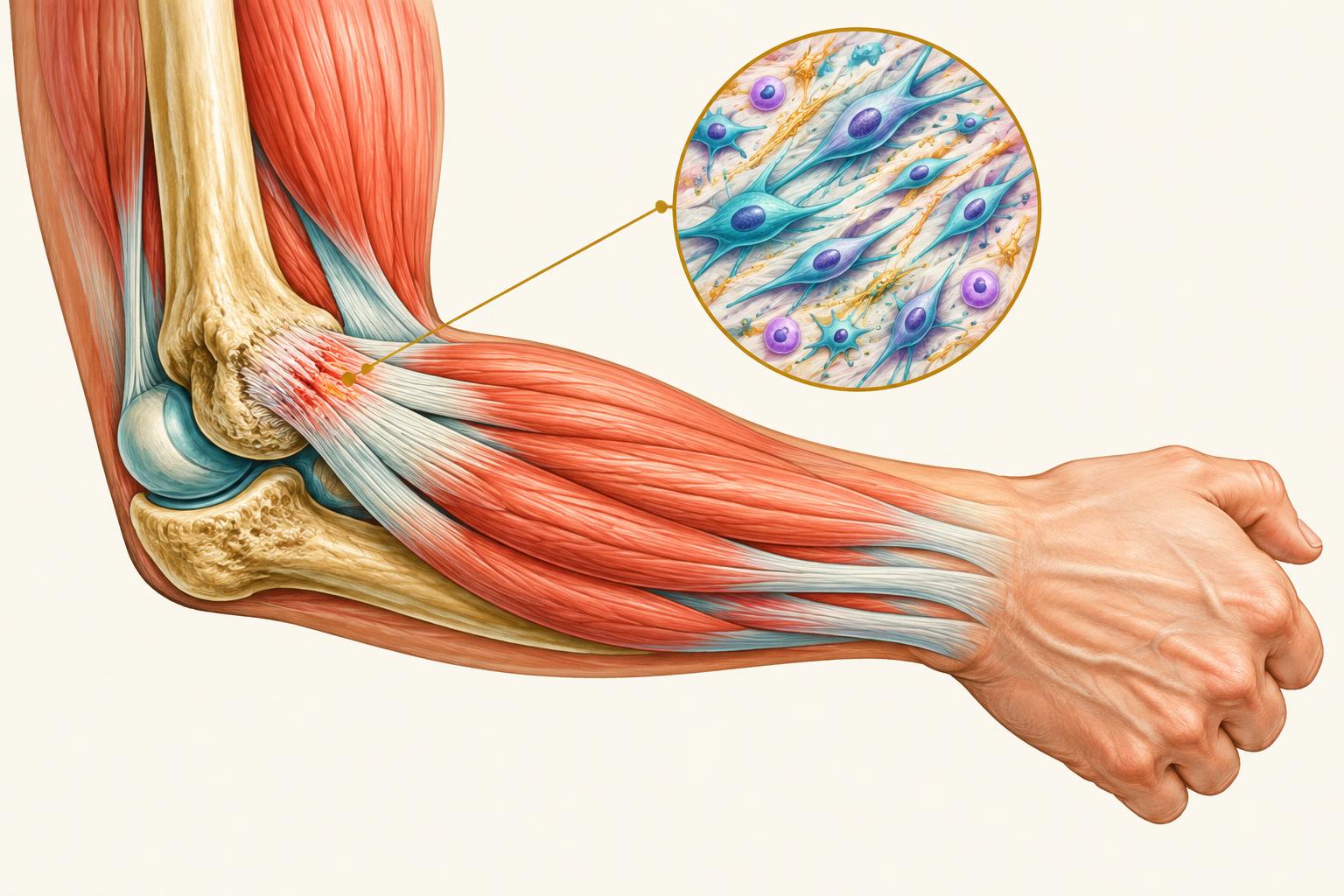
- Lateral epicondylitis is a degenerative condition of the extensor carpi radialis brevis tendon, where it attaches to the lateral epicondyle of the elbow. Despite the "-itis" suffix implying inflammation, biopsy studies have repeatedly shown that chronic cases are characterized by disorganized collagen, increased ground substance, and neovascularization — a pattern called angiofibroblastic tendinosis rather than classic inflammation.
- How It's Thought to Work
- The working hypothesis behind MSC and BMAC injections is biological, not purely mechanical. Bone marrow aspirate concentrate contains a mix of mesenchymal stromal cells, platelets, and growth factors that, when delivered directly into the degenerated tendon tissue, are theorized to secrete anti-inflammatory and trophic signals, recruit the body's own reparative cells, and support the reorganization of collagen fibers.
- What the Evidence Shows
- The clinical evidence here is genuinely encouraging but still early-stage and small in scale. In a notable 2015 pilot study published in the peer-reviewed journal STEM CELLS, Lee and colleagues injected allogeneic adipose-derived MSCs into the tendons of 12 patients with lateral epicondylosis, comparing two cell doses.
- Bottom Line
- Early, peer-reviewed pilot data on MSC and BMAC injections for tennis elbow — including one imaging-confirmed structural improvement in a dose-ranging trial — are genuinely promising and worth discussing with a qualified sports medicine or orthopedic physician for refractory cases. But "promising" should not be mistaken for "proven": every study to date has been small, mostly uncontrolled, and short in follow-up, and the treatment carries no FDA approval for this use.
Tennis elbow, medically known as lateral epicondylitis, is one of the most common overuse tendon injuries in adults, and for the subset of patients whose pain persists despite rest, physical therapy, and corticosteroid injections, cell-based therapies have emerged as an actively studied option. This article reviews what bone marrow concentrate (BMAC) and mesenchymal stem cell (MSC) injections actually are, how they are theorized to promote tendon healing, and what the real published clinical evidence — still limited to small pilot studies — does and does not show.
What Is Tennis Elbow?
Lateral epicondylitis is a degenerative condition of the extensor carpi radialis brevis tendon, where it attaches to the lateral epicondyle of the elbow. Despite the "-itis" suffix implying inflammation, biopsy studies have repeatedly shown that chronic cases are characterized by disorganized collagen, increased ground substance, and neovascularization — a pattern called angiofibroblastic tendinosis rather than classic inflammation. It is triggered by repetitive wrist extension and gripping, common in tennis players, but far more often in manual laborers, carpenters, and office workers. First-line care includes activity modification, eccentric strengthening, bracing, and NSAIDs; corticosteroid injections provide short-term relief but are linked to worse long-term outcomes and tissue thinning. This gap between quick symptom relief and durable tendon repair is exactly what has drawn interest toward regenerative, cell-based approaches.
How It's Thought to Work
The working hypothesis behind MSC and BMAC injections is biological, not purely mechanical. Bone marrow aspirate concentrate contains a mix of mesenchymal stromal cells, platelets, and growth factors that, when delivered directly into the degenerated tendon tissue, are theorized to secrete anti-inflammatory and trophic signals, recruit the body's own reparative cells, and support the reorganization of collagen fibers. Adipose-derived MSCs are harvested from fat tissue and are of particular interest because they can be expanded and standardized into defined doses in a laboratory setting before injection. Neither approach is thought to directly "become" new tendon tissue on a large scale; the more supported mechanism is paracrine signaling that shifts a degenerative, stalled-healing environment back toward active repair.
What the Evidence Shows
The clinical evidence here is genuinely encouraging but still early-stage and small in scale. In a notable 2015 pilot study published in the peer-reviewed journal STEM CELLS, Lee and colleagues injected allogeneic adipose-derived MSCs into the tendons of 12 patients with lateral epicondylosis, comparing two cell doses. Pain scores fell significantly, functional scores (Mayo Elbow Performance Index) improved through six weeks, and ultrasound imaging showed the structural tendon defect shrinking through 26 weeks, with no adverse events and no meaningful difference between doses — a rare case of imaging-confirmed structural change accompanying symptom relief. Separately, Singh and colleagues (2014, Journal of Natural Science, Biology and Medicine) treated 30 patients with a single bone marrow aspirate injection and reported Patient-Rated Tennis Elbow Evaluation scores dropping from a mean of 72.8 at baseline to 14.86 at 12 weeks, with no adverse events. A 2017 comparative study by Abuel Naga and colleagues (Journal of Advances in Medicine and Medical Research) found that 13 patients receiving autologous stem cell injections had larger drops in VAS pain (8.7 to 1.7) and Nirschl scores than a whole-blood comparison group. A 2022 narrative review in Research, Society and Development synthesizing this literature concluded the approach is promising but still constrained by small sample sizes and short follow-up. Importantly, none of these were large, placebo-controlled randomized trials, several lacked any control group at all, and no MSC or BMAC product is FDA-approved for lateral epicondylitis; related trials (e.g., ClinicalTrials.gov NCT03449082) remain registered as investigational.
Who Might Be a Candidate
- Patients with chronic lateral epicondylitis (typically pain lasting 6+ months) who have not responded to rest, physical therapy, bracing, or corticosteroid injections
- Those who have been advised against or want to avoid surgical tendon debridement
- Patients without active infection, bleeding disorders, or local malignancy near the injection site
- Individuals who understand this remains an off-label, investigational use with no guarantee of outcome
- Those able to participate in post-injection rehabilitation protocols, which appear to influence results in the available studies
Bottom Line
Early, peer-reviewed pilot data on MSC and BMAC injections for tennis elbow — including one imaging-confirmed structural improvement in a dose-ranging trial — are genuinely promising and worth discussing with a qualified sports medicine or orthopedic physician for refractory cases. But "promising" should not be mistaken for "proven": every study to date has been small, mostly uncontrolled, and short in follow-up, and the treatment carries no FDA approval for this use. Patients should treat it as an investigational option layered onto, not a replacement for, evidence-based conservative care.
Key Questions Answered
- Are stem cell injections proven for tennis elbow?
- No. Small pilot studies report encouraging symptom and imaging changes, but large placebo-controlled trials are lacking and no MSC or BMAC product is FDA-approved for lateral epicondylitis.
- How might MSC and BMAC injections support tendon repair?
- The proposed mechanism is paracrine signaling: cells and growth factors may support local repair and collagen reorganization rather than directly becoming new tendon tissue on a large scale.
- Who might discuss this investigational option?
- People with persistent tennis elbow despite conservative care may discuss it with a qualified physician, understanding the uncertain outcomes and need for rehabilitation.
Sources
- Lee SY, Kim W, Lim C, Chung SG. "Treatment of Lateral Epicondylosis by Using Allogeneic Adipose-Derived Mesenchymal Stem Cells: A Pilot Study." STEM CELLS, 2015, 33(10):2995-3005. https://scholarworks.bwise.kr/cau/handle/2019.sw.cau/64463
- Singh A, Gangwar DS, Singh S. "Bone marrow injection: A novel treatment for tennis elbow." Journal of Natural Science, Biology and Medicine, 2014, 5(2):389-391. https://pmc.ncbi.nlm.nih.gov/articles/PMC4121921
- Abuel Naga O, Othman AM, Hegazy IH, El Telbany MA, Korashi HI. "Treatment of Refractory Chronic Lateral Epicondylitis by Ultrasound Guided Injection of Autologous Stem Cells versus Autologous Whole Blood." Journal of Advances in Medicine and Medical Research, 2017, 22(3):1-12. https://bu.edu.eg/staff/islamhassan12-publications/38088
- Stecca TM, et al. "Lateral epicondylitis treatment using mesenchymal stem cells: a narrative review." Research, Society and Development, 2022, 11(16):e96111637965. https://rsdjournal.org/rsd/article/view/37965
- "Treatment of Intractable Common Extensor Tendon Injury Using Mesenchymal Stem Cells (Allo-ASC)." ClinicalTrials.gov, NCT03449082. https://clinicaltrials.gov/study/NCT03449082
Related Articles
- Clinical Applications
Can Stem Cells Help With Keloid and Hypertrophic Scars?
Keloid and hypertrophic scars resist standard treatments. Here's what stem cell and exosome research shows so far — promising animal data, one encouraging human pilot, and no FDA-approved products yet.
- Clinical Applications
Can Stem Cells Help With Achilles Tendinopathy?
A ten-person Achilles tendinopathy trial reported encouraging safety and function results, but without a control group the stem cell approach remains investigational.
- Clinical Applications
Can Stem Cells Help With Cystic Fibrosis?
Cystic fibrosis MSC safety-trial findings, preclinical anti-inflammatory research and lung organoids for drug testing — without established treatment efficacy.