How Are Stem Cells Delivered? IV Infusion, Injection, and Implantation Compared
What this article covers
- What This Article Covers
- When people hear "stem cell therapy," they often picture a single, simple procedure — but how the cells actually get into the body varies enormously depending on the condition being treated. The three broad delivery routes used in stem cell and mesenchymal stem cell (MSC) research today are intravenous (IV) infusion, local or direct injection, and surgical implantation.
- IV Infusion: The Systemic Route
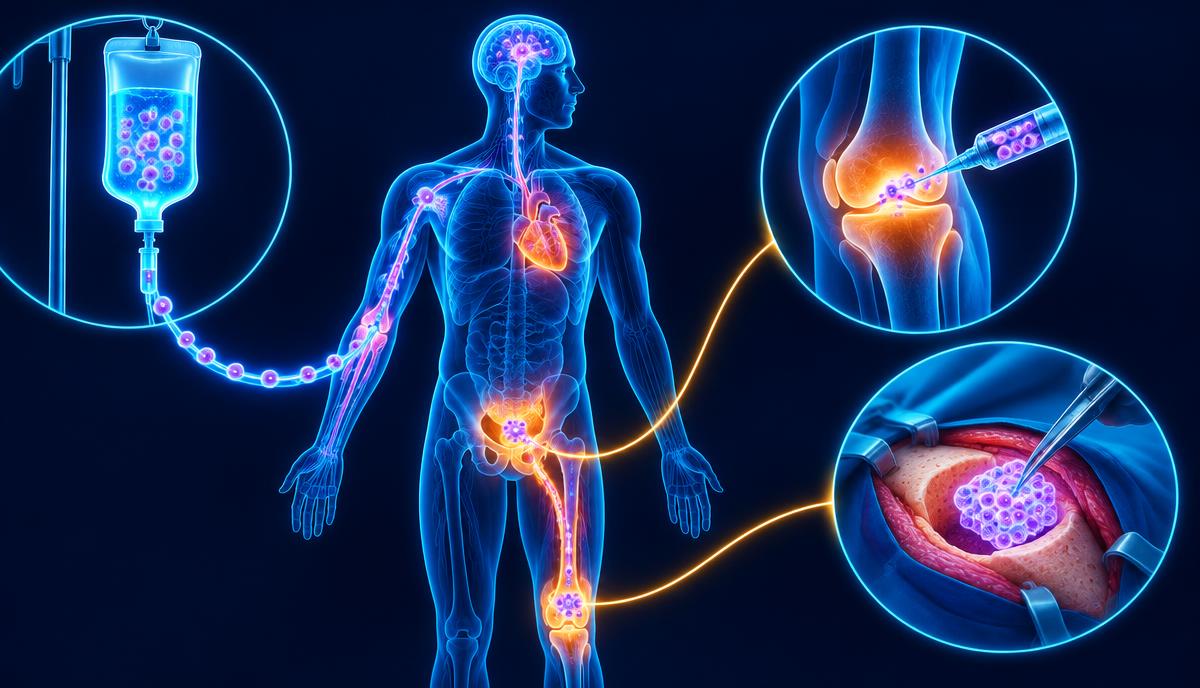
- Intravenous infusion is the most common route in MSC clinical research and many commercial clinics, largely because it's simple, minimally invasive, and can reach the whole body through the bloodstream. Cells are suspended in fluid and dripped into a vein, much like a standard IV medication.
- Local Injection: Concentrating Cells Where They're Needed
- When a therapy needs cells concentrated at one specific site, researchers often bypass the bloodstream altogether and inject cells directly into or near the target tissue, avoiding the pulmonary first-pass problem entirely. For joint conditions like knee osteoarthritis, intra-articular injection places MSCs directly into the joint space, an approach examined across multiple clinical studies in a 2018 systematic review in the American Journal of Sports Medicine.
- Surgical Implantation: Placing Cells or Tissue Directly
- The most invasive route is surgical implantation, where cells aren't simply injected as a liquid suspension but are placed as part of a structured tissue, scaffold, or graft during an operation. One well-established real-world example is limbal stem cell transplantation for corneal blindness caused by limbal stem cell deficiency, often from chemical or thermal burns to the eye.
- Bottom Line
- There's no universally "best" way to deliver stem cells — the right route depends entirely on the condition being treated, how accessible the target tissue is, and whether the therapeutic goal is a broad systemic effect or a concentrated, localized one. IV infusion offers simplicity and whole-body reach but loses most cells to the lungs on the first pass; local injection sacrifices that broad reach for precision at a single site; and surgical implantation is reserved for cases where cells need to be physically built into damaged tissue.
What This Article Covers
When people hear "stem cell therapy," they often picture a single, simple procedure — but how the cells actually get into the body varies enormously depending on the condition being treated. The three broad delivery routes used in stem cell and mesenchymal stem cell (MSC) research today are intravenous (IV) infusion, local or direct injection, and surgical implantation. Each route sends cells to different places in the body, keeps them there for different amounts of time, and is chosen based on what a specific disease or injury actually requires. This article walks through how each route works, what it's realistically used for, and why there is no single "best" way to deliver stem cells — only the route that best matches the target tissue.
IV Infusion: The Systemic Route
Intravenous infusion is the most common route in MSC clinical research and many commercial clinics, largely because it's simple, minimally invasive, and can reach the whole body through the bloodstream. Cells are suspended in fluid and dripped into a vein, much like a standard IV medication. But "reaching the whole body" doesn't mean the cells spread evenly. A well-documented phenomenon called the pulmonary first-pass effect means that when cells are infused into a vein, blood carries them straight to the heart and then into the lungs before they can reach any other organ — and because MSCs are relatively large, a substantial share of them get physically trapped in the fine capillary network of the lungs on this first pass. A foundational 2009 study in Stem Cells and Development, led by Fischer and colleagues, showed this trapping is a major obstacle to IV stem cell delivery, with cell size and adhesion molecules on the cell surface both contributing to cells getting stuck in lung capillaries rather than reaching target organs. A 2021 systematic review in the Journal of Clinical Medicine confirmed this pattern across animal and human studies: after IV infusion, cells accumulate first in the lungs, and only over the following hours to days does a smaller fraction redistribute to the liver, spleen, and kidneys, with many cells cleared by the immune system within days. This doesn't necessarily mean IV infusion is ineffective — some of the benefit of MSC therapy is thought to come from short-lived signaling effects rather than the cells permanently engrafting somewhere — but it does mean IV infusion is not an efficient way to deliver large numbers of living cells directly to a specific injured organ.
Local Injection: Concentrating Cells Where They're Needed
When a therapy needs cells concentrated at one specific site, researchers often bypass the bloodstream altogether and inject cells directly into or near the target tissue, avoiding the pulmonary first-pass problem entirely. For joint conditions like knee osteoarthritis, intra-articular injection places MSCs directly into the joint space, an approach examined across multiple clinical studies in a 2018 systematic review in the American Journal of Sports Medicine. For heart conditions, intramyocardial injection delivers cells directly into heart muscle, often during a catheter procedure or open-heart surgery. For central nervous system and spinal cord conditions, intrathecal injection delivers cells into the cerebrospinal fluid surrounding the spinal cord — a 2024 Phase I trial published in Nature Communications used this approach for traumatic spinal cord injury, placing a needle in the lower back to inject cells into the fluid space around the spinal cord, positioning them close to the injury without an open surgical procedure. The general logic across these examples is the same: local injection trades the broad reach of IV infusion for a much higher concentration of cells landing exactly where they're intended to act.
Surgical Implantation: Placing Cells or Tissue Directly
The most invasive route is surgical implantation, where cells aren't simply injected as a liquid suspension but are placed as part of a structured tissue, scaffold, or graft during an operation. One well-established real-world example is limbal stem cell transplantation for corneal blindness caused by limbal stem cell deficiency, often from chemical or thermal burns to the eye. As described in a 2018 review in Stem Cells International, surgeons take a small biopsy of limbal stem cells from a patient's healthy eye, expand those cells in a lab, and then surgically graft the resulting sheet of cells onto the damaged eye — sometimes using a fibrin gel or amniotic membrane as a supporting scaffold. Because the cells are implanted as an intact structure rather than injected loosely, they're positioned to integrate directly into the existing tissue architecture. This technique has shown success rates of roughly 70 to 80 percent in restoring a functional corneal surface, with some patients tracked for over a decade. Other implantation approaches use engineered scaffolds seeded with cells to help rebuild tissues such as skin, cartilage, or bone.
Comparing the Three Routes
- IV Infusion — Reaches the body systemically through blood circulation; simplest to administer; most cells get trapped in the lungs before reaching other organs; best suited for effects that rely on whole-body signaling rather than direct tissue engraftment.
- Local/Direct Injection — Delivers cells straight to a specific site (joint, heart muscle, spinal fluid); avoids pulmonary trapping; concentrates more cells at the target; used when a therapy needs a localized, high-density effect.
- Surgical Implantation — Places cells as part of a structured graft or scaffold during surgery; most invasive but allows physical integration into damaged tissue; used when the goal is to rebuild or replace tissue structure, such as the cornea.
Bottom Line
There's no universally "best" way to deliver stem cells — the right route depends entirely on the condition being treated, how accessible the target tissue is, and whether the therapeutic goal is a broad systemic effect or a concentrated, localized one. IV infusion offers simplicity and whole-body reach but loses most cells to the lungs on the first pass; local injection sacrifices that broad reach for precision at a single site; and surgical implantation is reserved for cases where cells need to be physically built into damaged tissue. Understanding this distinction is one of the most important first steps for anyone trying to evaluate a stem cell therapy claim, since the delivery route shapes what a treatment can realistically be expected to do.
Sources
- Pulmonary Passage is a Major Obstacle for Intravenous Stem Cell Delivery: The Pulmonary First-Pass Effect — Stem Cells and Development, 2009 — https://pubmed.ncbi.nlm.nih.gov/19099374/
- Biodistribution of Mesenchymal Stromal Cells after Administration in Animal Models and Humans: A Systematic Review — Journal of Clinical Medicine, 2021 — https://pmc.ncbi.nlm.nih.gov/articles/PMC8268414/
- Intra-articular Mesenchymal Stem Cell Therapy for the Human Joint: A Systematic Review — American Journal of Sports Medicine, 2018 — https://pubmed.ncbi.nlm.nih.gov/29099618/
- Intrathecal delivery of adipose-derived mesenchymal stem cells in traumatic spinal cord injury: Phase I trial — Nature Communications, 2024 — https://www.nature.com/articles/s41467-024-46259-y
- Limbal Stem Cell Transplantation: Clinical Results, Limits, and Perspectives — Stem Cells International, 2018 — https://pmc.ncbi.nlm.nih.gov/articles/PMC6201383/
Related Articles
- Fundamentals
Who Pays for Stem Cell Research? A Beginner's Guide to How Trials and Therapies Get Funded
Stem cell therapies move through a funding relay — NIH and state grants, universities, foundations, then venture capital. Legitimate trials don't charge patients for the experimental product.
- Fundamentals
Why Do Promising Stem Cell Therapies Sometimes Fail Late-Stage Clinical Trials? A Beginner's Guide to Trial Risk
Gene and cell therapies reach approval roughly 10–17% of the time. Here's why late-stage failure is common, what causes it, and how to read trial news carefully.
- Fundamentals
What Is Immune Privilege? Why Donor (Allogeneic) Stem Cells Usually Don't Trigger Rejection
Mesenchymal stem cells carry few of the molecular flags that trigger rejection — but researchers now call them immune evasive, not immune privileged.