Myth: If a Stem Cell Treatment Is Legal Somewhere, It Must Be Proven and Safe
What this article covers
- The Myth
- S. Food and Drug Administration (FDA) regulates drugs domestically.
- Where It Comes From
- Part of the confusion is that "regulated" sounds like one fixed standard, when it actually describes a spectrum. The FDA's own consumer guidance is blunt about the domestic reality: the only stem cell products it has approved are certain blood-forming (hematopoietic) stem cells derived from umbilical cord blood, used for specific blood and immune system disorders — not for orthopedic conditions, neurological disease, autism, or the many other uses frequently advertised.
- What the Evidence Actually Shows
- " Japan offers an instructive middle case: under its Pharmaceuticals and Medical Devices Act, regulators can grant regenerative medicine products a conditional, time-limited approval — lasting up to seven years — once safety is confirmed and efficacy is only predicted rather than definitively proven, while the developer continues collecting data toward full approval.
- What This Means for Patients
- These gaps aren't abstract. The International Society for Stem Cell Research (ISSCR), the field's leading professional body, has long urged that new stem cell treatments undergo rigorous scientific testing and evaluation before they reach patients, and has published patient guidance specifically warning against treatments marketed without that kind of evidence or regulatory review.
- Bottom Line
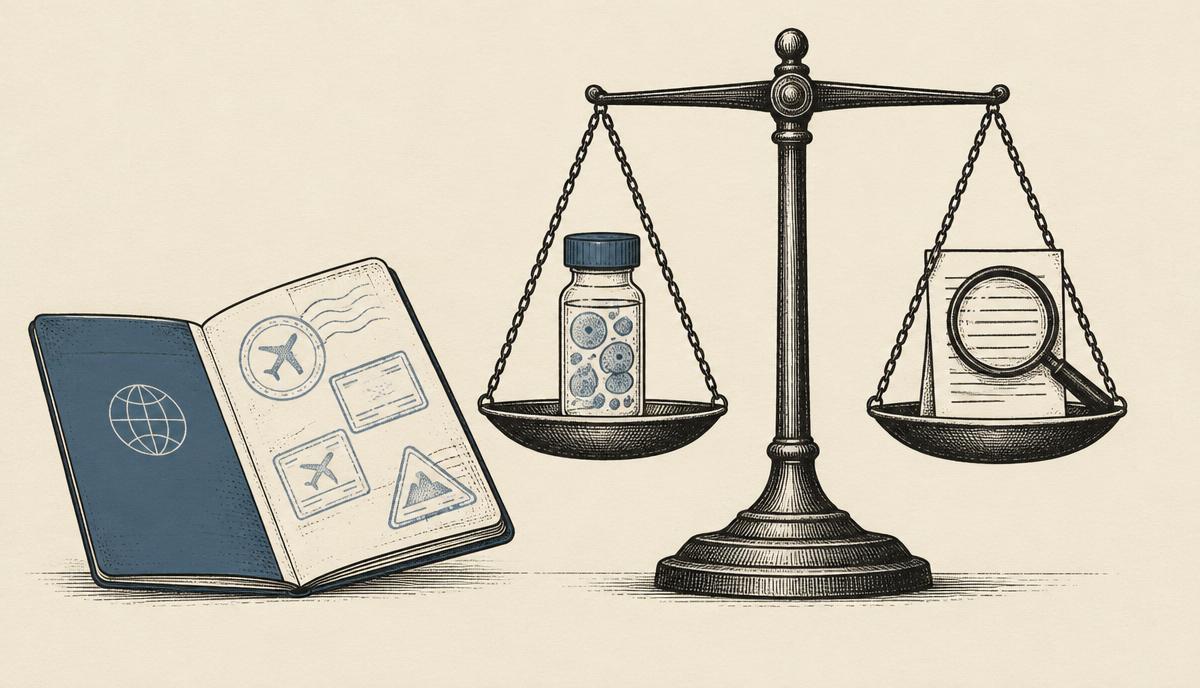
- A country allowing a stem cell treatment to be sold tells you about that government's specific rules, gaps, and enforcement choices — not about whether randomized, controlled, peer-reviewed trials have actually shown the treatment is safe and effective for your condition. " If a clinic's own answer substitutes a passport stamp for that evidence, treat that as a red flag, not reassurance.
A common and consequential misconception is that if a stem cell treatment can be legally purchased somewhere in the world, that fact alone tells you something meaningful about whether it works or is safe. In reality, "legal to sell" and "proven by rigorous trials" are two entirely different questions, and the gap between them varies enormously by country — from well-resourced regulators running accelerated pathways with real (if lighter) evidence standards, to jurisdictions where stem cell therapy itself is barely addressed by any specific rule at all. This piece unpacks how regulatory approval actually works across borders, and what that means for anyone evaluating a treatment offered abroad.
The Myth
The myth goes something like this: "This clinic operates legally in [Country X], so the government there must have reviewed the science and found it safe and effective — otherwise they wouldn't allow it." It feels like reasonable logic, especially for people used to how the U.S. Food and Drug Administration (FDA) regulates drugs domestically. But legality is a statement about a government's permission structure and enforcement priorities. It is not, by itself, a statement about clinical evidence.
Where It Comes From
Part of the confusion is that "regulated" sounds like one fixed standard, when it actually describes a spectrum. The FDA's own consumer guidance is blunt about the domestic reality: the only stem cell products it has approved are certain blood-forming (hematopoietic) stem cells derived from umbilical cord blood, used for specific blood and immune system disorders — not for orthopedic conditions, neurological disease, autism, or the many other uses frequently advertised. Everything else marketed to consumers for other conditions is, per the FDA, unapproved, and the agency has received reports of blindness, tumor formation, and serious infections linked to such products. If that much uncertainty exists even in a country with one of the world's most rigorous drug-approval systems, it's easy to see how "legal" can mean something far looser elsewhere.
What the Evidence Actually Shows
Regulatory frameworks genuinely differ, and not just between "strict" and "lawless." Japan offers an instructive middle case: under its Pharmaceuticals and Medical Devices Act, regulators can grant regenerative medicine products a conditional, time-limited approval — lasting up to seven years — once safety is confirmed and efficacy is only predicted rather than definitively proven, while the developer continues collecting data toward full approval. That's a legitimate government decision, made by a sophisticated regulator, to let a product reach patients before the kind of evidence most people picture when they hear "approved."
Contrast that with settings where even that level of structure doesn't exist. A 2021 peer-reviewed study in Stem Cell Research & Therapy examined clinics advertising stem cell therapy in the US-Mexico border region, and found that Mexico's health regulator, COFEPRIS, licenses tissue-handling facilities and biobanks but at the time had no specific regulation governing stem cell therapy applications themselves. Of 76 border-region clinics identified, only a small number whose claimed government licensing could actually be verified against the official registry matched by both name and address; of the handful of clinic websites that cited peer-reviewed research at all, none pointed to human clinical trial data — only animal studies. "Operating legally" in that environment can mean little more than that no specific law currently prohibits what a clinic is doing.
What This Means for Patients
These gaps aren't abstract. The International Society for Stem Cell Research (ISSCR), the field's leading professional body, has long urged that new stem cell treatments undergo rigorous scientific testing and evaluation before they reach patients, and has published patient guidance specifically warning against treatments marketed without that kind of evidence or regulatory review. The consequences of skipping that step can be severe: reported cases of serious harm and death following unproven stem cell procedures abroad have been documented by stem cell researchers and journalists, who note such clinics typically collect none of the systematic safety and efficacy data a real clinical trial would require. And this isn't purely a "foreign" problem — even within the U.S., where clearer rules exist, a 2024 Associated Press investigation noted the FDA has issued roughly 30 warning letters over unproven stem cell marketing since 2017, while a widely cited 2021 analysis estimated more than 2,700 U.S. clinics were selling such therapies, showing that written law and enforcement in practice can diverge considerably even domestically.
Bottom Line
A country allowing a stem cell treatment to be sold tells you about that government's specific rules, gaps, and enforcement choices — not about whether randomized, controlled, peer-reviewed trials have actually shown the treatment is safe and effective for your condition. Some legitimate regulators, like Japan's, openly grant conditional approval based on predicted rather than proven efficacy; others simply lack any specific rule covering stem cell therapy at all, leaving "legal" to mean little more than "not yet prohibited." Either way, the question worth asking isn't "is this allowed here?" but "where is the published clinical trial evidence for this specific treatment, for my specific condition?" If a clinic's own answer substitutes a passport stamp for that evidence, treat that as a red flag, not reassurance.
Key Questions Answered
- Does legal availability mean a stem cell treatment is proven?
- No. Legality reflects a government's rules and enforcement priorities, not clinical evidence. Some jurisdictions have no specific stem cell therapy regulation at all.
- Which stem cell products has the FDA approved?
- Only certain blood-forming (hematopoietic) stem cells derived from umbilical cord blood, for specific blood and immune system disorders — not orthopedic, neurological, or other commonly advertised uses.
- How does Japan's conditional approval differ from full approval?
- Japan can grant regenerative products a conditional, time-limited approval of up to seven years once safety is confirmed and efficacy is only predicted, while developers keep collecting data toward full approval.
Sources
- Important Patient and Consumer Information About Regenerative Medicine Therapies — U.S. Food and Drug Administration (FDA.gov), 2024 — https://www.fda.gov/vaccines-blood-biologics/consumers-biologics/important-patient-and-consumer-information-about-regenerative-medicine-therapies
- New ISSCR Guide to Stem Cell Treatments Promotes Patient Safety and Public Health — International Society for Stem Cell Research (ISSCR) — https://www.isscr.org/isscr-news/new-isscr-guide-to-stem-cell-treatments-promotes-patient-safety-and-public-health
- Chavez J, Shah NA, Ruoss S, Cuomo RE, Ward SR, Mackey TK, "Online marketing practices of regenerative medicine clinics in US-Mexico border region: a web surveillance study" — Stem Cell Research & Therapy, vol. 12, article 189, 2021 — https://pmc.ncbi.nlm.nih.gov/articles/PMC7977255
- Japan's Conditional Approval Pathway Offers Regenerative Medicines Earlier Market Access — Hogan Lovells — https://www.hlc.com/en/publications/japans-conditional-approval-pathway-offers-regenerative-medicines-earlier-market-access
- Hollingsworth H (The Associated Press), "Some Hawking Stem Cells Say They Can Treat Almost Anything. They Can't" — via Fortune, June 15, 2024 — https://fortune.com/2024/06/15/stem-cell-injection-scam-treatments-costs-lawsuits-fda-warning/
Related Articles
- Fundamentals
What Is 3D Bioprinting, and How Does It Use Stem Cells to Build Tissue?
3D bioprinting layers living cells and supportive gels to build tissue. Learn how stem cells fit into the process, what labs have shown, and what remains unsolved.
- Fundamentals
Types of Reproductive and Fertility Disorders: Which Are Being Studied With Stem Cell Therapy?
A map of reproductive conditions where stem cell research is credible, such as thin endometrium and azoospermia, versus areas still preclinical or speculative.
- Fundamentals
Protecting Nerve and Peripheral Health As You Age: What the Evidence Actually Shows
Blood sugar control, alcohol intake, B12 status, smoking and exercise all measurably affect peripheral nerve health as you age. Here is what the evidence supports.