What Is 3D Bioprinting, and How Does It Use Stem Cells to Build Tissue?
What this article covers
- From 3D Printing to 3D Bioprinting
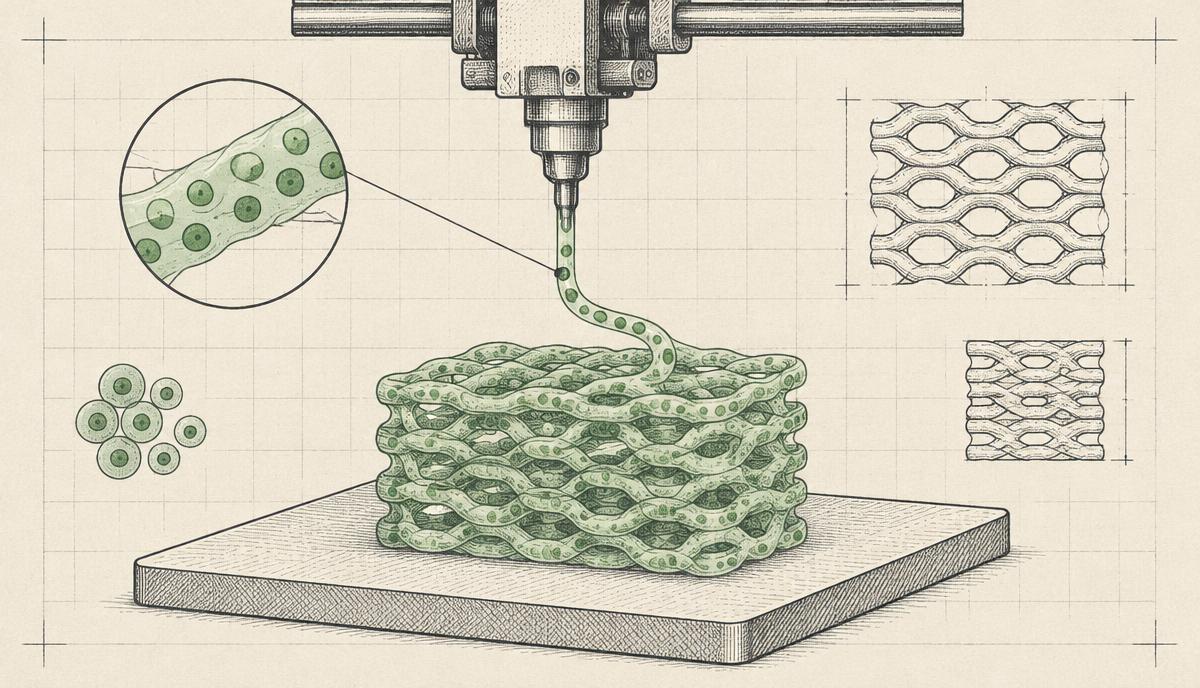
- Conventional 3D printing builds objects by depositing material layer by layer, guided by a digital blueprint — think plastic or metal parts. Bioprinting borrows that same layer-by-layer logic but swaps the raw material for something far more delicate: living cells suspended in a supportive gel called a bioink.
- Where Stem Cells Come In
- Printing a tissue's shape is only half the challenge — the printed structure also has to become functional, living tissue. That is where stem cells matter.
- What the Research Actually Shows
- This is not speculative science fiction; there is a real, peer-reviewed research base, though it remains largely preclinical.
- Why This Matters: The Problem It's Trying to Solve
- The appeal of combining bioprinting with stem cells is straightforward: organ and tissue damage from injury, disease, or aging often outpaces the body's own capacity to repair itself, and donor organ shortages mean many patients who need a transplant never receive one. If researchers can eventually print patient-specific tissue — or, further down the road, whole organ components — using a patient's own stem cells, it could in principle reduce both the wait for a donor match and the risk of immune rejection.
- How Regulators Think About Bioprinted Tissue
- Because a bioprinted construct typically combines living cells with a structural scaffold, it usually doesn't fit neatly into a single regulatory category. In the United States, the FDA has addressed this in two separate but related ways.
3D bioprinting is a manufacturing process that layers living cells, biological materials, and supportive gels to build tissue structures with a defined shape and internal architecture. When the "ink" includes stem cells, the technique moves beyond simply shaping a scaffold and toward growing functional, living tissue inside it. This article walks through how bioprinting actually works, where stem cells fit into that process, what has been demonstrated in labs so far, and how far the science still has to go before bioprinted tissue reaches patients.
From 3D Printing to 3D Bioprinting
Conventional 3D printing builds objects by depositing material layer by layer, guided by a digital blueprint — think plastic or metal parts. Bioprinting borrows that same layer-by-layer logic but swaps the raw material for something far more delicate: living cells suspended in a supportive gel called a bioink.
A bioprinter typically uses one of a few deposition methods:
- Extrusion-based printing, which pushes a continuous strand of cell-laden gel through a nozzle, similar to a very precise icing tip.
- Droplet-based (inkjet-style) printing, which deposits tiny droplets of bioink with high precision.
- Light-based printing, which uses focused light to solidify a liquid bioink layer by layer, allowing finer detail and faster builds.
Whichever method is used, the goal is the same: arrange cells and supportive material in a precise three-dimensional pattern that mimics the structure of real tissue, rather than growing cells as a flat, unstructured layer in a dish.
Where Stem Cells Come In
Printing a tissue's shape is only half the challenge — the printed structure also has to become functional, living tissue. That is where stem cells matter.
Because stem cells can self-renew and, depending on their potency, differentiate into various specialized cell types, they give researchers a renewable, flexible starting material to seed into a bioink. Induced pluripotent stem cells (iPSCs) are especially useful here because they can be derived from a patient's own adult cells and then guided to form the specific cell type a given tissue needs — cartilage, skin, or liver cells, for example — reducing (though not eliminating) concerns about immune rejection.
Mesenchymal stem/stromal cells are also commonly used in bioinks, particularly for cartilage, bone, and connective tissue applications, because they are relatively easy to expand in culture and have a track record in other areas of regenerative medicine.
Once printed, the cells are not finished developing. The printed construct is typically transferred to a bioreactor or incubated under controlled conditions, where the stem cells are encouraged to proliferate, differentiate, and begin organizing into tissue-like structures — a process that can take days to weeks depending on the target tissue.
What the Research Actually Shows
This is not speculative science fiction; there is a real, peer-reviewed research base, though it remains largely preclinical.
One frequently cited proof-of-concept, published in Scientific Reports in 2017 by researchers at Chalmers University of Technology and the University of Gothenburg, demonstrated that induced pluripotent stem cells could be 3D-bioprinted inside a nanocellulose-alginate bioink and, after roughly five weeks of culture, begin forming cartilage-like tissue. It was an early but important demonstration that iPSCs could survive the printing process itself and go on to differentiate inside a printed structure.
More recent work has pushed toward more complex targets. A 2024 review in the journal Engineering surveyed progress in bioprinting components relevant to the heart, liver, kidney, and pancreas, while underscoring that building a functioning blood vessel network inside printed tissue remains one of the field's central unsolved problems — without blood vessels, cells deep inside a printed structure cannot get enough oxygen and nutrients to survive.
On the federal research side, the National Institutes of Health has funded dedicated bioprinting infrastructure. In 2017, NIH awarded a $6.25 million grant to establish the Center for Engineering Complex Tissues, led by the University of Maryland in partnership with Rice University and the Wake Forest Institute for Regenerative Medicine, to serve as a national resource for tissue engineering and bioprinting research. Separately, NIH's National Center for Advancing Translational Sciences (NCATS) has run its own 3-D Tissue Bioprinting program since 2013, producing bioprinted skin and other tissue models — built in part using patient-derived iPSCs — primarily for drug screening and disease modeling rather than for implantation.
Why This Matters: The Problem It's Trying to Solve
The appeal of combining bioprinting with stem cells is straightforward: organ and tissue damage from injury, disease, or aging often outpaces the body's own capacity to repair itself, and donor organ shortages mean many patients who need a transplant never receive one. If researchers can eventually print patient-specific tissue — or, further down the road, whole organ components — using a patient's own stem cells, it could in principle reduce both the wait for a donor match and the risk of immune rejection.
That said, it's worth being clear-eyed about where the field actually stands. Printing a small patch of cartilage-like tissue in a dish is meaningfully different from printing a vascularized, functional organ that can be safely implanted in a person. Most bioprinted stem cell tissue to date has been used in research settings — drug testing, disease modeling, and preclinical studies — rather than in approved patient treatments.
How Regulators Think About Bioprinted Tissue
Because a bioprinted construct typically combines living cells with a structural scaffold, it usually doesn't fit neatly into a single regulatory category. In the United States, the FDA has addressed this in two separate but related ways.
First, in December 2017, the FDA issued guidance — "Technical Considerations for Additive Manufactured Medical Devices" — laying out its initial thinking on testing and characterization for medical devices that include a 3D-printed or additively manufactured component.
Second, when living cells are involved, the product is generally treated as a combination product under FDA's Office of Combination Products. A scaffold alone may be regulated as a medical device, while living human cells that have been meaningfully manipulated typically fall under the FDA's rules for human cells, tissues, and cellular and tissue-based products (HCT/Ps) and biologics regulations. Which center takes the lead — the device center or the biologics center — generally depends on which component is judged to drive the product's primary therapeutic effect. Legal and regulatory analysts have noted that there is still no single, dedicated FDA pathway built specifically for bioprinted products, meaning each one is currently evaluated against existing device and biologic frameworks on a case-by-case basis.
What Still Needs to Be Solved
- Vascularization: Printed tissue needs a working network of blood vessels to keep cells alive once it's thicker than a very thin layer.
- Cell survival and function: Cells must survive the mechanical stress of printing and then differentiate correctly and behave like the native tissue they're meant to replace.
- Scale and speed: Printing tissue large enough to be clinically useful, fast enough that cells don't die waiting, is still a significant engineering challenge.
- Regulatory validation: Any product intended for implantation will need to clear rigorous safety and efficacy testing before human use, a process that — as with other cell-based therapies — typically takes years.
Bottom Line
3D bioprinting with stem cells is a genuinely promising convergence of two fields — additive manufacturing and regenerative medicine — and it has already produced real, peer-reviewed demonstrations of stem cells surviving the printing process and forming early tissue structures, backed by sustained NIH investment in dedicated research infrastructure. But it remains, for now, a research and drug-testing tool rather than an approved patient treatment. Readers should be encouraged by the trajectory of the science while staying skeptical of any clinic or product that claims to already offer "bioprinted organ" treatments outside of a legitimate, regulated clinical trial.
Key Questions Answered
- What is 3D bioprinting?
- A manufacturing process that deposits living cells suspended in a supportive gel (bioink) layer by layer, building three-dimensional tissue structures guided by a digital blueprint.
- Why are stem cells used in bioinks?
- Stem cells can self-renew and differentiate into specialized cell types, so a printed structure can mature into functional tissue. Patient-derived iPSCs may also reduce immune rejection concerns.
- Can doctors implant bioprinted organs today?
- No. Bioprinted stem cell tissue is used in research, drug testing and disease modeling. Vascularization, cell survival, scale and regulatory validation remain unsolved, and no bioprinted organ treatment is approved.
Sources
- Cartilage Tissue Engineering by the 3D Bioprinting of iPS Cells in a Nanocellulose/Alginate Bioink — Scientific Reports, 2017 — https://pmc.ncbi.nlm.nih.gov/articles/PMC5428803
- Progress in Organ Bioprinting for Regenerative Medicine — Engineering (Wang et al.), 2024 — https://pubs.rsc.org/en/content/articlehtml/2024/bm/d3bm01934a
- University of Maryland to Lead NIH-Funded Center for Engineering Complex Tissues — University of Maryland Bioengineering, 2017 — https://bioe.umd.edu/release/university-of-maryland-to-lead-nihfunded-center-for-engineering-complex-tissues
- National Institutes of Health Funds $6.25 Million Center for 3D Bioprinting Tissue Engineering — 3D Printing Industry, 2017 — https://3dprintingindustry.com/news/national-institutes-health-funds-6-25-million-center-3d-bioprinting-tissue-engineering-110701/
- 3-D Tissue Bioprinting Program — National Center for Advancing Translational Sciences (NIH/NCATS) — https://ncats.nih.gov/research/research-activities/bioprinting/operational-model
- Technical Considerations for Additive Manufactured Medical Devices — Guidance for Industry and FDA Staff — U.S. Food and Drug Administration, 2017 — https://www.fda.gov/regulatory-information/search-fda-guidance-documents/technical-considerations-additive-manufactured-medical-devices
- New Frontiers in Organ Regeneration With 3D Bioprinting — News-Medical.Net (summarizing Wang et al., Engineering), 2024 — https://www.news-medical.net/news/20240802/New-frontiers-in-organ-regeneration-with-3D-bioprinting.aspx
Related Articles
- Fundamentals
Myth: If a Stem Cell Treatment Is Legal Somewhere, It Must Be Proven and Safe
"Legal to sell" and "proven by rigorous trials" are different questions, and the gap varies enormously by country. Here's how approval actually works across borders.
- Fundamentals
Types of Reproductive and Fertility Disorders: Which Are Being Studied With Stem Cell Therapy?
A map of reproductive conditions where stem cell research is credible, such as thin endometrium and azoospermia, versus areas still preclinical or speculative.
- Fundamentals
Protecting Nerve and Peripheral Health As You Age: What the Evidence Actually Shows
Blood sugar control, alcohol intake, B12 status, smoking and exercise all measurably affect peripheral nerve health as you age. Here is what the evidence supports.