What Is Graft-Versus-Host Disease (GVHD)?
What this article covers
- What GVHD Is and Why It Happens
- GVHD develops after an allogeneic stem cell transplant, in which a patient receives blood-forming stem cells from a donor rather than from their own body. The donor's immune cells, carried along with the transplanted stem cells, are supposed to help rebuild the patient's immune system and attack any remaining cancer cells.
- Acute vs. Chronic GVHD: Symptoms and Timing
- Clinicians distinguish GVHD by both timing and the pattern of organ involvement, not strictly by a 100-day cutoff as once assumed. Acute GVHD typically emerges within the first few months after transplant and most often targets the skin, gastrointestinal tract, and liver.
- Standard Treatment Approaches
- Corticosteroids remain the first-line treatment for both acute and chronic GVHD because they broadly suppress the overactive immune response. For many patients, steroids control symptoms effectively.
- Where Stem-Cell and Cell-Therapy Research Stands
- This is the area where the regenerative medicine field has genuinely delivered in recent years, after decades of research into using cells themselves — rather than broad immunosuppressants — to recalibrate the immune response driving GVHD.
- Bottom Line
- GVHD remains a serious and sometimes life-altering complication of allogeneic stem cell transplant, and corticosteroids plus targeted drugs like ruxolitinib remain the backbone of care for most patients. But the arrival of Ryoncil and Tregzi — two distinct, FDA-approved cell therapies addressing treatment and prevention, respectively — represents genuine, verifiable progress rather than speculative promise.
Graft-versus-host disease (GVHD) is one of the most significant complications facing patients who undergo an allogeneic (donor-derived) stem cell or bone marrow transplant, most often as treatment for blood cancers like leukemia and lymphoma. This article explains what GVHD is, why it happens, how acute and chronic forms differ, what standard treatment looks like, and — importantly — where cell-based research now stands, including two FDA-approved cell therapies that mark real progress against a disease that has long been difficult to manage.
What GVHD Is and Why It Happens
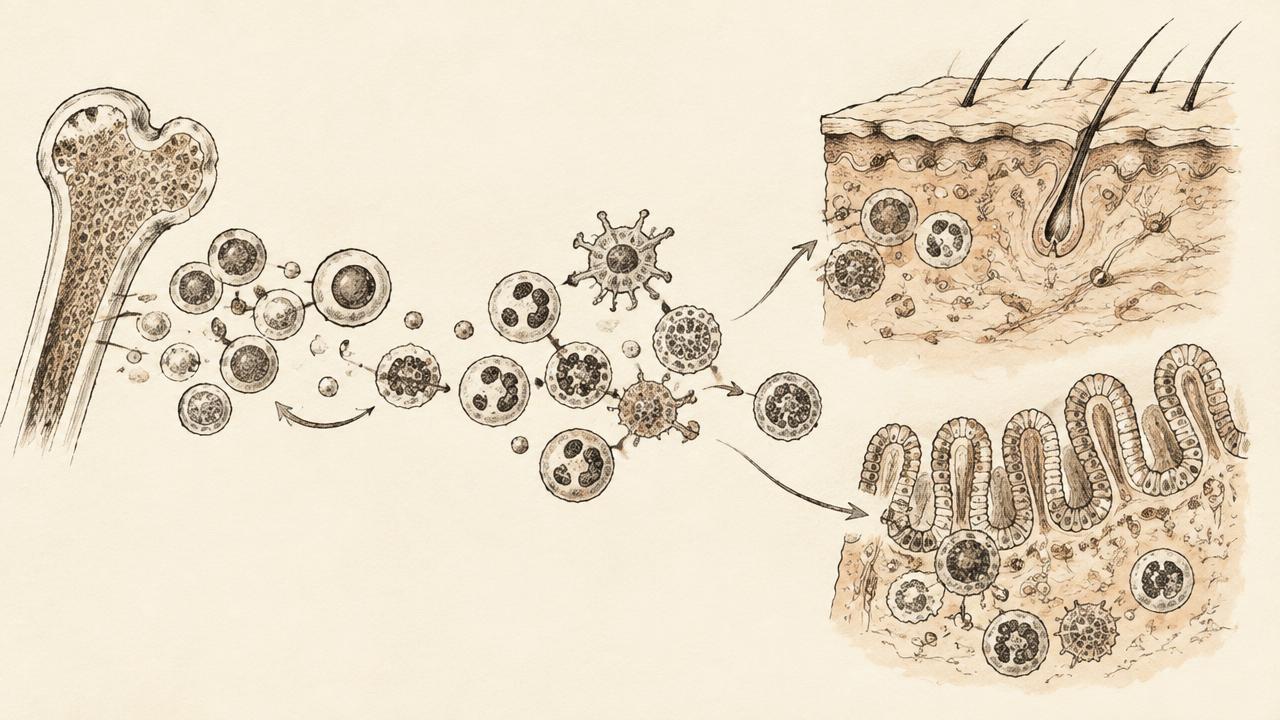
GVHD develops after an allogeneic stem cell transplant, in which a patient receives blood-forming stem cells from a donor rather than from their own body. The donor's immune cells, carried along with the transplanted stem cells, are supposed to help rebuild the patient's immune system and attack any remaining cancer cells. The problem is that those new immune cells can also recognize the recipient's own healthy tissues as foreign and attack them — the reverse of an organ-rejection scenario, which is why it's called "graft-versus-host" rather than "host-versus-graft." GVHD can range from mild to life-threatening, and its risk rises with the degree of mismatch between donor and recipient tissue types, even among closely matched donors such as siblings.
Acute vs. Chronic GVHD: Symptoms and Timing
Clinicians distinguish GVHD by both timing and the pattern of organ involvement, not strictly by a 100-day cutoff as once assumed. Acute GVHD typically emerges within the first few months after transplant and most often targets the skin, gastrointestinal tract, and liver. Common signs include a painful or itchy skin rash, nausea, vomiting, abdominal cramping, profuse diarrhea, and jaundice from liver involvement. Severe acute GVHD can be dangerous, damaging the gut lining and impairing the body's ability to absorb nutrients or fight infection.
Chronic GVHD behaves more like an autoimmune disease and can affect nearly any organ system, sometimes appearing months to years after transplant. It commonly involves the skin (tightening, discoloration, scarring), eyes (dryness, light sensitivity), mouth (dryness, sores, sensitivity to spicy or acidic foods), lungs (shortness of breath from airway narrowing), joints, and connective tissue. Because chronic GVHD can wax and wane over long stretches and involve multiple organs at once, it is often more challenging to manage day-to-day than the acute form, even when it is not immediately life-threatening.
Standard Treatment Approaches
Corticosteroids remain the first-line treatment for both acute and chronic GVHD because they broadly suppress the overactive immune response. For many patients, steroids control symptoms effectively. But a substantial share of patients either don't respond adequately or can't tolerate the long-term side effects of high-dose steroids — a situation known as steroid-refractory or steroid-dependent GVHD, which carries a notably worse prognosis and historically limited options.
This is where targeted therapies have made a real difference. Ruxolitinib, a JAK1/JAK2 inhibitor sold as Jakafi, became the first FDA-approved treatment specifically for steroid-refractory acute GVHD in adult and pediatric patients in 2019, based on the REACH2 trial showing it outperformed best available therapy. The FDA extended approval to chronic GVHD in 2021 after the REACH3 trial showed similar benefit. Other approaches for refractory disease include extracorporeal photopheresis, additional immunosuppressants, and supportive care for affected organs, tailored to which organ systems are involved.
Where Stem-Cell and Cell-Therapy Research Stands
This is the area where the regenerative medicine field has genuinely delivered in recent years, after decades of research into using cells themselves — rather than broad immunosuppressants — to recalibrate the immune response driving GVHD.
The clearest success is Ryoncil (remestemcel-L), a mesenchymal stromal cell (MSC) therapy derived from donor bone marrow. In December 2024, the FDA approved Ryoncil for steroid-refractory acute GVHD in pediatric patients, making it the first mesenchymal stromal cell therapy ever approved in the United States for any indication. Rather than suppressing the immune system broadly, MSCs are believed to work by releasing signaling molecules that calm the inflammatory and immune-cell activity driving tissue damage. For families facing a disease with few pediatric-specific options, having an approved, dedicated cell therapy is a meaningful milestone — though, as with any newly approved biologic, longer-term, real-world outcome data will continue to accumulate as more children are treated.
More recently, in mid-2026, the FDA approved Tregzi, a precision-engineered donor regulatory T-cell (Treg) therapy, for adults undergoing allogeneic stem cell transplant for blood cancers. Unlike Ryoncil, which treats GVHD after it develops, Tregzi is given around the time of transplant to help prevent chronic GVHD from taking hold in the first place, by rebalancing the donor immune cell graft before it has a chance to attack the recipient's tissues. Phase 3 trial data published in the journal Blood showed a significant improvement in chronic GVHD-free survival compared with a conventional transplant approach — a promising shift toward prevention rather than damage control. As with Ryoncil, broader real-world experience and longer follow-up will help clarify Tregzi's durability and its place in transplant protocols over time.
Beyond these two approved therapies, researchers continue to study other MSC formulations, expanded or engineered Treg products, and combination strategies aimed at making allogeneic transplant safer without blunting its cancer-fighting benefit. The field has moved from purely theoretical promise to actual FDA approvals within the past two years, which is a notable inflection point for a disease area that spent a long time without cell-based options.
Bottom Line
GVHD remains a serious and sometimes life-altering complication of allogeneic stem cell transplant, and corticosteroids plus targeted drugs like ruxolitinib remain the backbone of care for most patients. But the arrival of Ryoncil and Tregzi — two distinct, FDA-approved cell therapies addressing treatment and prevention, respectively — represents genuine, verifiable progress rather than speculative promise. Anyone facing a transplant or managing GVHD should discuss these and other options with their transplant care team, since individual eligibility, timing, and risk factors vary considerably.
Key Questions Answered
- What causes graft-versus-host disease?
- After an allogeneic transplant, donor immune cells can recognize the recipient's healthy tissues as foreign and attack them.
- How is GVHD treated?
- Corticosteroids are first-line; ruxolitinib is FDA-approved for steroid-refractory acute and chronic GVHD.
- Which cell therapies are FDA-approved for GVHD?
- Ryoncil (remestemcel-L), approved in December 2024 for pediatric steroid-refractory acute GVHD, and Tregzi, approved in mid-2026 to help prevent chronic GVHD.
Sources
- FDA Approves Remestemcel-L-rknd for Steroid-Refractory Acute Graft-Versus-Host Disease (Pediatric) — U.S. Food and Drug Administration, 2024 — https://www.fda.gov/drugs/resources-information-approved-drugs/fda-approves-remestemcel-l-rknd-steroid-refractory-acute-graft-versus-host-disease-pediatric
- Ryoncil Receives FDA Approval for Children With GVHD — CURE Today, December 18, 2024 — https://www.curetoday.com/view/ryoncil-receives-fda-approval-for-children-with-gvhd
- FDA Approves New Treatment That Uses Donor Immune Cells to Prevent Serious Complications of Blood Cancer Treatment — U.S. Food and Drug Administration, 2026 — https://www.fda.gov/news-events/press-announcements/fda-approves-new-treatment-uses-donor-immune-cells-prevent-serious-complications-blood-cancer
- FDA Approves Tregzi to Help Prevent a Serious Complication After Stem Cell Transplant — CURE Today, July 1, 2026 — https://www.curetoday.com/view/fda-approves-tregzi-to-help-prevent-a-serious-complication-after-stem-cell-transplant
- FDA Approves Ruxolitinib for Acute Graft-Versus-Host Disease — U.S. Food and Drug Administration, 2019 — https://www.fda.gov/drugs/resources-information-approved-drugs/fda-approves-ruxolitinib-acute-graft-versus-host-disease
- Symptoms of Graft-Versus-Host Disease (GVHD) — Memorial Sloan Kettering Cancer Center — https://www.mskcc.org/cancer-care/types/graft-versus-host-disease-gvhd/symptoms-graft-versus-host-disease-gvhd
Related Articles
- Fundamentals
What Is 3D Bioprinting, and How Does It Use Stem Cells to Build Tissue?
3D bioprinting layers living cells and supportive gels to build tissue. Learn how stem cells fit into the process, what labs have shown, and what remains unsolved.
- Fundamentals
Myth: If a Stem Cell Treatment Is Legal Somewhere, It Must Be Proven and Safe
"Legal to sell" and "proven by rigorous trials" are different questions, and the gap varies enormously by country. Here's how approval actually works across borders.
- Fundamentals
Types of Reproductive and Fertility Disorders: Which Are Being Studied With Stem Cell Therapy?
A map of reproductive conditions where stem cell research is credible, such as thin endometrium and azoospermia, versus areas still preclinical or speculative.