Preventing Sarcopenia: What the Evidence Says About Preserving Muscle Health As You Age
What this article covers
- What This Article Covers
- Age-related muscle loss, known clinically as sarcopenia, is common but not inevitable in its severity — decades of exercise and nutrition research point to specific, low-cost interventions that meaningfully slow it. This article summarizes what the evidence supports for preserving muscle mass, strength, and function with age, touches on the muscle stem cells (satellite cells) that make exercise effective, and gives a brief, honest picture of where cell-based approaches to sarcopenia stand today.
- Why Muscle Naturally Declines With Age
- Muscle mass and strength decline gradually starting in early adulthood, with most sources placing the onset around age 30 and effects becoming more noticeable after 60. S.
- The Role of Satellite Cells
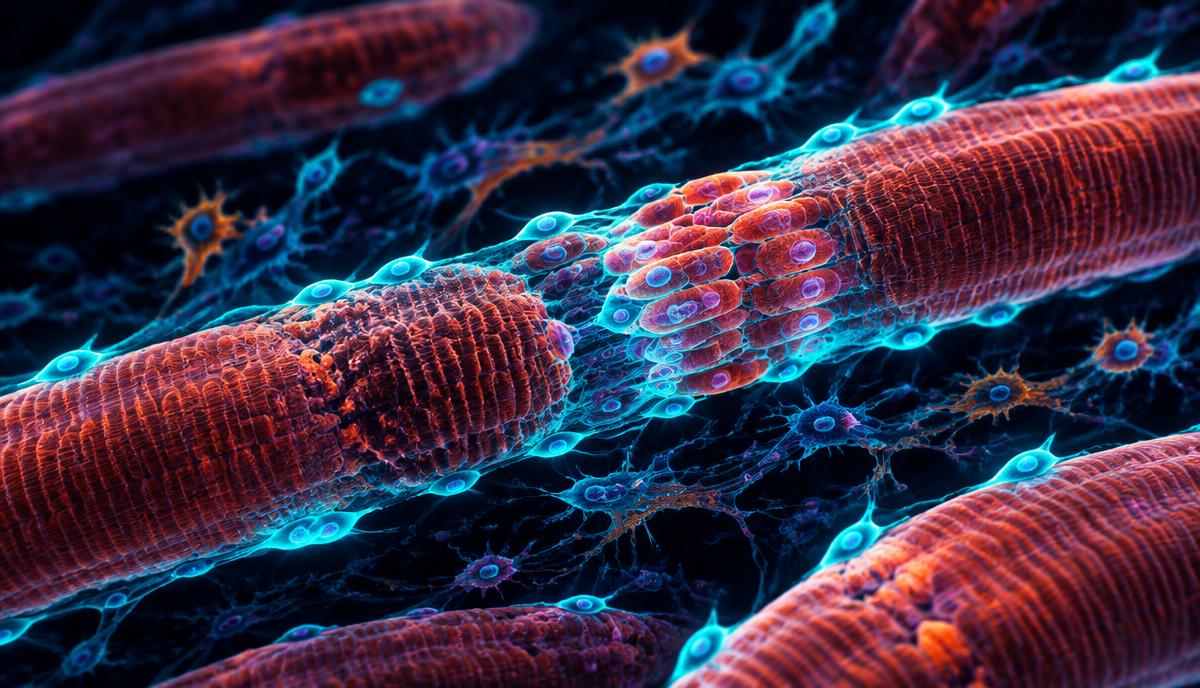
- Skeletal muscle contains its own resident stem cell population, called satellite cells, which sit dormant along muscle fibers until activated by damage or mechanical stress. Once activated, they proliferate and fuse into muscle fibers, supplying the machinery for repair and growth.
- What the Evidence Shows Actually Works
- The best-supported interventions are unglamorous and well studied:
- Where Cell-Based Approaches Stand
- Given satellite cells' role in muscle repair, researchers have asked whether cell-based therapies could treat sarcopenia directly. No cell therapy is approved for sarcopenia today, and this remains an early, investigational area.
What This Article Covers
Age-related muscle loss, known clinically as sarcopenia, is common but not inevitable in its severity — decades of exercise and nutrition research point to specific, low-cost interventions that meaningfully slow it. This article summarizes what the evidence supports for preserving muscle mass, strength, and function with age, touches on the muscle stem cells (satellite cells) that make exercise effective, and gives a brief, honest picture of where cell-based approaches to sarcopenia stand today.
Why Muscle Naturally Declines With Age
Muscle mass and strength decline gradually starting in early adulthood, with most sources placing the onset around age 30 and effects becoming more noticeable after 60. According to the U.S. Department of Health and Human Services' Office on Women's Health, the body naturally loses about 3-5% of its muscle mass per decade. This loss accelerates with inactivity, poor nutrition, chronic disease, and hormonal changes, and when it becomes severe enough to impair strength and physical function, it's classified as sarcopenia — a recognized geriatric condition linked to falls, frailty, and loss of independence.
The Role of Satellite Cells
Skeletal muscle contains its own resident stem cell population, called satellite cells, which sit dormant along muscle fibers until activated by damage or mechanical stress. Once activated, they proliferate and fuse into muscle fibers, supplying the machinery for repair and growth. A review published in Frontiers in Physiology by Snijders and colleagues found that the satellite cell pool — particularly in fast-twitch (type II) fibers, which drive strength and power — declines with healthy aging, and that older adults show a blunted satellite cell response to a single bout of exercise versus younger adults. Importantly, this reduced pool does not prevent older men and women from achieving meaningful muscle fiber hypertrophy with prolonged resistance training, and structured training can offset some of aging's negative effects on satellite cell number. The repair machinery slows with age, but it stays responsive to exercise.
What the Evidence Shows Actually Works
The best-supported interventions are unglamorous and well studied:
- Resistance (strength) training is the most consistently effective intervention. A 2020 meta-analysis in the Journal of Applied Physiology (Straight et al.), covering 35 studies and over 1,000 older adults, found resistance training produced moderate-to-large increases in muscle fiber size, with researchers estimating gains of roughly 20% in slow-twitch and 30% in fast-twitch fiber cross-sectional area from a typical program. Response diminishes somewhat with advancing age ("anabolic resistance"), a reason to start and stay consistent, not skip it.
- Adequate protein intake supports the muscle-building signal triggered by exercise. The PROT-AGE Study Group's position paper in the Journal of the American Medical Directors Association recommends healthy older adults consume at least 1.0-1.2 grams of protein per kilogram of body weight daily, distributed across meals, to help counter anabolic resistance.
- The CDC recommends older adults get at least 150 minutes of moderate-intensity aerobic activity weekly plus muscle-strengthening activity on 2 or more days per week, along with balance-focused activity.
- Avoiding prolonged bed rest or inactivity after illness matters — even short periods of disuse can cause disproportionate muscle and strength loss in older adults.
The evidence base for resistance training and adequate protein intake as ways to preserve muscle mass, strength, and satellite cell function is considerably stronger and more mature than for any experimental biologic approach.
Where Cell-Based Approaches Stand
Given satellite cells' role in muscle repair, researchers have asked whether cell-based therapies could treat sarcopenia directly. No cell therapy is approved for sarcopenia today, and this remains an early, investigational area. A small number of early-phase trials are underway — for example, a Phase 2 trial (STEM-META) is testing an investigational cell-derived secretome product in adults with sarcopenic obesity, and other registered trials test mesenchymal stromal cell products for general age-related frailty rather than sarcopenia specifically. These are safety- and feasibility-focused studies, not available or validated treatments, and it will likely be years before (or if) any such approach proves effective enough for approval. The exercise and nutrition strategies above remain the evidence-based standard; any regenerative approach is a research direction to watch, not an option to pursue outside a formal trial.
Bottom Line
Sarcopenia reflects a real, measurable decline in muscle tissue and in the satellite cells that repair it — but the rate and severity of that decline are substantially modifiable. Resistance training, adequate protein intake, and regular aerobic activity all have solid, peer-reviewed evidence behind them for preserving muscle mass, strength, and satellite cell function with age. Cell-based approaches for sarcopenia are a genuine area of early scientific investigation, but they are not a current alternative to lifestyle interventions — they're a research frontier still being tested for safety and effect.
Sources
- Sarcopenia, Office on Women's Health, U.S. Department of Health and Human Services (2025) — https://womenshealth.gov/sarcopenia
- Snijders T, et al., "Satellite Cells in Human Skeletal Muscle Plasticity," Frontiers in Physiology (2015) — https://www.frontiersin.org/articles/10.3389/fphys.2015.00283/pdf
- Straight CR, Fedewa MV, Toth MJ, Miller MS, "Improvements in Skeletal Muscle Fiber Size With Resistance Training Are Age-Dependent in Older Adults: A Systematic Review and Meta-Analysis," Journal of Applied Physiology (2020) — https://pmc.ncbi.nlm.nih.gov/articles/PMC7473942
- Bauer J, et al., "Evidence-Based Recommendations for Optimal Dietary Protein Intake in Older People: A Position Paper From the PROT-AGE Study Group," Journal of the American Medical Directors Association (2013) — https://pubmed.ncbi.nlm.nih.gov/23867520/
- How Much Physical Activity Do Older Adults Need?, Centers for Disease Control and Prevention (2025) — https://www.cdc.gov/physical-activity-basics/guidelines/older-adults.html
- Immunis, Inc., "Immunis Treats its First Patients for Sarcopenic Obesity" (STEM-META Phase 2 trial press release, 2025) — https://www.businesswire.com/news/home/20250304086289/en/Immunis-Treats-its-First-Patients-for-Sarcopenic-Obesity
Related Articles
- Fundamentals
Types of Neurodegenerative Disease: Which Ones Are Being Studied With Stem Cell Therapy?
Compare stem cell research across Parkinson’s, Huntington’s, ALS, Alzheimer’s, MSA and dementias by trial phase, evidence quality and treatment status.
- Fundamentals
What Is Multiple Sclerosis?
Understand multiple sclerosis symptoms, causes and subtypes, standard disease-modifying care, and where intensive AHSCT research fits for aggressive MS.
- Fundamentals
What Is a "Potency Assay"? How Scientists Confirm a Cell Therapy Actually Does Its Job
A potency assay tests whether each batch of cell therapy has its intended biological activity. Why living cells make this hard, and what regulators require.