Stem Cell Therapy for Burn Wounds
What this article covers
- Overview
- Severe burns damage skin's ability to regenerate itself, and standard care still relies on debridement, wound dressings, and skin grafting, either from the patient's own skin (autograft) or engineered/donor skin substitutes. Because grafting has limits, especially in large burns with little donor skin available, researchers have looked to stem cells as a way to speed healing, support blood vessel growth, and reduce the thick, contracted scarring (hypertrophic scarring) common after deep burns.
- How It's Thought to Work
- Mesenchymal stem cells, whether harvested from bone marrow, fat tissue, or umbilical cord tissue, don't appear to work by directly turning into new skin. Instead, researchers believe they act more like a signaling system: they release growth factors and other molecules that calm excess inflammation, encourage new blood vessels to form in the wound bed, and prompt the patient's own skin cells (fibroblasts and keratinocytes) to migrate and rebuild tissue.
- What the Evidence Shows
- A 2022 phase 1 dose-escalation trial published in Scars, Burns & Healing treated 10 adults with deep second-degree burns using donor (allogeneic) bone-marrow-derived MSCs, applied topically or injected around the wound. The results were genuinely encouraging: all patients achieved full wound closure, with minimal clinical scarring, no signs of immune rejection, and some evidence of re-pigmentation and hair follicle recovery compared to how their burns had healed before treatment.
- Who Might Be a Candidate
- Right now, MSC therapy for burns exists almost entirely within research settings.
- Bottom Line
- The idea of using stem cells to help burn wounds heal faster and scar less has real, published support, most notably a small but positive phase 1 human trial and extensive animal data. But this is still early-stage, investigational medicine: trials are small, protocols vary widely, and no MSC-based product is FDA-approved for burn treatment.
Researchers are studying whether mesenchymal stem cells (MSCs), including bone-marrow- and fat-derived cells, can help burn wounds heal faster, reduce scarring, and improve skin quality. Early-phase human trials show encouraging results, but this remains an investigational approach, not a standard or FDA-approved burn treatment. It's also easy to confuse with FDA-approved bioengineered skin substitutes, like StrataGraft, which use lab-grown skin cells rather than stem cells. This page explains what the research actually shows and how to tell the two approaches apart.
Overview
Severe burns damage skin's ability to regenerate itself, and standard care still relies on debridement, wound dressings, and skin grafting, either from the patient's own skin (autograft) or engineered/donor skin substitutes. Because grafting has limits, especially in large burns with little donor skin available, researchers have looked to stem cells as a way to speed healing, support blood vessel growth, and reduce the thick, contracted scarring (hypertrophic scarring) common after deep burns. Most of this work is still in animal studies or small early-phase human trials.
How It's Thought to Work
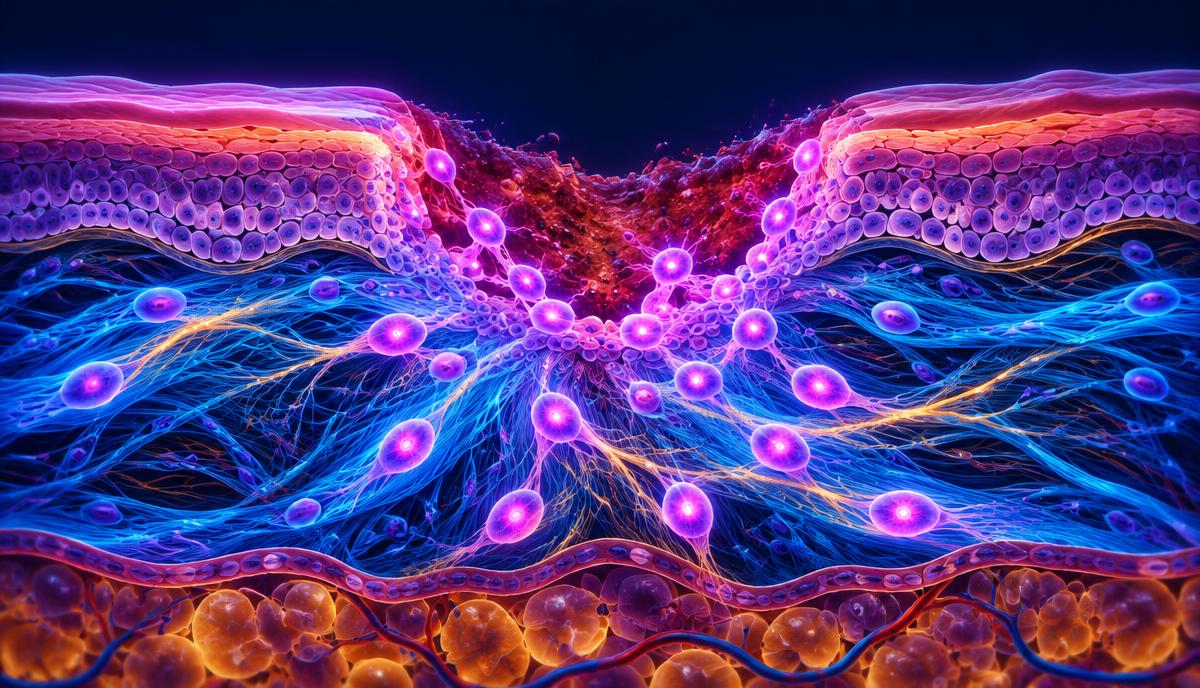
Mesenchymal stem cells, whether harvested from bone marrow, fat tissue, or umbilical cord tissue, don't appear to work by directly turning into new skin. Instead, researchers believe they act more like a signaling system: they release growth factors and other molecules that calm excess inflammation, encourage new blood vessels to form in the wound bed, and prompt the patient's own skin cells (fibroblasts and keratinocytes) to migrate and rebuild tissue. In animal studies, MSCs have been delivered by direct injection into the wound, applied in a gel or scaffold, or combined with a skin graft. Some studies suggest they can also influence how scar tissue matures, potentially producing softer, less contracted scars.
What the Evidence Shows
A 2022 phase 1 dose-escalation trial published in Scars, Burns & Healing treated 10 adults with deep second-degree burns using donor (allogeneic) bone-marrow-derived MSCs, applied topically or injected around the wound. The results were genuinely encouraging: all patients achieved full wound closure, with minimal clinical scarring, no signs of immune rejection, and some evidence of re-pigmentation and hair follicle recovery compared to how their burns had healed before treatment. A higher cell dose trended toward faster wound closure, though the trial was too small to prove a dose-response relationship statistically (Schulman et al., Scars, Burns & Healing, 2022).
That said, a comprehensive 2021 review in Burns & Trauma found the human evidence base is still thin. The authors identified only about a dozen registered clinical trials of MSC therapy for burns worldwide, most without published results, even as preclinical (animal) research consistently shows benefits for wound vascularization and healing speed. The review calls for standardized dosing, delivery methods, and outcome measures before MSC therapy for burns can be considered established treatment. Separately, laboratory and animal studies on adipose-derived stem cells (fat-derived MSCs) have shown improved blood flow, collagen formation, and graft survival in burn wounds, but this work also remains largely preclinical, with limited controlled human data.
It's important to distinguish this research from FDA-approved skin products sometimes marketed alongside "regenerative" burn care. StrataGraft, an allogeneic cultured-keratinocyte-and-dermal-fibroblast product approved by the FDA in June 2021, is a bioengineered skin substitute made of lab-grown skin cells, not stem cells, used to treat deep partial-thickness burns in adults. Its pivotal trial reported that a large majority of treated burn sites did not require a traditional skin autograft, with durable healing at three months in most patients. It's a real regulatory milestone in burn care, but it isn't a stem cell therapy, and its approval doesn't extend to MSC-based treatments.
Who Might Be a Candidate
Right now, MSC therapy for burns exists almost entirely within research settings. People most likely to be considered for clinical trials generally have:
- Deep second-degree (deep partial-thickness) burns being evaluated at an academic burn center running an active trial
- Burns where standard grafting options are limited or where reducing scarring is a specific study endpoint
- No active infection or other exclusion criteria set by the specific trial protocol
- Interest in enrolling through ClinicalTrials.gov rather than seeking treatment at a private clinic offering unproven "stem cell" burn injections, which are not FDA-approved and carry unknown risks
Bottom Line
The idea of using stem cells to help burn wounds heal faster and scar less has real, published support, most notably a small but positive phase 1 human trial and extensive animal data. But this is still early-stage, investigational medicine: trials are small, protocols vary widely, and no MSC-based product is FDA-approved for burn treatment. Meanwhile, an FDA-approved option does exist in the related but distinct category of bioengineered skin substitutes, such as StrataGraft, for appropriate deep burns. Anyone considering stem cell treatment for a burn should pursue it through a registered clinical trial at a reputable burn center, not a direct-to-consumer clinic, and should talk with a board-certified burn surgeon about which options, proven or investigational, fit their specific injury.
Sources
- The effect of mesenchymal stem cells improves the healing of burn wounds: a phase 1 dose-escalation clinical trial — Scars, Burns & Healing (SAGE), 2022 — https://journals.sagepub.com/doi/full/10.1177/20595131211070783
- Mesenchymal stem cell-based therapy for burn wound healing — Burns & Trauma, Oxford Academic, 2021 — https://academic.oup.com/burnstrauma/article/doi/10.1093/burnst/tkab002/6261432
- Effectiveness of the adipose stem cells in burn wound healing: literature review — PubMed, 2021 — https://pubmed.ncbi.nlm.nih.gov/34561790/
- FDA Approves StrataGraft for the Treatment of Adults with Thermal Burns — U.S. Food and Drug Administration, 2021 — https://www.fda.gov/news-events/press-announcements/fda-approves-stratagraft-treatment-adults-thermal-burns
- FDA Approves StrataGraft for Treating Thermal Burns in Adults — U.S. Pharmacist, 2021 — https://www.uspharmacist.com/article/fda-approves-stratagraft-for-treating-thermal-burns-in-adults
Related Articles
- Clinical Applications
Stem Cell Therapy for Diabetic Retinopathy
One small pilot trial found meaningful visual acuity gains in earlier-stage disease — but no stem cell product is FDA-approved for diabetic retinopathy, and anti-VEGF therapy remains the proven option.
- Clinical Applications
Stem Cell Therapy for ALS
No stem cell therapy is FDA-approved for ALS. Here's what NurOwn's Phase 3 actually showed, why South Korea approved Neuronata-R, and what realistic candidacy looks like today.
- Clinical Applications
Stem Cell Therapy for Interstitial Cystitis (Bladder Pain Syndrome)
Animal data is consistent and early human trials report shrinking Hunner lesions — but the entire human evidence base comes from one research group's small trials. Here's the honest picture.