Can Stem Cells Help With Myasthenia Gravis?
What this article covers
- What Myasthenia Gravis Treatment Normally Looks Like
- Before getting to stem cells, it helps to know the baseline. Standard MG care includes pyridostigmine (Mestinon) to improve nerve-muscle signaling, corticosteroids and other immunosuppressants to calm the immune system, thymectomy (surgical removal of the thymus gland) in appropriate patients, and short-term rescue therapies like IVIG or plasma exchange during crises.
- How Stem Cell Transplantation Is Thought to Work
- " Instead, the idea is immune reset. Doctors first collect a patient's own blood-forming (hematopoietic) stem cells, typically mobilizing them with cyclophosphamide and G-CSF, then purify the graft to CD34+ cells to strip out mature immune cells.
- What the Evidence Shows
- The best-documented and most encouraging data come from a 2024 retrospective study in Annals of Clinical and Translational Neurology by Beland and colleagues, following 21 patients with severe, treatment-refractory MG (all had failed corticosteroids plus at least two other immunosuppressants, and most had required ICU-level care) who underwent AHSCT between 2001 and 2022. 7 years — with some patients tracked for more than two decades.
- Who Might Be a Candidate
- AHSCT is not an alternative to first-line MG care, and it is not offered outside specialized transplant or neuroimmunology centers.
- Bottom Line
- For the narrow population of patients with severe myasthenia gravis that has defeated every conventional and biologic therapy, autologous HSCT has produced some of the most durable, drug-free remissions reported anywhere in the MG literature — a genuinely hopeful finding for a group with few other options. But this is a research-stage, high-risk intervention, not an FDA-approved or mainstream MG treatment, and it carries a real chance of serious complications or death.
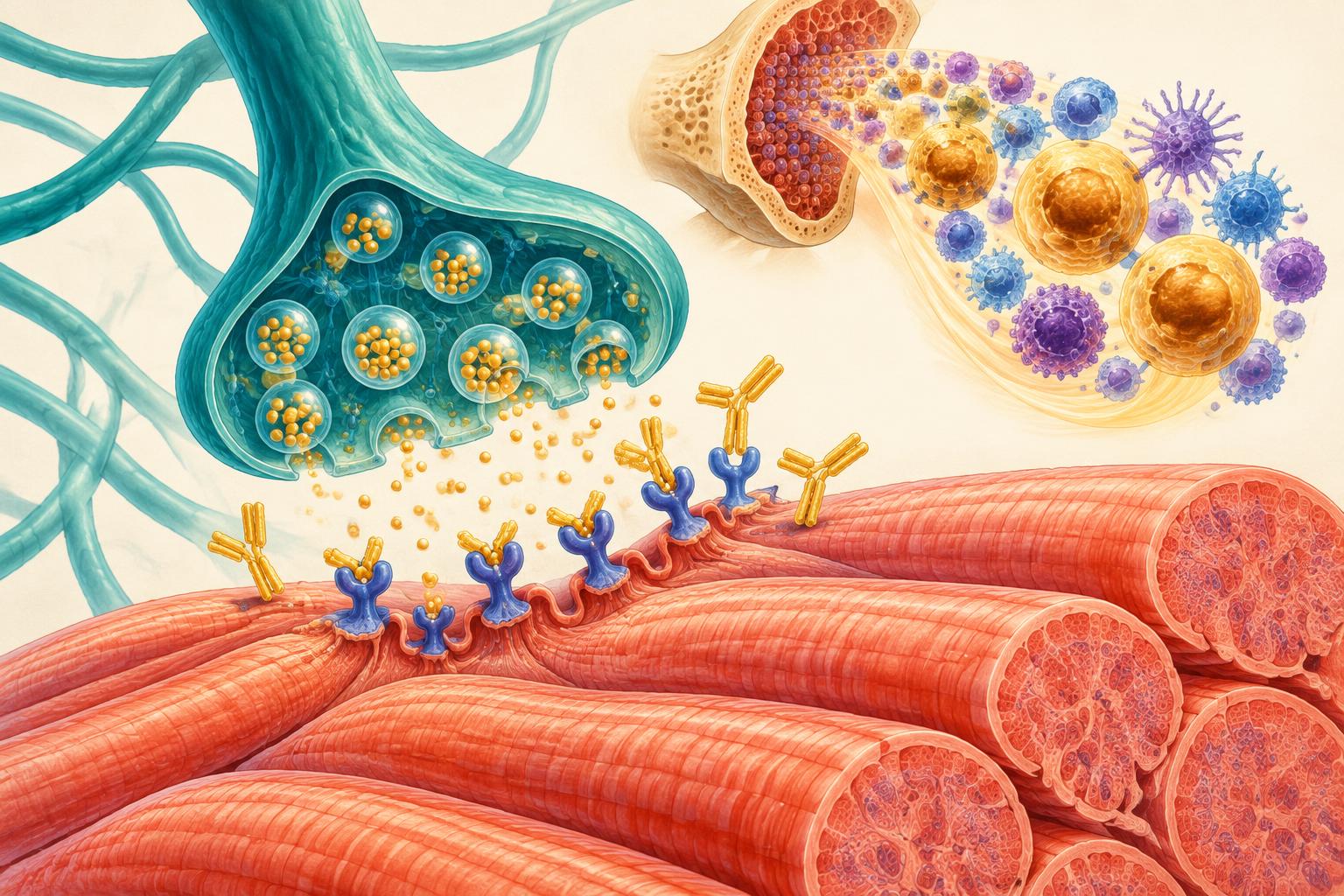
Myasthenia gravis (MG) is a chronic autoimmune disease in which the body's own antibodies disrupt communication between nerves and muscles, causing fluctuating weakness and fatigue. For most people with MG, modern drug therapy controls symptoms well. But a subset of patients have disease that keeps breaking through every standard treatment, and for them, a specific and intensive stem cell procedure — autologous hematopoietic stem cell transplantation (AHSCT) — has emerged as a research-stage option with some genuinely encouraging long-term results. This article explains what AHSCT is, what the evidence actually shows, and who it might realistically apply to.
What Myasthenia Gravis Treatment Normally Looks Like
Before getting to stem cells, it helps to know the baseline. Standard MG care includes pyridostigmine (Mestinon) to improve nerve-muscle signaling, corticosteroids and other immunosuppressants to calm the immune system, thymectomy (surgical removal of the thymus gland) in appropriate patients, and short-term rescue therapies like IVIG or plasma exchange during crises. Over the past several years, the FDA has also approved a new wave of targeted biologics for generalized MG, including complement inhibitors (eculizumab, ravulizumab, zilucoplan) and FcRn antagonists (efgartigimod, rozanolixizumab, nipocalimab), plus the B-cell-depleting agent inebilizumab. These newer drugs have meaningfully expanded options for antibody-positive patients. AHSCT is not part of this standard pathway — it is not FDA-approved for MG, and it is used only when this full arsenal of therapy has already failed.
How Stem Cell Transplantation Is Thought to Work
AHSCT for MG isn't about replacing damaged muscle or nerve tissue with new stem cells — a common misconception about "stem cell therapy." Instead, the idea is immune reset. Doctors first collect a patient's own blood-forming (hematopoietic) stem cells, typically mobilizing them with cyclophosphamide and G-CSF, then purify the graft to CD34+ cells to strip out mature immune cells. The patient then undergoes high-dose chemotherapy (commonly busulfan and cyclophosphamide) plus anti-thymocyte globulin, which wipes out the existing, misbehaving immune system almost entirely. Finally, the patient's own purified stem cells are reinfused, and a new immune system regenerates from them — one that, in a meaningful share of patients, no longer produces the autoantibodies driving MG. This is the same rationale already used for AHSCT in severe multiple sclerosis and other autoimmune diseases.
What the Evidence Shows
The best-documented and most encouraging data come from a 2024 retrospective study in Annals of Clinical and Translational Neurology by Beland and colleagues, following 21 patients with severe, treatment-refractory MG (all had failed corticosteroids plus at least two other immunosuppressants, and most had required ICU-level care) who underwent AHSCT between 2001 and 2022. The result worth highlighting: among the 18 patients who could be evaluated, 16 (88.9%) achieved sustained clinical remission or minimal symptoms off all MG treatment, maintained over a median follow-up of 6.7 years — with some patients tracked for more than two decades. That is a genuinely durable, drug-free remission rate in a population that had run out of other options. This cohort was also presented as an abstract at the American Academy of Neurology 2025 annual meeting. It builds on an earlier, smaller study: a 2016 JAMA Neurology report in which all 7 patients with severe MG who underwent AHSCT reached durable complete remission off therapy, with no treatment-related deaths. A 2025 review in the RRNMF Neuromuscular Journal pooling 16 published MG transplant cases similarly found that all patients improved and 11 of 16 reached complete stable remission.
The caveat that has to stay attached to these numbers: AHSCT carries real, sometimes fatal, procedural risk. In the Beland cohort, transplant-related mortality within 100 days was 9.5% (2 of 21 patients, from respiratory failure and sepsis), and total non-relapse mortality over follow-up reached 19% (4 of 21), including two later deaths from pulmonary embolism/sepsis and colon cancer whose relation to the transplant is uncertain. Non-fatal complications included febrile neutropenia, viral reactivations, immune thrombocytopenia, hypothyroidism, and premature menopause. The 2016 cohort, by contrast, had no deaths, underscoring how much outcomes vary with patient selection and center experience. Every author group studying this treatment, without exception, calls for prospective trials before it can be considered established therapy, and stresses that current evidence comes only from small, retrospective, single- or dual-center series.
Who Might Be a Candidate
AHSCT is not an alternative to first-line MG care, and it is not offered outside specialized transplant or neuroimmunology centers. Based on the published patient profiles, it has been considered for adults who:
- Have generalized MG classified as severe (MGFA class IIIb–V) at their worst
- Have failed corticosteroids plus at least two other immunosuppressive or immunomodulating agents, including, where relevant, newer biologics
- Have required ICU admission, intubation, or repeated plasma exchange/IVIG for MG crises
- Are medically fit enough to tolerate high-dose chemotherapy and a weeks-long hospitalization
- Are being evaluated at a center with transplant experience, ideally through a clinical study
It is not appropriate for newly diagnosed, mild, or drug-responsive MG, and it is not a treatment a patient should seek out on their own outside a specialist transplant program.
Bottom Line
For the narrow population of patients with severe myasthenia gravis that has defeated every conventional and biologic therapy, autologous HSCT has produced some of the most durable, drug-free remissions reported anywhere in the MG literature — a genuinely hopeful finding for a group with few other options. But this is a research-stage, high-risk intervention, not an FDA-approved or mainstream MG treatment, and it carries a real chance of serious complications or death. Anyone considering it should do so only through a specialized transplant center and ideally within a formal clinical study, after standard and biologic therapies have truly been exhausted.
Key Questions Answered
- How is AHSCT intended to help myasthenia gravis?
- It aims to reset the immune system, not replace muscle or nerve tissue. High-dose treatment removes existing immune cells before the patient’s own purified blood-forming stem cells are reinfused.
- What remission and mortality results did the Beland cohort report?
- Among 18 evaluable patients, 16 (88.9%) achieved sustained remission or minimal symptoms off MG treatment over a median 6.7 years. Transplant-related mortality within 100 days was 9.5% (2 of 21 patients).
- Is AHSCT standard treatment for MG?
- No. It is not FDA-approved for MG and remains a high-risk research-stage option considered only for severe, treatment-refractory patients through specialist transplant evaluation, ideally within a clinical study.
Sources
- Beland B, et al. "Refractory myasthenia gravis treated with autologous hematopoietic stem cell transplantation." Annals of Clinical and Translational Neurology, 2024 — https://pmc.ncbi.nlm.nih.gov/articles/PMC11752101
- Beland B, et al. "Refractory Myasthenia Gravis Treated with Autologous Hematopoietic Stem Cell Transplantation." American Academy of Neurology 2025 Annual Meeting Abstract — https://index.mirasmart.com/AAN2025/PDFfiles/AAN2025-000120.html
- Bryant A, Atkins H, Pringle CE, et al. "Autologous Hematopoietic Stem Cell Transplantation for Myasthenia Gravis." JAMA Neurology, 2016 (covered in: "Stem cell procedure sends patients with severe myasthenia gravis into remission") — https://www.institut-myologie.org/en/?p=10920
- Li, Heber, Pike-Lee. "An updated review on the utility of hematopoietic stem cell transplant in the treatment of refractory myasthenia gravis." RRNMF Neuromuscular Journal, 2025 — https://journals.ku.edu/rrnmf/article/view/22987
- "Approved Treatments for Myasthenia Gravis." Myasthenia Gravis News, 2025 — https://myastheniagravisnews.com/approved-treatments
Related Articles
- Clinical Applications
Can Stem Cells Help With Tennis Elbow (Lateral Epicondylitis)?
MSC and bone marrow injections for tennis elbow show encouraging small-study signals, but controlled evidence remains limited and no product is FDA-approved for this use.
- Clinical Applications
Can Stem Cells Help With Keloid and Hypertrophic Scars?
Keloid and hypertrophic scars resist standard treatments. Here's what stem cell and exosome research shows so far — promising animal data, one encouraging human pilot, and no FDA-approved products yet.
- Clinical Applications
Can Stem Cells Help With Achilles Tendinopathy?
A ten-person Achilles tendinopathy trial reported encouraging safety and function results, but without a control group the stem cell approach remains investigational.