Stem Cell Therapy for Crohn's Disease
What this article covers
- How It's Thought to Work
- The therapy in question, darvadstrocel (brand name Alofisel), uses allogeneic (donor-derived) mesenchymal stem cells taken from adipose (fat) tissue and expanded in a lab. A single dose is injected directly into the tissue surrounding a cleaned-out fistula tract during a minor surgical procedure.
- What the Evidence Shows
- Darvadstrocel's approval was built on the phase 3 ADMIRE-CD trial, in which a single local injection produced meaningfully higher combined remission (fistula closure plus resolution of abscesses on MRI) than placebo at 24 weeks, with more than half of treated patients maintaining clinical remission at 52 weeks; long-term follow-up data suggested remission could be sustained out to two years in a subset of patients. On the strength of this, the European Medicines Agency approved Alofisel in March 2018 — a genuine milestone as the first allogeneic stem cell medicine authorized in the EU — specifically for adults with complex perianal fistulas and non-active or mildly active luminal Crohn's disease whose fistulas had responded inadequately to at least one conventional or biologic therapy.
- Bottom Line
- Darvadstrocel's history is a genuinely useful case study: real trial data, a real EU approval, and real promise for a painful, hard-to-treat complication of Crohn's disease — followed by a larger confirmatory trial that didn't replicate the benefit and a voluntary market withdrawal. That doesn't erase the scientific interest in MSCs for Crohn's, but it does mean no stem cell therapy is currently FDA-approved for Crohn's disease or its complications, and the therapy that came closest to living up to the promise is no longer on the market in Europe either.
Crohn's disease is a chronic inflammatory bowel disease that can cause pain, diarrhea, and, in roughly a third of patients, complex perianal fistulas — abnormal tunnels that form between the intestine and the skin near the anus. These fistulas are notoriously hard to heal and often resist surgery, antibiotics, and biologic drugs. People searching for "stem cell therapy for Crohn's disease" are usually hoping for a cure for the disease itself, but the honest picture is narrower and more complicated: stem cells have not been shown to cure Crohn's disease, but one mesenchymal stem cell (MSC) therapy did earn real regulatory approval in Europe specifically for treatment-resistant perianal fistulas — and its story since then is an instructive lesson in how promising early trial data doesn't always hold up.
How It's Thought to Work
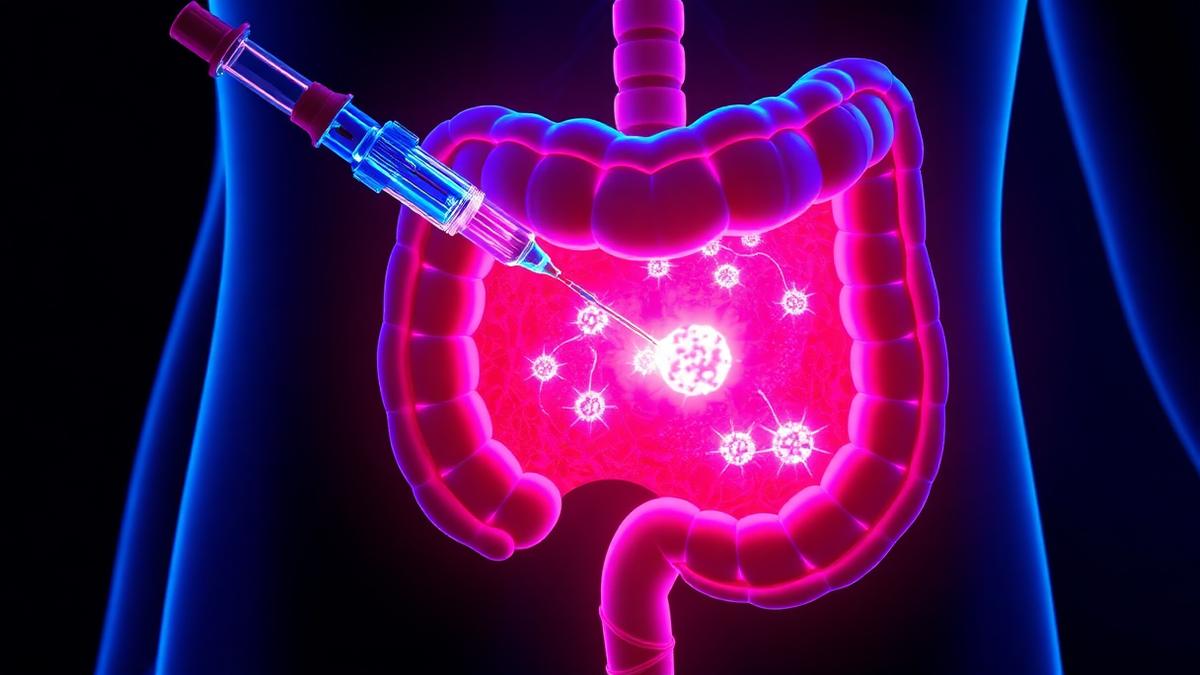
The therapy in question, darvadstrocel (brand name Alofisel), uses allogeneic (donor-derived) mesenchymal stem cells taken from adipose (fat) tissue and expanded in a lab. A single dose is injected directly into the tissue surrounding a cleaned-out fistula tract during a minor surgical procedure. Rather than circulating throughout the body, these cells act locally: they release signaling molecules that calm the surrounding inflammatory environment, encourage local tissue remodeling, and are thought to help create conditions favorable for the fistula tract to close and heal. This is distinct from experimental approaches that infuse MSCs intravenously to try to dampen inflammation throughout the gut wall in luminal Crohn's disease more broadly.
What the Evidence Shows
Darvadstrocel's approval was built on the phase 3 ADMIRE-CD trial, in which a single local injection produced meaningfully higher combined remission (fistula closure plus resolution of abscesses on MRI) than placebo at 24 weeks, with more than half of treated patients maintaining clinical remission at 52 weeks; long-term follow-up data suggested remission could be sustained out to two years in a subset of patients. On the strength of this, the European Medicines Agency approved Alofisel in March 2018 — a genuine milestone as the first allogeneic stem cell medicine authorized in the EU — specifically for adults with complex perianal fistulas and non-active or mildly active luminal Crohn's disease whose fistulas had responded inadequately to at least one conventional or biologic therapy.
That story has since taken an important turn. Regulators required a larger confirmatory phase 3 trial, ADMIRE-CD II, involving 568 patients. Its results, reported in 2024, showed no statistically meaningful advantage over placebo (roughly 50% vs. 47% combined remission at 24 weeks), driven partly by an unexpectedly strong placebo response. Citing this outcome, Takeda voluntarily withdrew Alofisel's EU marketing authorization, effective December 2024, stating the demonstrated clinical benefit no longer justified continued use. Darvadstrocel has never been approved by the FDA and has not been available in the United States. Separately, smaller trials of systemic MSC infusion for luminal Crohn's disease itself — not fistulas — have shown early signals of benefit (one small, unblinded phase 2 study reported clinical response in most participants), but this remains investigational and unproven in larger controlled trials.
Who Might Be a Candidate
- Darvadstrocel's approved use, where it was available, was narrow: adults with complex perianal fistulas plus non-active/mildly active luminal Crohn's disease that hadn't responded adequately to conventional or biologic treatment.
- It was never intended for uncomplicated fistulas, active luminal disease flares, or as a general Crohn's "cure."
- Given the 2024 EU withdrawal and lack of FDA approval, this specific product is not currently a standard treatment option in most places, including the US.
- Anyone considering stem cell approaches for Crohn's should ask their gastroenterologist about current treatment availability, whether any comparable therapies are being studied in clinical trials, and how established options (biologics, immunomodulators, surgery) compare.
Bottom Line
Darvadstrocel's history is a genuinely useful case study: real trial data, a real EU approval, and real promise for a painful, hard-to-treat complication of Crohn's disease — followed by a larger confirmatory trial that didn't replicate the benefit and a voluntary market withdrawal. That doesn't erase the scientific interest in MSCs for Crohn's, but it does mean no stem cell therapy is currently FDA-approved for Crohn's disease or its complications, and the therapy that came closest to living up to the promise is no longer on the market in Europe either. Anyone drawn to this space should treat it as an active area of research, not an established treatment, and rely on their care team for what's actually available and evidence-backed today.
Key Questions Answered
- Has stem cell therapy been shown to cure Crohn's disease?
- Stem cells have not been shown to cure Crohn's disease. The specific stem cell therapy darvadstrocel (Alofisel) was approved in Europe for treatment-resistant perianal fistulas, a complication of Crohn's, but it was never intended as a general cure for the disease itself.
- How does darvadstrocel (Alofisel) work for Crohn's-related fistulas?
- Darvadstrocel uses donor-derived mesenchymal stem cells injected directly into the tissue around a cleaned fistula tract. These cells act locally by releasing signaling molecules to calm inflammation, encourage tissue remodeling, and create conditions for the fistula tract to close and heal. This local action is distinct from experimental approaches that infuse stem cells systemically.
- Is darvadstrocel (Alofisel) currently available as a treatment for Crohn's fistulas?
- No, darvadstrocel (Alofisel) is not currently available as a standard treatment option in most places, including the US. Although it received European approval in 2018 based on initial trials, a larger confirmatory trial later showed no statistically meaningful advantage over placebo. Consequently, its EU marketing authorization was voluntarily withdrawn, effective December 2024, and it has never been approved by the FDA.
- Are there any FDA-approved stem cell therapies for Crohn's disease or its complications?
- No stem cell therapy is currently FDA-approved for Crohn's disease or its complications. While darvadstrocel (Alofisel) came closest to market approval in Europe for perianal fistulas, it was never approved by the FDA and has since been withdrawn from the European market.
Sources
- Alofisel (darvadstrocel) | European Medicines Agency (EMA) — European Medicines Agency, 2026 — https://www.ema.europa.eu/en/medicines/human/EPAR/alofisel
- Takeda Update on Alofisel (darvadstrocel) — Takeda Pharmaceutical Company, 2024 — https://www.takeda.com/newsroom/statements/2024/takeda-alofisel-update-2024/
- 'Unexpectedly high' placebo response derails darvadstrocel for Crohn's perianal fistulas — Healio Gastroenterology, 2024 — https://www.healio.com/news/gastroenterology/20240528/unexpectedly-high-placebo-response-derails-darvadstrocel-for-crohns-perianal-fistulas
- Darvadstrocel: A Review in Treatment-Refractory Complex Perianal Fistulas in Crohn's Disease — BioDrugs (Springer Nature), 2018 — https://link.springer.com/article/10.1007/s40259-018-0311-4
- A Phase 2 Study of Allogeneic Mesenchymal Stromal Cells for Luminal Crohn's Disease Refractory to Biologic Therapy — Clinical Gastroenterology and Hepatology, 2014 — https://www.cghjournal.org/article/S1542-3565(13)01033-1/fulltext
Related Articles
- Clinical Applications
Can Stem Cells Help With Stress Urinary Incontinence?
Cell therapy for stress urinary incontinence missed its Phase 3 primary endpoint, but a subgroup with prior failed surgery showed a durable signal.
- Clinical Applications
Can Stem Cells Help With Drug-Resistant Focal Epilepsy?
Stem-cell-derived interneurons show encouraging seizure reductions in early drug-resistant epilepsy trials, but NRTX-1001 remains investigational and unapproved.
- Clinical Applications
Stem Cell-Derived Retina Cells Show Sustained Vision Gains Three Years After a Single Treatment for Geographic Atrophy
Three-year OpRegen follow-up suggests durable vision gains in a small geographic atrophy trial. The treatment remains investigational and lacks randomized efficacy data.