Stem Cell Therapy for Degenerative Disc Disease (Chronic Low Back Pain)
What this article covers
- The Basics
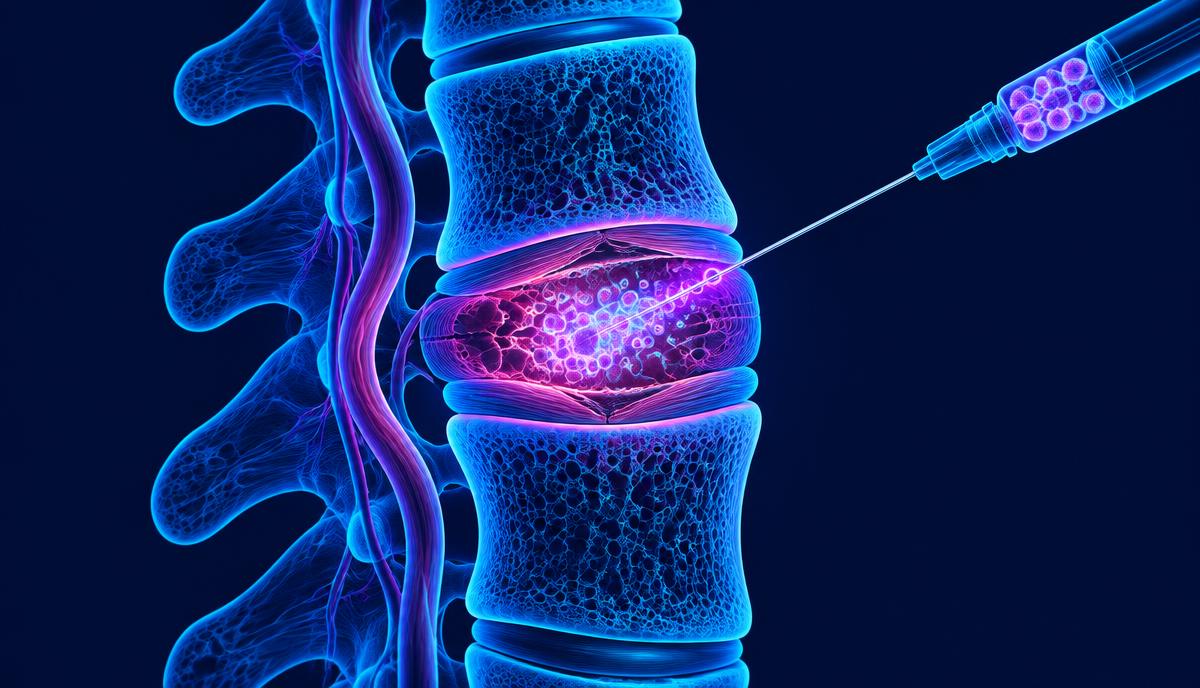
- Degenerative disc disease (DDD) occurs when the cushioning discs between vertebrae lose hydration and height over time, often causing chronic low back pain that standard care — physical therapy, injections, medication, even surgery — doesn't always resolve. Intradiscal stem cell therapy is an investigational approach that injects a concentrated dose of mesenchymal stem cells, typically derived from bone marrow or, in some trials, from allogeneic (donor) sources, directly into the affected disc.
- How It's Thought to Work
- Researchers theorize that MSCs injected into a degenerated disc may reduce local inflammation and secrete growth factors that support the disc's remaining native cells, potentially slowing further breakdown. The pain relief seen in trials is generally attributed more to these anti-inflammatory and signaling effects than to the cells physically rebuilding new disc tissue, which remains largely unproven in humans.
- What the Evidence Shows
- The most comprehensive look at this question is a 2026 systematic review and meta-analysis in the Asian Spine Journal, which pooled seven randomized controlled trials totaling 594 patients with discogenic chronic low back pain. It's a genuinely encouraging dataset: MSC injection produced statistically significant improvements in pain (VAS) and function (Oswestry Disability Index) versus control, with treated patients substantially more likely to achieve a meaningful pain reduction, and no significant difference in serious adverse events between groups.
- Bottom Line
- No stem cell product is FDA-approved for degenerative disc disease or chronic low back pain in the United States as of this writing. The best available trial and meta-analysis data show a real, statistically significant, but modest pain-relief signal for intradiscal MSC injection — promising enough that a major pivotal program is now in its second confirmatory Phase 3 trial — alongside a primary-endpoint miss in that program's first trial and effect sizes that often fall short of what patients would call life-changing.
This article reviews what clinical research actually shows about injecting mesenchymal stem cells (MSCs) directly into degenerated spinal discs to treat chronic low back pain — the strongest trial data available, the real limitations in that evidence, and the current regulatory status in the United States.
The Basics
Degenerative disc disease (DDD) occurs when the cushioning discs between vertebrae lose hydration and height over time, often causing chronic low back pain that standard care — physical therapy, injections, medication, even surgery — doesn't always resolve. Intradiscal stem cell therapy is an investigational approach that injects a concentrated dose of mesenchymal stem cells, typically derived from bone marrow or, in some trials, from allogeneic (donor) sources, directly into the affected disc.
How It's Thought to Work
Researchers theorize that MSCs injected into a degenerated disc may reduce local inflammation and secrete growth factors that support the disc's remaining native cells, potentially slowing further breakdown. The pain relief seen in trials is generally attributed more to these anti-inflammatory and signaling effects than to the cells physically rebuilding new disc tissue, which remains largely unproven in humans.
It's worth being direct here: "regeneration" language in marketing materials often outpaces the evidence. Imaging studies have not consistently shown disc height or hydration changes that track with reported pain relief, so exactly why some patients improve is still not fully settled.
What the Evidence Shows
The most comprehensive look at this question is a 2026 systematic review and meta-analysis in the Asian Spine Journal, which pooled seven randomized controlled trials totaling 594 patients with discogenic chronic low back pain. It's a genuinely encouraging dataset: MSC injection produced statistically significant improvements in pain (VAS) and function (Oswestry Disability Index) versus control, with treated patients substantially more likely to achieve a meaningful pain reduction, and no significant difference in serious adverse events between groups. The authors did flag an important caveat, though: average improvements fell short of the minimal clinically important difference typically used to define a meaningful benefit for an individual patient — a real signal, but not yet proof this reliably changes someone's day-to-day pain.
The largest single program is Mesoblast's rexlemestrocel-L (MPC-06-ID), the most clinically advanced cell therapy candidate for this indication. Its first Phase 3 trial (NCT02412735) did not meet its pre-specified primary composite endpoint, according to a 2021 statement from development partner Grünenthal — a genuine and important miss, not a technicality. At the same time, the trial did show a statistically significant pain-reduction effect that Mesoblast has reported as durable over an extended follow-up period, along with reduced opioid use among treated patients. The FDA subsequently acknowledged, in feedback on the company's regulatory pathway, that the trial's effects on pain intensity favored rexlemestrocel-L — while still requiring a second, confirmatory Phase 3 trial (NCT06325566) before any approval decision. That second trial recently completed patient dosing; results are not yet public.
Taken together, this is a genuinely mixed picture: real, statistically significant pain-relief signals across multiple independent trials and a favorable safety profile, sitting alongside a primary-endpoint miss in the largest pivotal trial, effect sizes that often fall short of clinically meaningful thresholds, and no confirmed disc-regeneration benefit.
Who Might Be a Candidate
- Adults with chronic (generally six-plus months) low back pain attributed specifically to one or two degenerated lumbar discs, confirmed on MRI, who haven't responded to conservative care
- People who have exhausted standard non-surgical options (physical therapy, NSAIDs, epidural or facet injections) and want to explore alternatives before considering spinal fusion
- Patients willing to enroll in a registered clinical trial, where treatment is standardized, monitored, and typically free — rather than paying out-of-pocket at a clinic offering an unapproved product
- Not a good fit for anyone expecting a guaranteed cure, disc "regrowth," or an FDA-approved treatment; none of those currently exist for this indication
Bottom Line
No stem cell product is FDA-approved for degenerative disc disease or chronic low back pain in the United States as of this writing. The best available trial and meta-analysis data show a real, statistically significant, but modest pain-relief signal for intradiscal MSC injection — promising enough that a major pivotal program is now in its second confirmatory Phase 3 trial — alongside a primary-endpoint miss in that program's first trial and effect sizes that often fall short of what patients would call life-changing. Anyone considering this treatment outside a registered clinical trial should treat it as unproven, ask direct questions about a clinic's regulatory status, and discuss realistic expectations and risks with a spine specialist first.
Sources
- Statement – Initial results from Mesoblast's Phase III trial (MSB-DR003) — Grünenthal, 2021 — https://www.grunenthal.com/en/press-room/statements/initial-results-from-mesoblast-phase-three-trial
- Intradiscal mesenchymal stem cell therapy for degenerative disc disease: a systematic review and meta-analysis of randomized trials — Asian Spine Journal, 2026 — https://www.asianspinejournal.org/journal/view.php?doi=10.31616%2Fasj.2025.0354
- FDA Acknowledges Effects on Pain Intensity Favor Rexlemestrocel-L, Confirms 12-Month Reduction in Back Pain Supports Product Efficacy — Mesoblast Limited investor release, 2026 — https://investorsmedia.mesoblast.com/static-files/3eebafb1-d857-443a-8e93-1fb36a37f45e
- Placebo-controlled Study to Evaluate Rexlemestrocel-L Alone or Combined With Hyaluronic Acid in Participants With Chronic Low Back Pain (NCT02412735) — ClinicalTrials.gov, U.S. National Library of Medicine — https://clinicaltrials.gov/study/NCT02412735
- Efficacy and Safety of Rexlemestrocel-L Combined With HA in Participants With Moderate to Severe Chronic Low Back Pain (NCT06325566) — ClinicalTrials.gov, U.S. National Library of Medicine — https://clinicaltrials.gov/study/NCT06325566
Related Articles
- Clinical Applications
Stem Cell Therapy for Peyronie's Disease
Small human studies of adipose-derived and placental stem cells show shrinking plaques and less distress in Peyronie's disease, but the best trial missed its curvature goal and nothing is FDA-approved.
- Clinical Applications
Stem Cell Therapy for Hidradenitis Suppurativa
Lab studies and a small case series suggest mesenchymal stem cells may calm hidradenitis suppurativa inflammation and help stubborn tunnels heal — but the approach is experimental and not FDA-approved.
- Clinical Applications
Stem Cell Therapy for TMJ Disorders (Temporomandibular Joint Osteoarthritis)
Randomized trials of fat-derived stem cell injections into the jaw joint beat hyaluronic acid on pain and mouth opening — but the evidence base is small and rated weak.