Stem Cell Therapy for Fatty Liver Disease (NAFLD/NASH)
What this article covers
- How It's Thought to Work
- MSCs are adult stem cells, most often sourced from bone marrow, fat tissue, or umbilical cord tissue, that do not typically become new liver cells themselves. Instead, researchers believe their benefit comes mainly from paracrine signaling — the growth factors, cytokines, and extracellular vesicles they release into surrounding tissue.
- What the Evidence Shows
- The evidence base here is real but early-stage, and it is important to be precise about what kind of evidence exists. A 2024 review in the World Journal of Stem Cells lays out the mechanistic case for MSCs in NAFLD — including exosome effects on lipid metabolism, anti-inflammatory signaling, and antioxidant effects — while explicitly noting that human clinical evidence remains minimal and that standardized protocols and rigorous trials are still needed.
- Who Might Be a Candidate
- Because no MSC-based therapy for NAFLD/NASH is an approved or standard-of-care treatment, “candidacy” here means candidacy for learning about or potentially enrolling in a registered clinical trial — not access to an available therapy.
- Bottom Line
- No stem cell or exosome-based therapy for NAFLD, NASH, MASLD, or MASH is FDA-approved, and none should be considered a proven or readily available treatment. The scientific rationale is credible — MSCs and their extracellular vesicles have shown anti-inflammatory, anti-fibrotic, and lipid-lowering effects in cell and animal models of fatty liver disease — but this evidence is overwhelmingly preclinical.
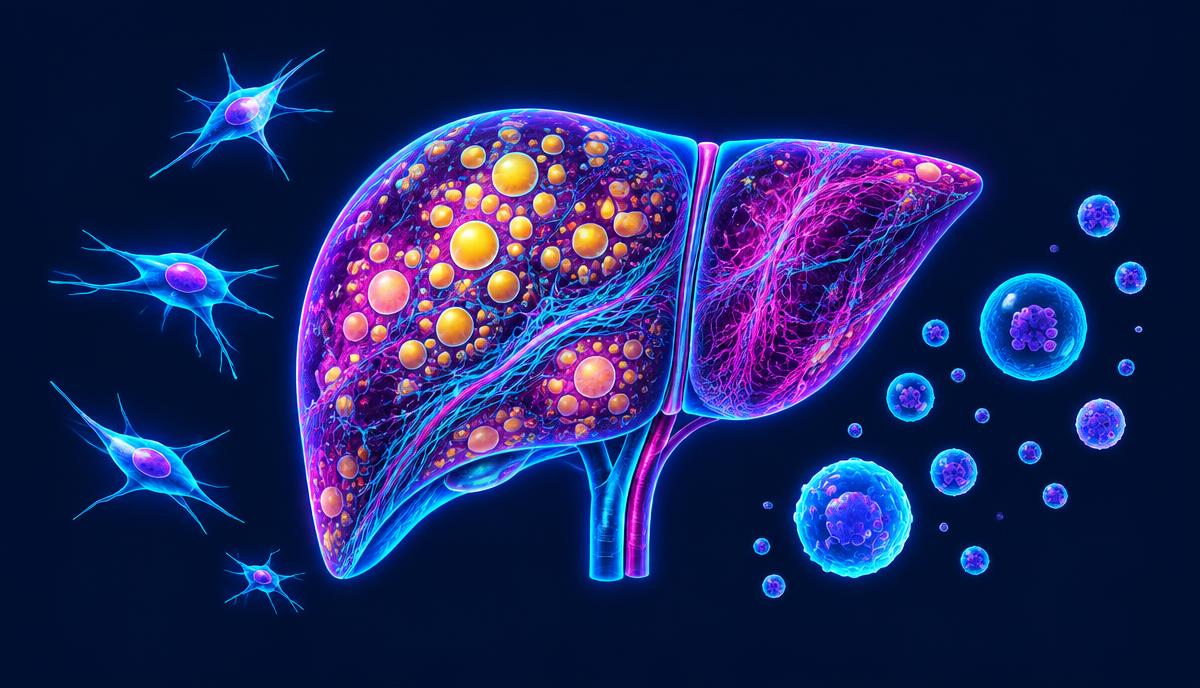
Non-alcoholic fatty liver disease (NAFLD) and its more severe form, non-alcoholic steatohepatitis (NASH) — now increasingly called MASLD/MASH — affect a large share of adults worldwide, and no cell-based therapy is yet FDA-approved to reverse the liver scarring they can cause. Researchers are studying mesenchymal stem cells (MSCs) and the extracellular vesicles (EVs) they release as a possible way to calm liver inflammation, reduce fat buildup, and slow fibrosis. This article summarizes what the science actually shows: promising results in animal studies, a real mechanistic rationale, and almost no direct human trial data in NAFLD/NASH specifically.
How It's Thought to Work
MSCs are adult stem cells, most often sourced from bone marrow, fat tissue, or umbilical cord tissue, that do not typically become new liver cells themselves. Instead, researchers believe their benefit comes mainly from paracrine signaling — the growth factors, cytokines, and extracellular vesicles they release into surrounding tissue. In laboratory and animal models, these signals have been linked to reduced fat accumulation in liver cells (partly by improving fatty acid oxidation and suppressing new fat synthesis), lower levels of inflammatory markers, reduced activation of hepatic stellate cells (the cells responsible for liver scarring), and support for the liver's own regenerative processes. MSC-derived exosomes, a specific type of extracellular vesicle, have drawn particular interest because they may be able to deliver some of these signaling benefits without infusing whole cells, potentially with a different safety profile. Both whole-cell MSC therapy and MSC-EV/exosome approaches are being studied, almost entirely in rodent models to date.
What the Evidence Shows
The evidence base here is real but early-stage, and it is important to be precise about what kind of evidence exists. A 2024 review in the World Journal of Stem Cells lays out the mechanistic case for MSCs in NAFLD — including exosome effects on lipid metabolism, anti-inflammatory signaling, and antioxidant effects — while explicitly noting that human clinical evidence remains minimal and that standardized protocols and rigorous trials are still needed. A 2024 review in Stem Cells Translational Medicine examined MSC-based approaches for both alcohol-associated liver disease and NAFLD together. It found that the great majority of the supporting data comes from mouse models, and it identified real translational hurdles: donor-to-donor variability, cell trapping in the lungs after intravenous infusion, cryopreservation-related loss of cell function, and theoretical tumor-growth concerns in some patients. Notably, this review's one cited human clinical trial involved MSC therapy for alcoholic cirrhosis, not NAFLD/NASH — underscoring how little direct human data exists for fatty liver disease specifically.
A 2025 systematic review and meta-analysis in Lipids in Health and Disease pooled preclinical studies of MSC-derived extracellular vesicles in NAFLD animal models. It reported statistically significant reductions in liver triglycerides and cholesterol, improvements in inflammatory markers, and better histology scores — but the authors were explicit that every included study was preclinical (rodent), and they called for future clinical trials to test whether these effects translate to humans. A separate 2025 review in Stem Cell Research & Therapy surveyed currently registered clinical trials of MSC therapy across liver diseases broadly. It found dedicated trials for conditions like cirrhosis, liver failure, and autoimmune liver disease, but no completed or actively enrolling trial specifically targeting NAFLD/NASH/MASLD/MASH populations. Taken together, these sources point to the same conclusion: the mechanistic and animal-model rationale is genuinely interesting, but rigorous human trials in NAFLD/NASH specifically have not yet been conducted.
Who Might Be a Candidate
Because no MSC-based therapy for NAFLD/NASH is an approved or standard-of-care treatment, “candidacy” here means candidacy for learning about or potentially enrolling in a registered clinical trial — not access to an available therapy.
- Adults with confirmed NAFLD or NASH (ideally with biopsy- or imaging-based staging) who have exhausted standard lifestyle and medical management options
- Patients interested in participating in legitimate, IRB-approved clinical trials, who should search ClinicalTrials.gov and discuss any trial with their hepatologist first
- People who understand that most current evidence comes from animal studies, not human outcomes data, and are comfortable with that uncertainty
- Patients who are wary of unregulated “stem cell clinics” offering fatty liver treatments outside of formal trials
- Individuals for whom diet, exercise, weight management, and guideline-recommended medical therapies remain the appropriate first-line approach
Bottom Line
No stem cell or exosome-based therapy for NAFLD, NASH, MASLD, or MASH is FDA-approved, and none should be considered a proven or readily available treatment. The scientific rationale is credible — MSCs and their extracellular vesicles have shown anti-inflammatory, anti-fibrotic, and lipid-lowering effects in cell and animal models of fatty liver disease — but this evidence is overwhelmingly preclinical. The few human MSC liver trials that exist have generally targeted other conditions, such as alcoholic cirrhosis, rather than NAFLD/NASH specifically. Anyone considering this approach should be skeptical of clinics marketing stem cell treatments for fatty liver disease outside of registered clinical trials, and should rely on established, evidence-based management while research in this area continues to mature.
Sources
- Mesenchymal stem cells: A promising therapeutic avenue for non-alcoholic fatty liver disease — World Journal of Stem Cells, 2024 — https://pmc.ncbi.nlm.nih.gov/articles/PMC11362857/
- Recent Advances in Mesenchymal Stem/Stromal Cell-Based Therapy for Alcohol-Associated Liver Disease and Non-alcoholic Fatty Liver Disease — Stem Cells Translational Medicine, 2024 — https://pmc.ncbi.nlm.nih.gov/articles/PMC10872699/
- Therapeutic potential of mesenchymal stem cell-derived extracellular vesicle in nonalcoholic fatty liver disease: a systematic review and meta-analysis of preclinical evidence — Lipids in Health and Disease, 2025 — https://lipidworld.biomedcentral.com/articles/10.1186/s12944-025-02635-1
- Mesenchymal stem cell therapy as a game-changer in liver diseases: review of current clinical trials — Stem Cell Research & Therapy, 2025 — https://link.springer.com/article/10.1186/s13287-024-04127-y
- Are mesenchymal stem/stromal cells a novel avenue for the treatment of non-alcoholic fatty liver disease? — PMC, 2025 — https://pmc.ncbi.nlm.nih.gov/articles/PMC12149800/
Related Articles
- Clinical Applications
Stem Cell Therapy for Peyronie's Disease
Small human studies of adipose-derived and placental stem cells show shrinking plaques and less distress in Peyronie's disease, but the best trial missed its curvature goal and nothing is FDA-approved.
- Clinical Applications
Stem Cell Therapy for Hidradenitis Suppurativa
Lab studies and a small case series suggest mesenchymal stem cells may calm hidradenitis suppurativa inflammation and help stubborn tunnels heal — but the approach is experimental and not FDA-approved.
- Clinical Applications
Stem Cell Therapy for TMJ Disorders (Temporomandibular Joint Osteoarthritis)
Randomized trials of fat-derived stem cell injections into the jaw joint beat hyaluronic acid on pain and mouth opening — but the evidence base is small and rated weak.