Stem Cell Therapy for Sickle Cell Disease
What this article covers
- Overview
- Sickle cell disease is caused by a single gene mutation that makes red blood cells rigid and sickle-shaped, leading to pain crises, organ damage, and shortened life expectancy. Because the defect lives in blood-forming (hematopoietic) stem cells, replacing or correcting those stem cells can address the disease at its source — something drugs that manage symptoms cannot do.
- How It's Thought to Work
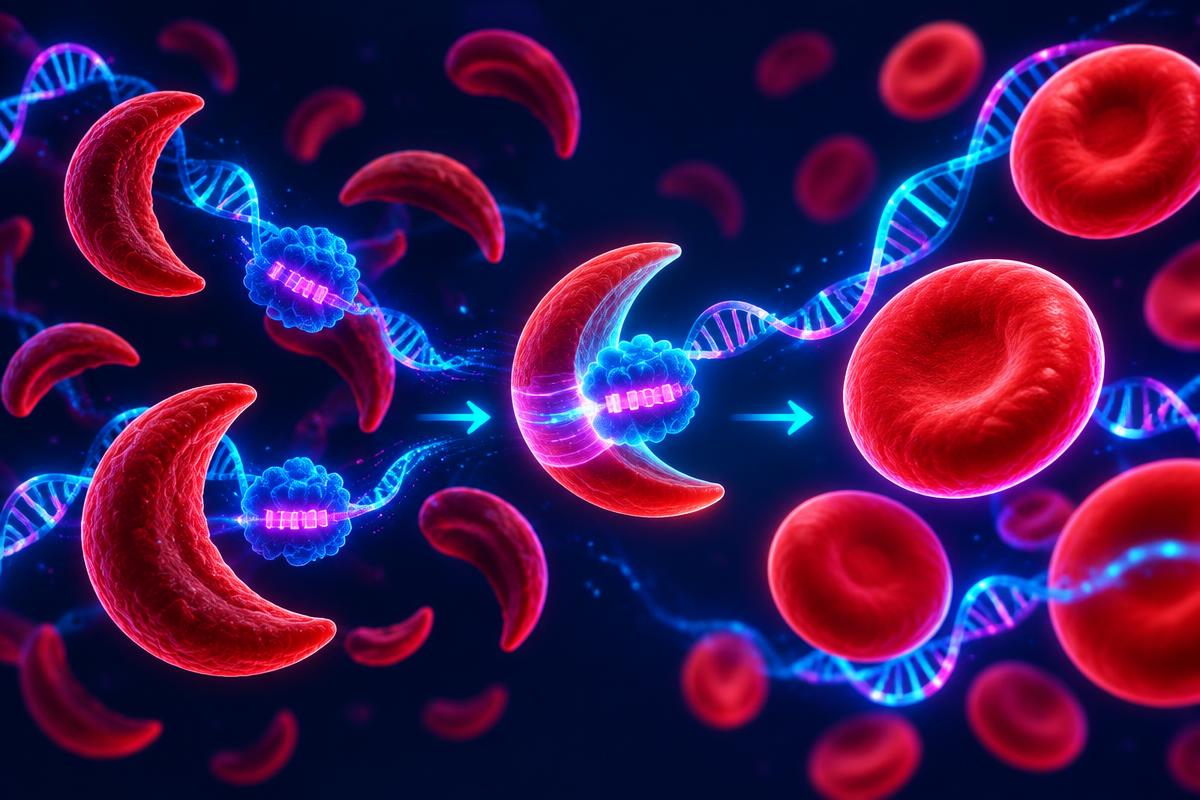
- Allogeneic hematopoietic stem cell transplant (HSCT) replaces a patient's sickle-producing bone marrow with healthy stem cells from a matched donor, typically a sibling, after conditioning chemotherapy clears out the diseased marrow. Casgevy uses CRISPR/Cas9 gene editing on the patient's own collected stem cells to boost fetal hemoglobin, which doesn't sickle; Lyfgenia uses a lentiviral vector to insert a gene for an anti-sickling hemoglobin.
- Bottom Line
- This is genuinely good news for a disease that had no curative options a few years ago: matched-sibling-donor transplant has cured sickle cell disease in the majority of treated children for over a decade, and two new gene therapies now offer a curative-intent path that doesn't require finding a donor at all. But none of this is risk-free or universally accessible — conditioning chemotherapy is demanding, donor availability remains a major bottleneck, and Lyfgenia's cancer-risk warning means long-term monitoring isn't optional.
Sickle cell disease is one of the few conditions where "stem cell therapy" is not a vague promise — it is an established medical reality with two distinct paths: decades-old allogeneic (donor) bone marrow/stem cell transplantation, which can cure the disease outright, and two newer FDA-approved gene therapies, Casgevy and Lyfgenia, that modify a patient's own stem cells instead of using a donor. This article explains how each approach works, what the clinical evidence actually shows, and the real limitations — donor scarcity, chemotherapy risks, and a cancer-risk warning on one of the gene therapies — that any honest overview has to include.
Overview
Sickle cell disease is caused by a single gene mutation that makes red blood cells rigid and sickle-shaped, leading to pain crises, organ damage, and shortened life expectancy. Because the defect lives in blood-forming (hematopoietic) stem cells, replacing or correcting those stem cells can address the disease at its source — something drugs that manage symptoms cannot do.
How It's Thought to Work
Allogeneic hematopoietic stem cell transplant (HSCT) replaces a patient's sickle-producing bone marrow with healthy stem cells from a matched donor, typically a sibling, after conditioning chemotherapy clears out the diseased marrow. Casgevy uses CRISPR/Cas9 gene editing on the patient's own collected stem cells to boost fetal hemoglobin, which doesn't sickle; Lyfgenia uses a lentiviral vector to insert a gene for an anti-sickling hemoglobin. In both gene therapies, the edited cells are infused back into the same patient (autologous), avoiding the need for a donor — but conditioning chemotherapy is still required to make room in the bone marrow.
What the Evidence Shows
- The FDA approved both Casgevy (exagamglogene autotemcel) and Lyfgenia (lovotibeglogene autotemcel) on December 8, 2023, for patients 12 and older with sickle cell disease — the first gene therapies approved for the condition (FDA, 2023).
- In Casgevy's pivotal trial, 29 of 31 evaluable patients (93.5%) were free of severe vaso-occlusive crises for at least 12 consecutive months. In Lyfgenia's trial, 28 of 32 patients (88%) achieved complete resolution of vaso-occlusive events (FDA, 2023).
- Lyfgenia carries an FDA boxed warning that hematologic malignancy has occurred in treated patients, and the label requires blood-count monitoring at least every six months plus integration-site analysis at months 6 and 12 for years after treatment (FDA prescribing information).
- Traditional matched-sibling-donor allogeneic HSCT has the longest track record: in children treated over the past two decades, overall survival has run roughly 93–100% and event-free survival often above 90%, with outcomes best when transplant happens before age 5 (NIH/PMC evidence review, 2022).
- That same evidence base flags real trade-offs: even with a matched donor, transplant carries roughly a 9% risk of graft rejection and a 15% risk of chronic graft-versus-host disease, and conditioning chemotherapy can cause infertility and, rarely, secondary cancers — and only a minority of patients have a suitable matched sibling donor in the first place (NCBI StatPearls).
Who Might Be a Candidate
- People with severe sickle cell disease (recurrent pain crises, stroke, or organ damage) who have not responded well to standard treatments
- Patients age 12+ with a history of vaso-occlusive events, for the FDA-approved gene therapies
- Patients — often children — who have a healthy, HLA-matched sibling or other suitable donor, for traditional allogeneic transplant
- Anyone considering these options should be evaluated at a specialized transplant/gene-therapy center, since eligibility, organ function, and fertility counseling all factor into candidacy
Bottom Line
This is genuinely good news for a disease that had no curative options a few years ago: matched-sibling-donor transplant has cured sickle cell disease in the majority of treated children for over a decade, and two new gene therapies now offer a curative-intent path that doesn't require finding a donor at all. But none of this is risk-free or universally accessible — conditioning chemotherapy is demanding, donor availability remains a major bottleneck, and Lyfgenia's cancer-risk warning means long-term monitoring isn't optional. Anyone considering stem cell therapy for sickle cell disease should discuss the specific risks and eligibility criteria with a hematologist at an experienced transplant center.
Key Questions Answered
- Is stem cell therapy for sickle cell disease actually available?
- Yes. Allogeneic bone marrow/stem cell transplant from a matched donor has been used for decades, and the FDA approved two gene therapies — Casgevy and Lyfgenia — on December 8, 2023, for patients 12 and older.
- How well do the gene therapies work?
- In Casgevy's pivotal trial, 29 of 31 evaluable patients (93.5%) were free of severe vaso-occlusive crises for at least 12 consecutive months. In Lyfgenia's trial, 28 of 32 patients (88%) achieved complete resolution of vaso-occlusive events.
- What is the difference between Casgevy and Lyfgenia?
- Casgevy uses CRISPR/Cas9 editing of the patient's own stem cells to boost fetal hemoglobin, which doesn't sickle. Lyfgenia uses a lentiviral vector to insert a gene for an anti-sickling hemoglobin. Both are autologous, so no donor is needed.
- What are the risks?
- Lyfgenia carries an FDA boxed warning for hematologic malignancy, with blood-count monitoring at least every six months and integration-site analysis at months 6 and 12. Matched-sibling transplant carries roughly a 9% risk of graft rejection and 15% risk of chronic graft-versus-host disease, and conditioning chemotherapy can cause infertility and, rarely, secondary cancers.
- Who can get a traditional transplant?
- Only a minority of patients have a suitable HLA-matched sibling donor. Outcomes are best when transplant happens before age 5, with overall survival of roughly 93-100% in children treated over the past two decades.
Sources
- FDA Approves First Gene Therapies to Treat Patients with Sickle Cell Disease — U.S. Food and Drug Administration, 2023 — https://www.fda.gov/news-events/press-announcements/fda-approves-first-gene-therapies-treat-patients-sickle-cell-disease
- LYFGENIA (lovotibeglogene autotemcel) Prescribing Information — U.S. Food and Drug Administration, 2023 — https://www.fda.gov/media/174610/download
- Evidence-Based Minireview: In young children with severe sickle cell disease, do the benefits of HLA-identical sibling donor HCT outweigh the risks? — PMC/NIH, 2022 — https://pmc.ncbi.nlm.nih.gov/articles/PMC8791135/
- Hematopoietic Stem Cell Transplantation in Sickle Cell Disease — StatPearls, NCBI Bookshelf (NIH) — https://www.ncbi.nlm.nih.gov/books/NBK538515/
- Sickle Cell Gene Therapies Casgevy and Lyfgenia Still Lacking Traction 2 Years In — BioSpace, 2025 — https://www.biospace.com/drug-development/sickle-cell-gene-therapies-casgevy-and-lyfgenia-still-lacking-traction-2-years-in
Related Articles
- Clinical Applications
Stem Cell Therapy for Peyronie's Disease
Small human studies of adipose-derived and placental stem cells show shrinking plaques and less distress in Peyronie's disease, but the best trial missed its curvature goal and nothing is FDA-approved.
- Clinical Applications
Stem Cell Therapy for Hidradenitis Suppurativa
Lab studies and a small case series suggest mesenchymal stem cells may calm hidradenitis suppurativa inflammation and help stubborn tunnels heal — but the approach is experimental and not FDA-approved.
- Clinical Applications
Stem Cell Therapy for TMJ Disorders (Temporomandibular Joint Osteoarthritis)
Randomized trials of fat-derived stem cell injections into the jaw joint beat hyaluronic acid on pain and mouth opening — but the evidence base is small and rated weak.