Stem Cell Therapy for TMJ Disorders (Temporomandibular Joint Osteoarthritis)
What this article covers
- How It's Thought to Work
- Adipose-derived mesenchymal stem cells (ADSCs) are typically obtained through a minor liposuction-type procedure, processed into a concentrated “adipose extract” or stromal vascular fraction, and injected directly into the TMJ, often alongside joint lavage (arthrocentesis). Rather than physically regrowing new cartilage on their own, these cells are believed to act mainly through paracrine signaling — releasing anti-inflammatory and trophic factors that calm the joint's synovial environment.
- What the Evidence Shows
- Human evidence specifically for TMJ is still limited but more encouraging than many regenerative therapies at this stage. A randomized controlled trial published in the International Dental Journal (2026) compared a single injection of adipose-derived stem cell-enriched adipose extract (ARDE) against hyaluronic acid in 50 patients with TMJ osteoarthritis who had failed conservative treatment.
- Bottom Line
- Early human trial data for adipose-derived stem cell injections in TMJ osteoarthritis is genuinely encouraging — real randomized trials have shown statistically significant improvements in pain, jaw opening, and joint effusion compared with standard hyaluronic acid injections. But this evidence base is still small: only a handful of controlled trials exist, sample sizes are modest, follow-up periods are short, and independent systematic reviews describe the overall quality of evidence as weak with a high risk of bias.
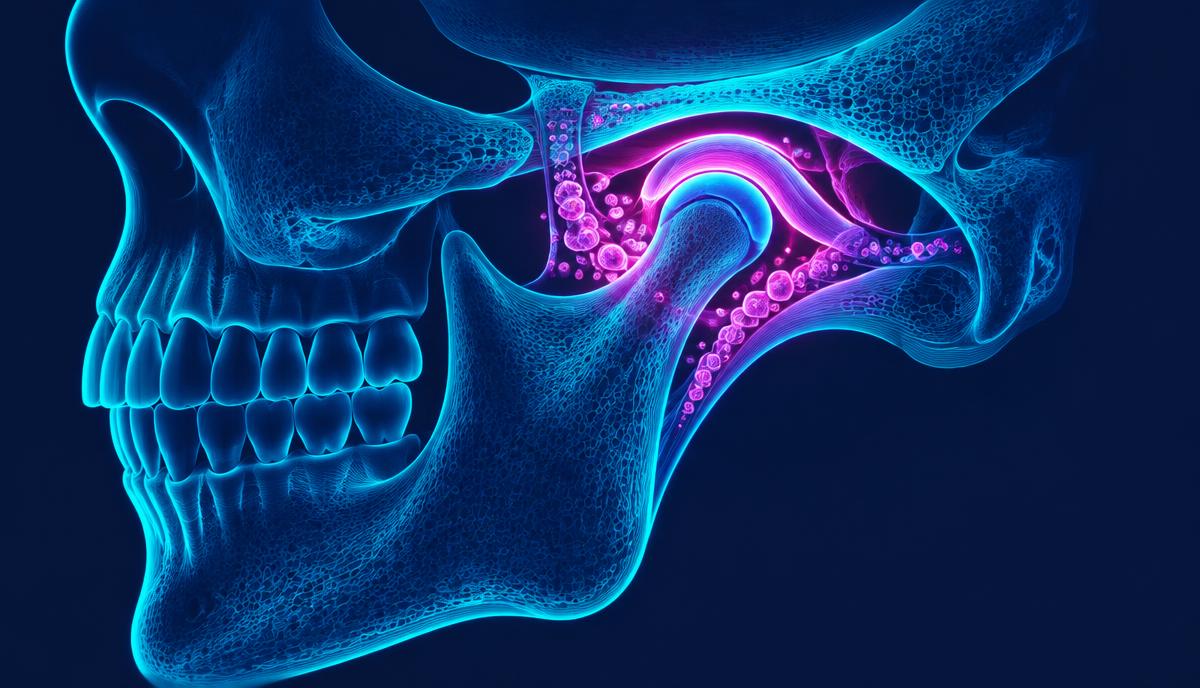
Temporomandibular joint (TMJ) osteoarthritis causes jaw pain, clicking, and limited mouth opening, and standard treatments (splints, physical therapy, anti-inflammatories, hyaluronic acid injections) don't help everyone. In recent years, researchers have tested whether mesenchymal stem cells — most often harvested from a patient's own fat tissue — can be injected into the joint to reduce inflammation and support cartilage repair. This article summarizes what real clinical and laboratory research actually shows, and how strong (or early) that evidence currently is.
How It's Thought to Work
Adipose-derived mesenchymal stem cells (ADSCs) are typically obtained through a minor liposuction-type procedure, processed into a concentrated “adipose extract” or stromal vascular fraction, and injected directly into the TMJ, often alongside joint lavage (arthrocentesis). Rather than physically regrowing new cartilage on their own, these cells are believed to act mainly through paracrine signaling — releasing anti-inflammatory and trophic factors that calm the joint's synovial environment. A 2025 mechanistic study published in the Journal of Translational Medicine reported that ADSC-enriched adipose extract reduced cartilage fibrosis in TMJ osteoarthritis models by inhibiting chondrocyte senescence, offering a plausible biological explanation for symptom improvement, though this type of evidence comes from laboratory and animal-model work rather than patients.
What the Evidence Shows
Human evidence specifically for TMJ is still limited but more encouraging than many regenerative therapies at this stage. A randomized controlled trial published in the International Dental Journal (2026) compared a single injection of adipose-derived stem cell-enriched adipose extract (ARDE) against hyaluronic acid in 50 patients with TMJ osteoarthritis who had failed conservative treatment. At 6 months, the ARDE group showed a significantly greater reduction in pain (VAS score improvement of −4.9 vs. −4.3, p=.009) and greater improvement in maximum mouth opening (+1.7 cm vs. +1.4 cm, p=.022), along with notably better resolution of joint effusion on MRI. A separate randomized trial in the Journal of Oral and Maxillofacial Surgery (2021, Sembronio et al.) tested arthrocentesis combined with microfragmented adipose tissue injection for TMJ internal derangement and osteoarthritis, adding to the small but real body of human trial data.
Zooming out, a 2022 systematic review and meta-analysis in the journal Cells (Chęciński et al.) pooled data from a handful of small clinical trials (roughly 50 patients, under 70 joints total) and found that intra-articular stem cell administration was associated with a substantial average reduction in pain and meaningful improvement in mouth-opening at 6 months. However, the authors were explicit that this conclusion rests on “weak evidence,” since every included study carried a high risk of bias — small samples, limited blinding, and inconsistent methodology. A broader 2022 systematic review in Osteoarthritis and Cartilage, focused on preclinical (animal-model) experiments, similarly found that stem cell-based approaches show biological promise for cartilage and osteochondral regeneration in the TMJ, while stressing that most of this evidence has not yet been replicated in well-controlled human trials. A related 2026 systematic review in Bioengineering reached a similar conclusion about scaffold- and cell-based TMJ regeneration: encouraging histology in animal models, but a persistent “translational gap” because functional, clinically relevant outcomes are rarely measured consistently.
Who Might Be a Candidate
- Adults with TMJ osteoarthritis who have not responded adequately to conservative measures (splints, NSAIDs, physical therapy)
- Patients considering it as an alternative or adjunct to hyaluronic acid or corticosteroid injections, in consultation with an oral and maxillofacial surgeon
- Those who understand this remains an off-label, investigational use and are willing to accept the uncertainty of a young evidence base
- People enrolled in or seeking legitimate clinical trials, where treatment protocols and outcomes are monitored
Bottom Line
Early human trial data for adipose-derived stem cell injections in TMJ osteoarthritis is genuinely encouraging — real randomized trials have shown statistically significant improvements in pain, jaw opening, and joint effusion compared with standard hyaluronic acid injections. But this evidence base is still small: only a handful of controlled trials exist, sample sizes are modest, follow-up periods are short, and independent systematic reviews describe the overall quality of evidence as weak with a high risk of bias. Most of the mechanistic and regenerative claims are still supported primarily by animal and laboratory studies rather than large human trials. Stem cell therapy for TMJ disorders is not FDA-approved and should be considered investigational; anyone considering it should discuss risks, costs, and realistic expectations with a qualified specialist, and be cautious of clinics overstating what the current science actually supports.
Sources
- Injection of Adipose-Derived Mesenchymal Stem Cell-Enriched Adipose Extract for Temporomandibular Joint Osteoarthritis: A Randomised Controlled Trial — International Dental Journal, 2026 — https://pmc.ncbi.nlm.nih.gov/articles/PMC13202285/
- Autologous Stem Cells Transplants in the Treatment of Temporomandibular Joints Disorders: A Systematic Review and Meta-Analysis of Clinical Trials — Cells, 2022 — https://pubmed.ncbi.nlm.nih.gov/36078117/
- Stem Cell-Based Therapies for Temporomandibular Joint Osteoarthritis and Regeneration of Cartilage/Osteochondral Defects: A Systematic Review of Preclinical Experiments — Osteoarthritis and Cartilage, 2022 — https://www.oarsijournal.com/article/S1063-4584(22)00747-6/fulltext
- Temporomandibular Joint Arthrocentesis and Microfragmented Adipose Tissue Injection for the Treatment of Internal Derangement and Osteoarthritis: A Randomized Clinical Trial — Journal of Oral and Maxillofacial Surgery, 2021 — https://www.sciencedirect.com/science/article/abs/pii/S0278239121001063
- ADSC-Enriched Adipose Extract Alleviates Cartilage Fibrosis in Temporomandibular Joint Osteoarthritis by Inhibiting Chondrocyte Senescence — Journal of Translational Medicine, 2025 — https://pubmed.ncbi.nlm.nih.gov/41068761/
- Scaffolds and Stem Cells Show Promise for TMJ Regeneration: A Systematic Review — Bioengineering, 2026 — https://www.mdpi.com/2306-5354/13/2/169
Related Articles
- Clinical Applications
Stem Cell Therapy for Peyronie's Disease
Small human studies of adipose-derived and placental stem cells show shrinking plaques and less distress in Peyronie's disease, but the best trial missed its curvature goal and nothing is FDA-approved.
- Clinical Applications
Stem Cell Therapy for Hidradenitis Suppurativa
Lab studies and a small case series suggest mesenchymal stem cells may calm hidradenitis suppurativa inflammation and help stubborn tunnels heal — but the approach is experimental and not FDA-approved.
- Clinical Applications
Stem Cell Therapy for Fatty Liver Disease (NAFLD/NASH)
Mesenchymal stem cells and their vesicles reduce liver fat and fibrosis in animal models — but there is still no completed human trial in NAFLD or NASH specifically.