Types of Cartilage Damage: What Regenerative Options Exist for Each?
What this article covers
- What This Article Covers
- "Cartilage damage" is not one condition, and that distinction matters enormously for anyone researching regenerative treatment. A sharp, traumatic gouge in an otherwise healthy knee is a fundamentally different problem than the diffuse, whole-joint wear of osteoarthritis — and the two have very different regenerative evidence bases.
- Focal Traumatic Chondral and Osteochondral Defects
- This is the category with the strongest cell-based evidence. A focal defect — a discrete gouge or crater in the hyaline cartilage, often from a sports injury, fall, or single traumatic event — occurs in an otherwise largely healthy joint.
- Osteochondritis Dissecans
- Osteochondritis dissecans (OCD) is a distinct entity: a segment of subchondral bone loses its blood supply and can separate, along with the cartilage covering it, from the underlying bone. It overwhelmingly affects children, adolescents, and young athletes, most often at the knee.
- Degenerative Cartilage Loss From Osteoarthritis
- Osteoarthritis (OA) is different in kind, not just degree, from a focal defect: it is diffuse, progressive thinning of cartilage across the joint surface, usually in older adults, and it involves the whole joint environment — inflammation, altered joint mechanics, subchondral bone changes — not just a repairable hole. This is where the regenerative evidence is weakest, despite being the most heavily marketed use of "stem cell" injections.
- Meniscal Damage: A Related but Distinct Problem
- The meniscus is fibrocartilage, structurally and biologically different from the hyaline articular cartilage covering the ends of bones, and meniscal tears are often discussed alongside cartilage damage but really deserve their own category. Cell-based meniscus repair is genuinely early-stage.
What This Article Covers
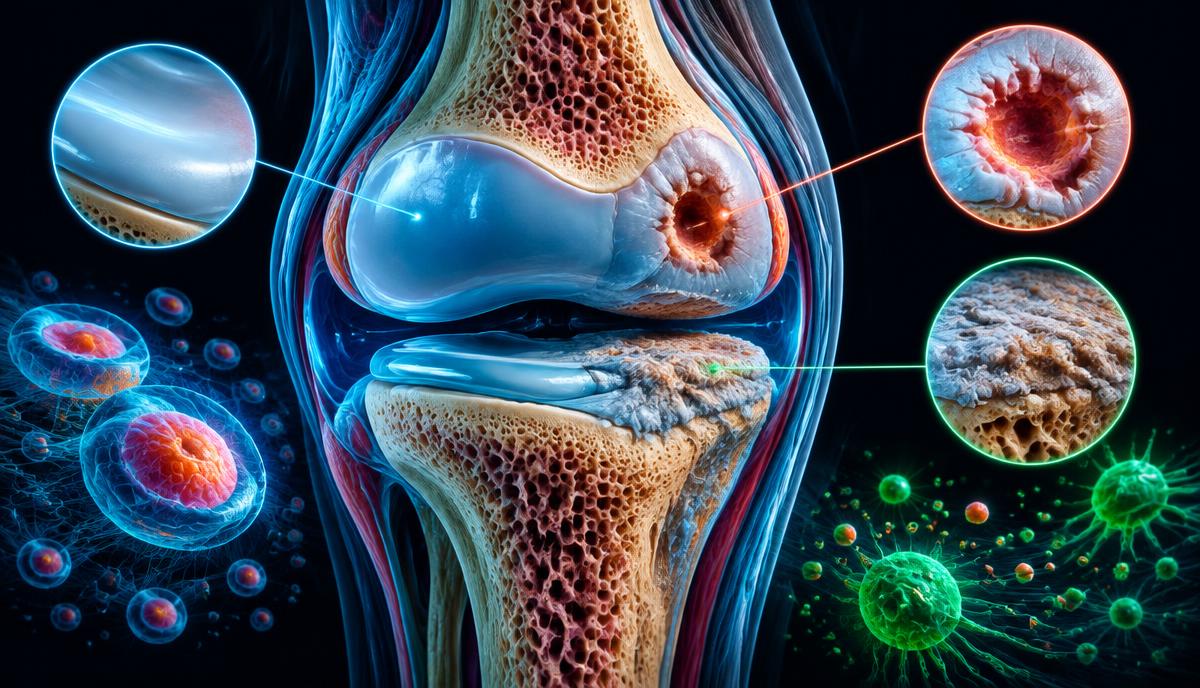
"Cartilage damage" is not one condition, and that distinction matters enormously for anyone researching regenerative treatment. A sharp, traumatic gouge in an otherwise healthy knee is a fundamentally different problem than the diffuse, whole-joint wear of osteoarthritis — and the two have very different regenerative evidence bases. This article walks through the major categories of cartilage damage — focal traumatic defects, osteochondritis dissecans, osteoarthritis-related degeneration, and meniscal (fibrocartilage) tears — and lays out, honestly, what is actually FDA-approved, what is in active trials, and what remains speculative for each.
Focal Traumatic Chondral and Osteochondral Defects
This is the category with the strongest cell-based evidence. A focal defect — a discrete gouge or crater in the hyaline cartilage, often from a sports injury, fall, or single traumatic event — occurs in an otherwise largely healthy joint. It's also the one indication where a stem-cell-adjacent, cell-based therapy has real FDA approval: MACI (matrix-induced autologous chondrocyte implantation), made by Vericel, was approved by the FDA in December 2016 for the repair of symptomatic full-thickness cartilage defects of the knee in adults, based on trial data in patients with more severe (Outerbridge Grade III or IV) lesions. MACI works by taking a patient's own cartilage cells, expanding them in a lab, and implanting them on a collagen membrane — it is autologous cell therapy, though built from differentiated chondrocytes rather than stem cells. Separately, bone marrow aspirate concentrate (BMAC) — a same-day, unmanipulated concentration of a patient's own bone marrow cells, including mesenchymal stem cells (MSCs) — has a growing but still developing evidence base specifically for these focal defects, with case series and comparative studies suggesting benefit over chondroplasty alone, though large randomized trials are still limited.
Osteochondritis Dissecans
Osteochondritis dissecans (OCD) is a distinct entity: a segment of subchondral bone loses its blood supply and can separate, along with the cartilage covering it, from the underlying bone. It overwhelmingly affects children, adolescents, and young athletes, most often at the knee. Because OCD involves both bone and cartilage, and because patients are young with high healing capacity, this is an active area for cell-based approaches — but the evidence is still preliminary. Published reports include small case series and case reports of MSC-based procedures (bone marrow-derived, adipose-derived, and even allogeneic umbilical cord-derived cells) used alongside or instead of standard fixation/drilling techniques in juvenile OCD, with encouraging individual outcomes but no large controlled trials yet establishing this as standard care.
Degenerative Cartilage Loss From Osteoarthritis
Osteoarthritis (OA) is different in kind, not just degree, from a focal defect: it is diffuse, progressive thinning of cartilage across the joint surface, usually in older adults, and it involves the whole joint environment — inflammation, altered joint mechanics, subchondral bone changes — not just a repairable hole. This is where the regenerative evidence is weakest, despite being the most heavily marketed use of "stem cell" injections. A 2024 systematic review and meta-analysis of 18 randomized controlled trials (over 1,100 patients) found MSC injections outperformed placebo on pain and function scores at 6 and 12 months, with adipose-derived cells showing the most consistent benefit — but the authors flagged high heterogeneity between studies, short follow-up, small trial sizes, and inconsistent protocols, concluding that more standardized, longer-term trials are needed before firm conclusions can be drawn. No MSC product is FDA-approved for osteoarthritis, and injections should not be understood as "regrowing" lost cartilage across a degenerated joint — that claim outpaces the current evidence.
Meniscal Damage: A Related but Distinct Problem
The meniscus is fibrocartilage, structurally and biologically different from the hyaline articular cartilage covering the ends of bones, and meniscal tears are often discussed alongside cartilage damage but really deserve their own category. Cell-based meniscus repair is genuinely early-stage. A 2023 first-in-human Phase I dose-escalation trial of stem-cell-derived "immunity-and-matrix-regulatory cells" injected into 18 patients with meniscus injuries reported good safety and MRI evidence of repair in a majority of patients by 12 weeks — but it was a small, single-center, open-label study without a control group, and the authors themselves called for randomized, blinded trials before any broader conclusions.
Where the Research Stands
Across all four categories, a consistent pattern emerges: cell-based regenerative approaches are most validated where the problem is a discrete, repairable defect in an otherwise healthy joint (focal chondral defects, where MACI has real FDA approval and solid outcomes data), and least validated where the damage is diffuse and degenerative (osteoarthritis and, to a lesser extent, chronic meniscal wear), where most MSC evidence remains early-phase or heterogeneous.
Bottom Line
Not all cartilage damage is regeneratively equal. Focal traumatic defects have an FDA-approved cell-based option (MACI) with meaningful clinical trial support, and BMAC shows promise for the same indication. Osteochondritis dissecans and meniscal tears are active but early research areas with encouraging small studies, not established standards. Diffuse osteoarthritis-related cartilage loss has the most MSC research volume but the least definitive evidence — real signals of pain and function improvement exist, but "regrowing cartilage" in an arthritic joint remains unproven. Anyone evaluating a regenerative option should ask which category their cartilage damage actually falls into, since that answer changes what the evidence can honestly promise.
Sources
- FDA Approves MACI for the Treatment of Symptomatic Cartilage Defects of the Knee in Adults — Vericel Corporation, 2016 — https://investors.vcel.com/news-releases/news-release-details/fda-approves-maci-treatment-symptomatic-cartilage-defects-knee
- Approved Cellular and Gene Therapy Products — U.S. Food and Drug Administration — https://www.fda.gov/vaccines-blood-biologics/cellular-gene-therapy-products/approved-cellular-and-gene-therapy-products
- Relative efficacy and safety of mesenchymal stem cells for osteoarthritis: a systematic review and meta-analysis of randomized controlled trials — Frontiers in Endocrinology (PMC), 2024 — https://pmc.ncbi.nlm.nih.gov/articles/PMC11194387/
- Immunity-and-matrix-regulatory cells enhance cartilage regeneration for meniscus injuries: a phase I dose-escalation trial — Signal Transduction and Targeted Therapy (Nature), 2023 — https://www.nature.com/articles/s41392-023-01670-7
- Understanding Osteochondritis Dissecans: A Narrative Review of the Disease Commonly Affecting Children and Adolescents — PMC, 2024 — https://pmc.ncbi.nlm.nih.gov/articles/PMC11049496/
- Bone Marrow Aspirate Concentrate for Cartilage Defects of the Knee: From Bench to Bedside Evidence — PubMed, 2017 — https://pubmed.ncbi.nlm.nih.gov/29126349/
- Meniscus repair: up-to-date advances in stem cell-based therapy — Stem Cell Research & Therapy, 2022 — https://link.springer.com/article/10.1186/s13287-022-02863-7
Related Articles
- Fundamentals
Can Exercise Boost Your Body's Own Stem Cell Activity? What the Evidence Actually Shows
Exercise activates muscle satellite cells and temporarily mobilizes blood progenitors. What human and animal studies show—and what they cannot yet prove about regeneration.
- Fundamentals
What Is Rheumatoid Arthritis?
Rheumatoid arthritis symptoms, diagnosis and proven DMARD treatments explained, with a look at why MSC therapy remains an early-stage research question.
- Fundamentals
How Are Stem Cells Delivered? IV Infusion, Injection, and Implantation Compared
IV infusion, local injection, and surgical implantation send stem cells to very different places. How each delivery route works, what it's used for, and why the lungs trap most IV-infused cells.