Types of Hearing and Balance Disorders: Which Are Being Studied With Stem Cell Therapy?
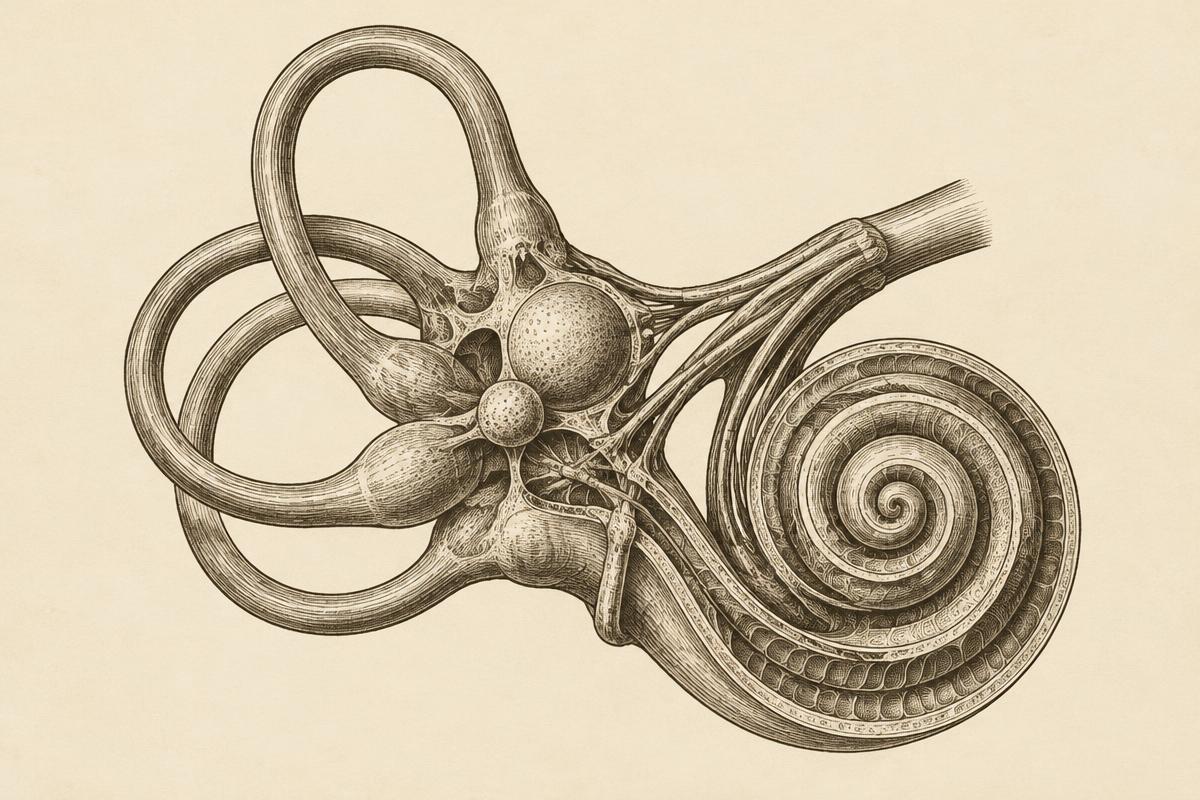
What this article covers
- What This Article Covers
- "Hearing loss" is not one disease — it covers several distinct conditions, from inherited mutations present at birth to the slow wear of aging and noise exposure, to balance disorders rooted in the inner ear's vestibular system. Each type has a different mechanism: a therapy built to regrow cochlear hair cells does nothing for a fluid-pressure balance disorder, and a gene therapy for one mutation does not generalize to age-related decline.
- Sensorineural Hearing Loss and Cochlear Hair Cell Loss
- Sensorineural hearing loss (SNHL), the broad category covering most permanent hearing loss, stems from damage to the cochlea's sensory hair cells or auditory nerve. Humans don't regenerate cochlear hair cells once lost, which is why hair-cell regeneration has been a top regenerative-medicine target for over a decade.
- Age-Related Hearing Loss (Presbycusis)
- S. adults report some hearing trouble, and for those 65 to 74 it ranks among the most common chronic conditions.
- Noise-Induced Hearing Loss
- Noise-induced hearing loss (NIHL) results from damage to cochlear hair cells from loud sound, whether a single acoustic trauma or cumulative occupational exposure. It overlaps mechanistically with other SNHL, which is why NIHL patients were included in trials like the FX-322 program.
- Hereditary Hearing Loss and Gene Therapy
- This is where the most genuinely encouraging news has emerged — worth letting that optimism breathe, because the data are real, even from a small, early-stage study. In January 2024, a US gene therapy developer announced initial results from its Phase 1/2 AK-OTOF-101 trial, a gene therapy for hearing loss caused by mutations in the OTOF (otoferlin) gene, a rare condition affecting an estimated 200,000 people worldwide.
What This Article Covers
"Hearing loss" is not one disease — it covers several distinct conditions, from inherited mutations present at birth to the slow wear of aging and noise exposure, to balance disorders rooted in the inner ear's vestibular system. Each type has a different mechanism: a therapy built to regrow cochlear hair cells does nothing for a fluid-pressure balance disorder, and a gene therapy for one mutation does not generalize to age-related decline. This article walks through the major categories and summarizes, honestly, where regenerative research stands for each — including a high-profile Phase 2 failure that reset expectations for the field.
Sensorineural Hearing Loss and Cochlear Hair Cell Loss
Sensorineural hearing loss (SNHL), the broad category covering most permanent hearing loss, stems from damage to the cochlea's sensory hair cells or auditory nerve. Humans don't regenerate cochlear hair cells once lost, which is why hair-cell regeneration has been a top regenerative-medicine target for over a decade.
The most closely watched attempt was FX-322, a small-molecule drug (not a stem cell transplant, but built on coaxing resident progenitor-like supporting cells in the cochlea to convert into new hair cells) from a US biotech company. Early Phase 1/2 data generated real excitement. But in a Phase 2a study of 95 adults reported in March 2021, four weekly injections showed no measurable hearing benefit over placebo at 90 days — word recognition scores improved in both groups, erasing any apparent drug effect. The company pointed to an unexpectedly strong placebo response and said the repeated-dosing regimen may have blunted the benefit seen with single doses earlier. It's a useful reminder that encouraging early or preclinical hair-cell data have not yet translated into a validated human therapy.
Age-Related Hearing Loss (Presbycusis)
Presbycusis, the gradual high-frequency loss that accompanies aging, is extremely common: roughly 15% of U.S. adults report some hearing trouble, and for those 65 to 74 it ranks among the most common chronic conditions. It results from hair cell loss, stria vascularis degeneration, and auditory nerve decline layered together — multiple failure points that make it a harder regenerative target than a single-gene condition. No stem cell or regenerative therapy is approved or in late-stage trials specifically for presbycusis; broader SNHL research would eventually need to address aging-related cases, but none has yet shown benefit there specifically.
Noise-Induced Hearing Loss
Noise-induced hearing loss (NIHL) results from damage to cochlear hair cells from loud sound, whether a single acoustic trauma or cumulative occupational exposure. It overlaps mechanistically with other SNHL, which is why NIHL patients were included in trials like the FX-322 program. No stem cell or regeneration therapy has shown effectiveness for NIHL in humans; standard care remains prevention and, after the fact, hearing aids or cochlear implants.
Hereditary Hearing Loss and Gene Therapy
This is where the most genuinely encouraging news has emerged — worth letting that optimism breathe, because the data are real, even from a small, early-stage study. In January 2024, a US gene therapy developer announced initial results from its Phase 1/2 AK-OTOF-101 trial, a gene therapy for hearing loss caused by mutations in the OTOF (otoferlin) gene, a rare condition affecting an estimated 200,000 people worldwide. The first participant, an 11-year-old profoundly deaf from birth, showed measurable improvement across tested frequencies within 30 days of a single intracochlear dose, with some frequencies reaching normal range. The therapy was well tolerated, and the FDA granted Orphan Drug and Rare Pediatric Disease designations. It's an important proof of concept — but a single-patient, early-phase result; OTOF mutations account for only a small slice of hereditary deafness; and it says nothing about regeneration for non-genetic hearing loss.
Ménière's Disease and Vestibular/Balance Disorders
Ménière's disease and related vestibular disorders affect the inner ear's balance organs, causing vertigo, tinnitus, and fluctuating hearing loss. Research here is markedly earlier-stage. Scientists have generated patient-derived induced pluripotent stem cell (iPSC) lines from people with Ménière's disease, differentiated into hair-cell-like and inner-ear neuron-like cells, and early inner-ear organoids are being built from patients with related genetic variants — but these are disease-modeling tools, not treatments. Field reviews note there are no FDA-approved cellular therapies for genetic or vestibular inner-ear disorders, that long-term survival of transplanted otic progenitor cells remains "a major challenge" in animal studies, and that lab-grown hair-cell-like cells still resemble vestibular rather than cochlear cells. Protocols need standardization before any path to human trials is plausible.
Cochlear Implants and Combination Approaches
Separately from biological regeneration, researchers are exploring whether stem cell or growth-factor approaches could help implant recipients by preserving residual hair cells or nerve fibers near the electrode, or reducing post-implant scarring. This work remains preclinical, meant to complement rather than replace implants, still the standard of care for severe-to-profound SNHL.
Bottom Line
Hearing and balance disorders span a wide range of biology, and "stem cells for hearing loss" means something different depending on the condition. The clearest recent movement is gene therapy for specific inherited mutations like OTOF, where early human data are genuinely promising, if preliminary. Hair-cell regeneration for broader age-related and noise-induced hearing loss delivered a sobering lesson in the FX-322 Phase 2 setback, and Ménière's disease and vestibular regeneration remain confined to lab models. No stem cell or regenerative therapy for any hearing or balance disorder is FDA-approved, and claims of an available "stem cell cure" for hearing loss warrant skepticism.
Key Questions Answered
- Did the FX-322 hair-cell drug work?
- No. In a 95-adult Phase 2a study reported in March 2021, four weekly injections showed no measurable hearing benefit over placebo at 90 days.
- Where is the most encouraging progress?
- Gene therapy for specific inherited mutations such as OTOF, where an early single-patient result showed measurable hearing improvement within 30 days.
- Is any stem cell therapy approved for hearing or balance disorders?
- No. No stem cell or regenerative therapy for any hearing or balance disorder is FDA-approved.
Sources
- Frequency Therapeutics Reports Disappointing Trial Results for Hearing Restoration Drug, Hearing Review, 2021 — https://hearingreview.com/inside-hearing/industry-news/frequency-therapeutics-reports-disappointing-trial-results-for-hearing-restoration-drug
- Akouos Announces Positive Initial Clinical Results from the Phase 1/2 AK-OTOF-101 Study, Hearing Review, 2024 — https://hearingreview.com/hearing-loss/clinical-trial-of-gene-therapy-for-genetic-hearing-loss-gets-positive-results
- By the Numbers: Hearing Loss Affects Millions, NIH MedlinePlus Magazine — https://magazine.medlineplus.gov/multimedia/by-the-numbers-hearing-loss-affects-millions
- Application of Human Stem Cells to Model Genetic Sensorineural Hearing Loss and Meniere Disease, Encyclopedia.pub (MDPI), 2023 — https://encyclopedia.pub/entry/46270
- Evidence Builds Behind Regeneron's Deafness Gene Therapy, pharmaphorum — https://pharmaphorum.com/news/evidence-builds-behind-regenerons-deafness-gene-therapy
Related Articles
- Fundamentals
What Is Angiogenesis, and Why Does It Matter for Stem Cell Therapy?
New blood vessels don't just show up — they're built, through a process called angiogenesis. Here's what it is, why the body depends on it for healing, and why so much stem cell research is focused on helping it along.
- Fundamentals
Myth: If a Treatment Is Listed on ClinicalTrials.gov, It Must Be Safe and Effective
Seeing a treatment listed on ClinicalTrials.gov can feel like a stamp of approval — but registering a trial costs nothing, requires no proof the treatment works, and isn't vetted by the government for safety or scientific quality.
- Fundamentals
What Are Organoids, and How Are They Grown From Stem Cells?
Organoids are tiny, self-organizing models grown from stem cells. They help study human biology and drug responses but are not complete transplant-ready organs.