Types of Liver Disease: Which Ones Are Being Studied With Stem Cell Therapy?
What this article covers
- What This Article Covers
- "Liver disease" is not one condition but a broad category that includes everything from a buildup of fat in liver cells to sudden organ failure to rare inherited enzyme disorders diagnosed in infancy. Stem cell and cell-based therapies are being investigated across several of these subtypes, but the amount and quality of evidence varies enormously — some categories have multiple randomized trials and meta-analyses behind them, while others have only small early-phase studies or laboratory research.
- Chronic Liver Disease: Fatty Liver Disease, Fibrosis, and Cirrhosis
- This is the largest and most heavily researched cluster. S.
- Acute and Acute-on-Chronic Liver Failure
- Acute liver failure is a medical emergency in which liver function collapses rapidly, often from drug toxicity or infection; acute-on-chronic liver failure (ACLF) is a related but distinct syndrome in which a person with existing chronic liver disease experiences sudden, severe decompensation. 60).
- Autoimmune and Cholestatic Liver Diseases
- Autoimmune hepatitis and primary biliary cholangitis (PBC, formerly called primary biliary cirrhosis) are conditions in which the immune system attacks liver cells or bile ducts. Standard treatment — immunosuppressants for autoimmune hepatitis, ursodeoxycholic acid for PBC — works well for many patients, but a subset don't respond adequately.
- Pediatric and Inherited Metabolic Liver Diseases
- Conditions like Crigler-Najjar syndrome — a rare genetic disorder in which the liver cannot properly process bilirubin — have long been of interest for cell-based approaches because the underlying defect is a single missing or malfunctioning liver enzyme, in principle correctable by introducing healthy liver cells. Research groups, including an Italian Telethon Foundation–funded project, have explored transplanting human liver stem cells or healthy hepatocytes as a potential alternative to whole-organ liver transplant for Crigler-Najjar type I.
What This Article Covers
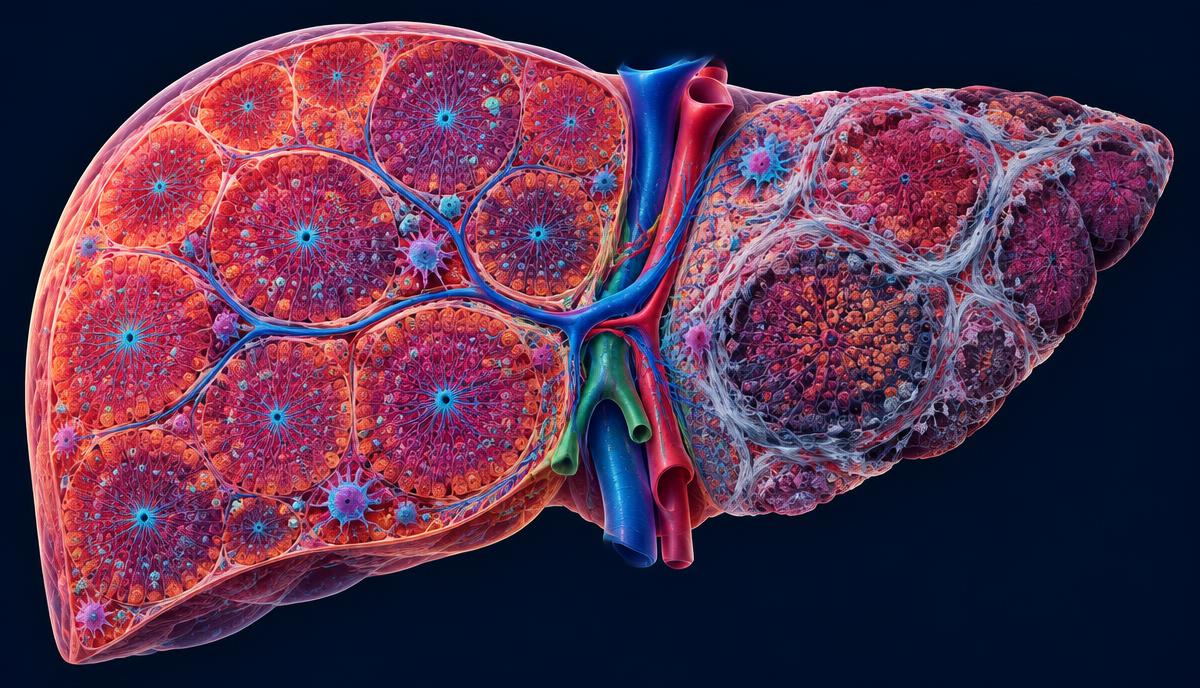
"Liver disease" is not one condition but a broad category that includes everything from a buildup of fat in liver cells to sudden organ failure to rare inherited enzyme disorders diagnosed in infancy. Stem cell and cell-based therapies are being investigated across several of these subtypes, but the amount and quality of evidence varies enormously — some categories have multiple randomized trials and meta-analyses behind them, while others have only small early-phase studies or laboratory research. This article maps the major types of liver disease and summarizes, honestly, where stem cell and cell-therapy research actually stands for each — including the categories, like hepatocellular carcinoma, where cell therapy means something quite different (engineered immune cells, not regenerative stem cells).
Chronic Liver Disease: Fatty Liver Disease, Fibrosis, and Cirrhosis
This is the largest and most heavily researched cluster. Nonalcoholic fatty liver disease (NAFLD, increasingly called MASLD) affects an estimated 24% of U.S. adults, according to the National Institute of Diabetes and Digestive and Kidney Diseases (NIDDK), though only a minority — roughly 1.5% to 6.5% — progress to the more damaging inflammatory form, NASH/MASH. Left unchecked, chronic liver injury from NASH, chronic viral hepatitis, or heavy alcohol use can progress to fibrosis (scarring) and eventually cirrhosis. Mesenchymal stem cell (MSC) therapy has been studied specifically for cirrhosis and fibrosis in multiple clinical trials, and RegenMed Review covers that research in dedicated articles on liver cirrhosis, liver fibrosis, and fatty liver disease. In short: this is the subtype with the most clinical-trial activity, but still no approved stem cell treatment — findings remain early-stage and mixed.
Acute and Acute-on-Chronic Liver Failure
Acute liver failure is a medical emergency in which liver function collapses rapidly, often from drug toxicity or infection; acute-on-chronic liver failure (ACLF) is a related but distinct syndrome in which a person with existing chronic liver disease experiences sudden, severe decompensation. Several clinical trials registered on ClinicalTrials.gov are testing umbilical cord– or bone marrow–derived MSCs in ACLF, and a 2022 systematic review and meta-analysis of 12 randomized controlled trials (846 patients) found that MSC infusion improved liver function markers such as MELD score and albumin, with a modest pooled survival benefit (odds ratio 1.29, 95% CI 1.03–1.60). However, the same analysis found no significant benefit on liver enzyme levels or short-term survival, reported substantial variation between studies, and the only consistently documented adverse event was fever. The authors were explicit that questions about optimal cell source, dose, and delivery route remain unresolved before any routine clinical use.
Autoimmune and Cholestatic Liver Diseases
Autoimmune hepatitis and primary biliary cholangitis (PBC, formerly called primary biliary cirrhosis) are conditions in which the immune system attacks liver cells or bile ducts. Standard treatment — immunosuppressants for autoimmune hepatitis, ursodeoxycholic acid for PBC — works well for many patients, but a subset don't respond adequately. For this "treatment-refractory" group, a handful of early-phase trials have tested allogeneic or umbilical cord–derived MSCs, including studies registered specifically for UDCA-refractory PBC. Published results from this line of research are limited to small, mostly open-label studies; they are not large enough or rigorously controlled enough to establish efficacy, and this remains a niche, early-stage research area rather than an established option.
Pediatric and Inherited Metabolic Liver Diseases
Conditions like Crigler-Najjar syndrome — a rare genetic disorder in which the liver cannot properly process bilirubin — have long been of interest for cell-based approaches because the underlying defect is a single missing or malfunctioning liver enzyme, in principle correctable by introducing healthy liver cells. Research groups, including an Italian Telethon Foundation–funded project, have explored transplanting human liver stem cells or healthy hepatocytes as a potential alternative to whole-organ liver transplant for Crigler-Najjar type I. This work remains largely preclinical and early clinical research; it is not an available treatment, and families affected by these ultra-rare conditions should treat any claim of a ready stem cell cure with skepticism.
Hepatocellular Carcinoma: A Different Kind of "Cell Therapy"
Hepatocellular carcinoma (HCC), the most common form of primary liver cancer, is sometimes mentioned alongside "stem cell therapy," but the active cell-therapy research here is different in kind: it involves CAR-T and other engineered immune cell therapies designed to recognize and attack tumor cells — not regenerative stem cells meant to repair liver tissue. Several early-phase trials are testing CAR-T cells targeting the tumor antigen GPC3 in advanced HCC. These are investigational immunotherapy approaches in early human testing, conceptually distinct from the MSC-based research used for cirrhosis, fibrosis, or liver failure, and they should not be confused with regenerative "stem cell therapy" marketing.
Bottom Line
Stem cell and cell-based research spans nearly the full range of liver disease — from fatty liver and cirrhosis to acute failure, autoimmune conditions, rare pediatric metabolic disorders, and even liver cancer — but the depth of evidence differs sharply by subtype. Chronic liver disease and acute-on-chronic liver failure have the most clinical trial activity and the only existing meta-analyses, which show modest, inconsistent benefits alongside a generally favorable short-term safety profile. Autoimmune/cholestatic disease and inherited pediatric disorders remain in early, small-scale research. No stem cell therapy is FDA-approved for any form of liver disease, and the FDA has repeatedly warned consumers about clinics marketing unapproved, unproven stem cell treatments. Anyone considering participation in this research should look for registered clinical trials with appropriate oversight rather than direct-to-consumer treatment offers.
Sources
- Definition & Facts of NAFLD & NASH, National Institute of Diabetes and Digestive and Kidney Diseases (NIDDK), 2021, https://www.niddk.nih.gov/health-information/liver-disease/nafld-nash/definition-facts
- The assessment of mesenchymal stem cells therapy in acute on chronic liver failure and chronic liver disease: a systematic review and meta-analysis of randomized controlled clinical trials, PMC, 2022, https://pmc.ncbi.nlm.nih.gov/articles/PMC9109309/
- Human Umbilical Cord Mesenchymal Stem Cell Transplantation for The Treatment of Acute-on-Chronic Liver Failure, ClinicalTrials.gov (NCT05985863), 2023, https://clinicaltrials.gov/study/NCT05985863
- Mesenchymal Stem Cells as New Therapeutic Agents for the Treatment of Primary Biliary Cholangitis, PMC, 2017, https://www.ncbi.nlm.nih.gov/pmc/articles/PMC5749170/
- Phase I/II Trial of Human Umbilical Cord Mesenchymal Stromal Cells for UDCA-Refractory Primary Biliary Cholangitis, ClinicalTrials.gov (NCT07795151), 2025, https://clinicaltrials.gov/study/NCT07795151
- Cell Therapy for Crigler-Najjar Type I Syndrome Using Human Adult Liver Stem Cells, Fondazione Telethon, https://www.fondazionetelethon.it/en/what-we-do/research/projects-funded/cell-therapy-for-crigler-najjar-type-i-syndrome-using-human-adult-liver-stem-cells/
- Novel GPC3 CAR-T Cell Therapy for Hepatocellular Carcinoma, ClinicalTrials.gov (NCT05344664), 2022, https://clinicaltrials.gov/study/NCT05344664
- FDA Warns About Stem Cell Therapies, U.S. Food and Drug Administration / reported by NPR, 2017, https://www.npr.org/sections/health-shots/2017/08/28/546719842/fda-cracks-down-on-stem-cell-clinics-selling-unapproved-treatments
Related Articles
- Fundamentals
What Are Organoids? How Scientists Grow Miniature Organs From Stem Cells
How stem cells form organoids, what these miniature tissue models reveal about disease and drugs, and why they are research tools rather than treatments.
- Fundamentals
Myth: Stem Cell Therapy Works Immediately — and the Results Last Forever
Stem cell treatment rarely acts instantly, and long-term durability is often unknown. Compare common marketing claims with trial follow-up and biology.
- Fundamentals
Protecting Bone Health As You Age: What the Evidence Actually Shows
Protecting bone health with resistance training, calcium, vitamin D and fall prevention; where experimental stem cell research fits.