What Are Hematopoietic Stem Cells? The Cells That Make All of Your Blood
What this article covers
- What This Article Covers
- Every red blood cell, white blood cell, and platelet in your body traces back to a single remarkable cell hidden inside your bones: the hematopoietic stem cell (HSC). This article explains what HSCs are, where they live, how they keep your blood supply running for a lifetime, and why they're the biological basis for bone marrow and stem cell transplants used to treat leukemia, lymphoma, sickle cell disease, and other blood disorders — and draws a clear line between HSCs and mesenchymal stem cells (MSCs), a different cell type this site covers extensively, so newcomers don't confuse the two.
- What Is a Hematopoietic Stem Cell?
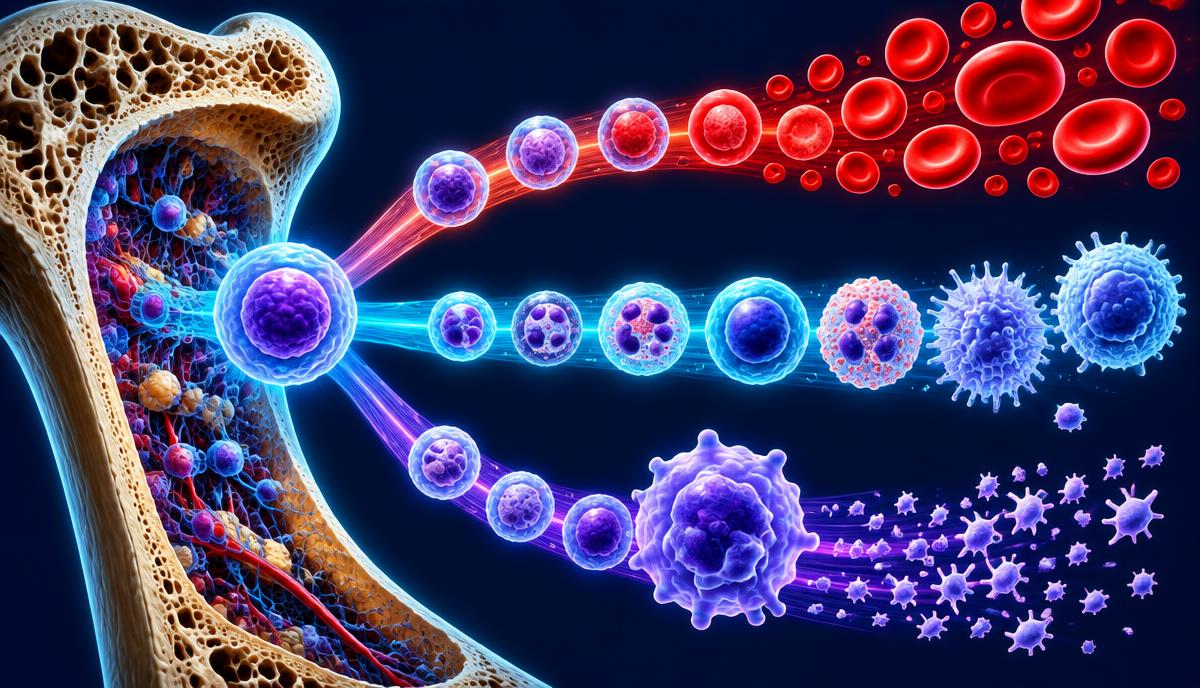
- " A hematopoietic stem cell is an immature cell, found mainly in bone marrow, that can grow into any mature blood cell type: red blood cells, which carry oxygen; white blood cells, which fight infection; and platelets, which help blood clot, according to patient education materials from the American Society of Hematology (ASH). HSCs aren't blood cells in the functional sense — they don't carry oxygen or fight infection themselves.
- Where Hematopoietic Stem Cells Are Found
- HSCs live mainly inside bone marrow — the soft, spongy tissue inside bones such as the pelvis, sternum, and femur, often called the body's "blood factory" since most blood cell production (hematopoiesis) happens there, per Dana-Farber Cancer Institute. Small numbers of HSCs also circulate normally in the bloodstream, and doctors can dramatically increase that number through mobilization: a medication (commonly filgrastim, a lab-made version of a natural growth factor called G-CSF) given for several days.
- Self-Renewal and Differentiation: The Two Talents That Define a Stem Cell
- What makes an HSC a stem cell — rather than just another blood cell — comes down to two abilities: self-renewal and differentiation. Self-renewal means that when an HSC divides, at least one daughter cell remains an HSC, identical to the parent, ready to divide again later — keeping the stem cell pool from running out over a lifetime.
- Why HSCs Are the Basis of Bone Marrow and Stem Cell Transplants
- Because HSCs are the ultimate source of all blood and immune cells, transplanting healthy HSCs into someone whose blood-forming system has failed can rebuild that system from the ground up. That's the principle behind hematopoietic stem cell transplantation (HSCT), better known as a bone marrow or stem cell transplant.
What This Article Covers
Every red blood cell, white blood cell, and platelet in your body traces back to a single remarkable cell hidden inside your bones: the hematopoietic stem cell (HSC). This article explains what HSCs are, where they live, how they keep your blood supply running for a lifetime, and why they're the biological basis for bone marrow and stem cell transplants used to treat leukemia, lymphoma, sickle cell disease, and other blood disorders — and draws a clear line between HSCs and mesenchymal stem cells (MSCs), a different cell type this site covers extensively, so newcomers don't confuse the two.
What Is a Hematopoietic Stem Cell?
"Hematopoietic" simply means "blood-forming." A hematopoietic stem cell is an immature cell, found mainly in bone marrow, that can grow into any mature blood cell type: red blood cells, which carry oxygen; white blood cells, which fight infection; and platelets, which help blood clot, according to patient education materials from the American Society of Hematology (ASH). HSCs aren't blood cells in the functional sense — they don't carry oxygen or fight infection themselves. Think of them as raw material and factory foreman combined: a small, self-sustaining population whose entire job is producing every other blood and immune cell your body needs, for life.
Where Hematopoietic Stem Cells Are Found
HSCs live mainly inside bone marrow — the soft, spongy tissue inside bones such as the pelvis, sternum, and femur, often called the body's "blood factory" since most blood cell production (hematopoiesis) happens there, per Dana-Farber Cancer Institute. Small numbers of HSCs also circulate normally in the bloodstream, and doctors can dramatically increase that number through mobilization: a medication (commonly filgrastim, a lab-made version of a natural growth factor called G-CSF) given for several days. Per the NMDP, filgrastim "increases stem cell production, moving them into the bloodstream for easy collection," where cells are gathered by apheresis — blood drawn from one arm, filtered through a machine, and returned through the other. That's why "peripheral blood stem cells" comes up so often in transplant medicine; "peripheral blood" just means blood outside the marrow. A third source is umbilical cord blood, left in the cord and placenta after birth, naturally rich in HSCs and collectible painlessly, without risk to mother or infant, then frozen for later use, per cord blood banking research published through the NCBI Bookshelf's StemBook resource. Cord blood, bone marrow, and mobilized peripheral blood are the three main sources used in stem cell transplantation today, per the National Cancer Institute (NCI) and Mayo Clinic.
Self-Renewal and Differentiation: The Two Talents That Define a Stem Cell
What makes an HSC a stem cell — rather than just another blood cell — comes down to two abilities: self-renewal and differentiation. Self-renewal means that when an HSC divides, at least one daughter cell remains an HSC, identical to the parent, ready to divide again later — keeping the stem cell pool from running out over a lifetime. Differentiation is the complementary process: an HSC, or a descendant that inherits its potential, gradually commits to becoming a specific mature blood cell — a red cell, a white cell, or a platelet-producing cell — through step-by-step maturation. Researchers describe this balance as one of the defining, most intensely studied features of hematopoietic stem cell biology. Because a single HSC can give rise to every cell type in blood, scientists call it "multipotent," distinct from "pluripotent" stem cells, which can in principle form virtually any cell type in the body. The daily output is staggering: bone marrow generates roughly 500 billion new blood cells every day, per Dana-Farber Cancer Institute — a pace that must be sustained continuously, since mature blood cells have limited lifespans and need constant replacing.
Why HSCs Are the Basis of Bone Marrow and Stem Cell Transplants
Because HSCs are the ultimate source of all blood and immune cells, transplanting healthy HSCs into someone whose blood-forming system has failed can rebuild that system from the ground up. That's the principle behind hematopoietic stem cell transplantation (HSCT), better known as a bone marrow or stem cell transplant. Per the NCI, these transplants most often treat blood cancers such as leukemia, lymphoma, and multiple myeloma, and are also used for disorders including aplastic anemia, sickle cell disease, certain autoimmune diseases, and some solid tumors like neuroblastoma — a list Mayo Clinic corroborates, adding specific leukemia and lymphoma subtypes and certain immune deficiencies. The logic differs by disease. In blood cancers, high-dose chemotherapy or radiation destroys cancer cells but also destroys healthy marrow, so a transplant of healthy HSCs (the patient's own, collected beforehand — called autologous — or a donor's, called allogeneic) rebuilds the blood-forming system afterward, per Mayo Clinic and the NCI. In sickle cell disease, a person's own HSCs continuously produce red blood cells carrying a genetic defect that makes them sickle-shaped, so replacing those HSCs with healthy donor HSCs can be curative, according to ASH and the NMDP — effectively giving the patient a new blood-forming system. Either way, transplanted HSCs are typically infused intravenously, then travel on their own to the bone marrow and begin producing new blood cells, as the NMDP's sickle cell transplant materials describe.
Don't Confuse HSCs With Mesenchymal Stem Cells (MSCs)
If you've read other articles on this site, you've likely encountered mesenchymal stem cells (MSCs) — a very different cell type, discussed constantly in regenerative medicine, easy to mix up with HSCs since both are found in bone marrow. The key distinction: HSCs are blood-forming, generating blood cell types through hematopoiesis. MSCs are not blood-forming — research comparing the two describes MSCs as capable of differentiating into fat cells (adipocytes), cartilage cells (chondroblasts), and bone-forming cells (osteoblasts), and studied clinically mainly for tissue repair, calming an overactive immune response, and conditions like graft-versus-host disease, largely through immune-modulating effects rather than direct cell replacement. HSCs, by contrast, treat blood disorders by literally repopulating the blood and immune system. The two are even identified by different molecular markers in the lab — HSCs typically express CD34, while MSCs are typically CD34-negative and identified by markers like CD73, CD90, and CD105 — underscoring how biologically distinct these categories are, despite sharing a neighborhood inside the marrow. When you read about MSC-based therapies elsewhere on RegenMed Review, you're reading about a fundamentally different cell doing a fundamentally different job.
Bottom Line
Hematopoietic stem cells are the quiet, continuously working source of every red blood cell, white blood cell, and platelet in your body — a self-renewing population in your bone marrow (and, in smaller numbers, your circulating blood and, at birth, your umbilical cord blood) that balances self-renewal with differentiation to keep your blood and immune system supplied for life. That same biology is why transplanting healthy HSCs can rebuild a patient's blood-forming system after cancer treatment or replace a genetically faulty one in diseases like sickle cell disease, making HSCs one of the most clinically proven stem cell types in medicine. Just remember: HSCs are not mesenchymal stem cells, a separate, non-blood-forming cell type covered extensively elsewhere on this site — keeping the two straight is a first step toward understanding the stem cell field as a whole.
Sources
- Understanding Bone and Blood Marrow Transplants (Patient Education) — American Society of Hematology (ASH) — https://www.hematology.org/-/media/hematology/files/education/patients/understanding-bone-and-blood-marrow-transplants_patient_ed.pdf
- Stem Cell Transplants for Cancer — National Cancer Institute (NCI) — https://www.cancer.gov/about-cancer/treatment/types/stem-cell-transplant
- Bone Marrow Transplant — Mayo Clinic — https://www.mayoclinic.org/tests-procedures/bone-marrow-transplant/about/pac-20384854
- American Society of Hematology 2021 Guidelines for Sickle Cell Disease: Stem Cell Transplantation — Blood Advances, ASH, 2021 — https://ashpublications.org/bloodadvances/article/5/18/3668/476988/American-Society-of-Hematology-2021-guidelines-for
- Sickle Cell Disease (SCD) Treatment by Transplant — NMDP (National Marrow Donor Program) — https://www.nmdp.org/patients/understanding-transplant/diseases-treated-by-transplant/sickle-cell-disease-treatment-by-transplant
- Cord Blood Hematopoietic Stem Cell Transplantation — StemBook, NCBI Bookshelf — https://www.ncbi.nlm.nih.gov/books/NBK44751/
- What Is Bone Marrow and Why Is It Important? — Dana-Farber Cancer Institute, 2023 — https://blog.dana-farber.org/insight/2023/04/what-is-bone-marrow-and-why-is-it-important/
- Hematopoietic Stem Cell and Mesenchymal Stem Cell Comparison — PMC, National Institutes of Health — https://pmc.ncbi.nlm.nih.gov/articles/PMC6269357/
Related Articles
- Fundamentals
Does Using Your Own Stem Cells Make the Treatment Automatically Safe?
Your own stem cells avoid donor rejection, but not surgical, processing or injection risks. Published harm reports and FDA guidance explain why.
- Fundamentals
Types of Cartilage Damage: What Regenerative Options Exist for Each?
Focal cartilage defects, osteochondritis dissecans, osteoarthritis and meniscus tears need different evidence. Where MACI is approved and where MSCs remain experimental.
- Fundamentals
Can Exercise Boost Your Body's Own Stem Cell Activity? What the Evidence Actually Shows
Exercise activates muscle satellite cells and temporarily mobilizes blood progenitors. What human and animal studies show—and what they cannot yet prove about regeneration.