What Is Apheresis, and Why Is It the First Step in CAR-T Cell Therapy?
What this article covers
- What This Article Covers
- Before a single CAR-T cell can be engineered, a patient's own T cells have to be physically removed from their bloodstream — a procedure called leukapheresis, often just called apheresis. It is the unglamorous, low-tech first step underneath every high-tech CAR-T therapy, and it matters more than its plumbing-and-tubing appearance suggests: the quality and quantity of cells collected here largely determines whether a manufacturer can build a working product at all.
- What Apheresis Is and How the Procedure Works
- Leukapheresis is a blood-filtering procedure, not a surgery. A patient is connected to a cell-separator machine through two IV lines — one arm, or occasionally a temporary central venous catheter placed in the chest if arm veins can't sustain adequate flow.
- Why This Is the Critical First Step for CAR-T Specifically
- CAR-T therapy works by genetically re-engineering a patient's own T cells to express a chimeric antigen receptor (CAR) that recognizes a specific marker on cancer cells — commonly CD19 in certain B-cell leukemias and lymphomas. That engineering can only happen to T cells that have already been collected outside the body.
- Real Risks and Side Effects of the Procedure
- Apheresis is generally considered low-risk and manageable, but it is not without side effects. The most common issue is a drop in blood calcium (hypocalcemia) caused by the citrate anticoagulant used during processing; this can cause tingling or numbness around the mouth or fingertips, and sometimes muscle cramping, which is treated with calcium replacement during the procedure.
- Not Every Patient Collects Enough — A Clinically Important Caveat
- A less-discussed but clinically significant reality is that apheresis does not always yield enough good-quality T cells to manufacture a product. Patients who have already been through multiple rounds of chemotherapy — a very common situation for those eligible for CAR-T, since it is typically offered after other treatments have failed — often have lymphopenia, meaning abnormally low circulating lymphocyte counts, along with T cells that are more exhausted and less able to expand and function once engineered.
What This Article Covers
Before a single CAR-T cell can be engineered, a patient's own T cells have to be physically removed from their bloodstream — a procedure called leukapheresis, often just called apheresis. It is the unglamorous, low-tech first step underneath every high-tech CAR-T therapy, and it matters more than its plumbing-and-tubing appearance suggests: the quality and quantity of cells collected here largely determines whether a manufacturer can build a working product at all. This article explains what apheresis involves, why it is non-negotiable for CAR-T specifically, what risks patients should expect, and the real — and clinically important — possibility that some patients, particularly those who are heavily pretreated, don't collect enough usable T cells on the first try.
What Apheresis Is and How the Procedure Works
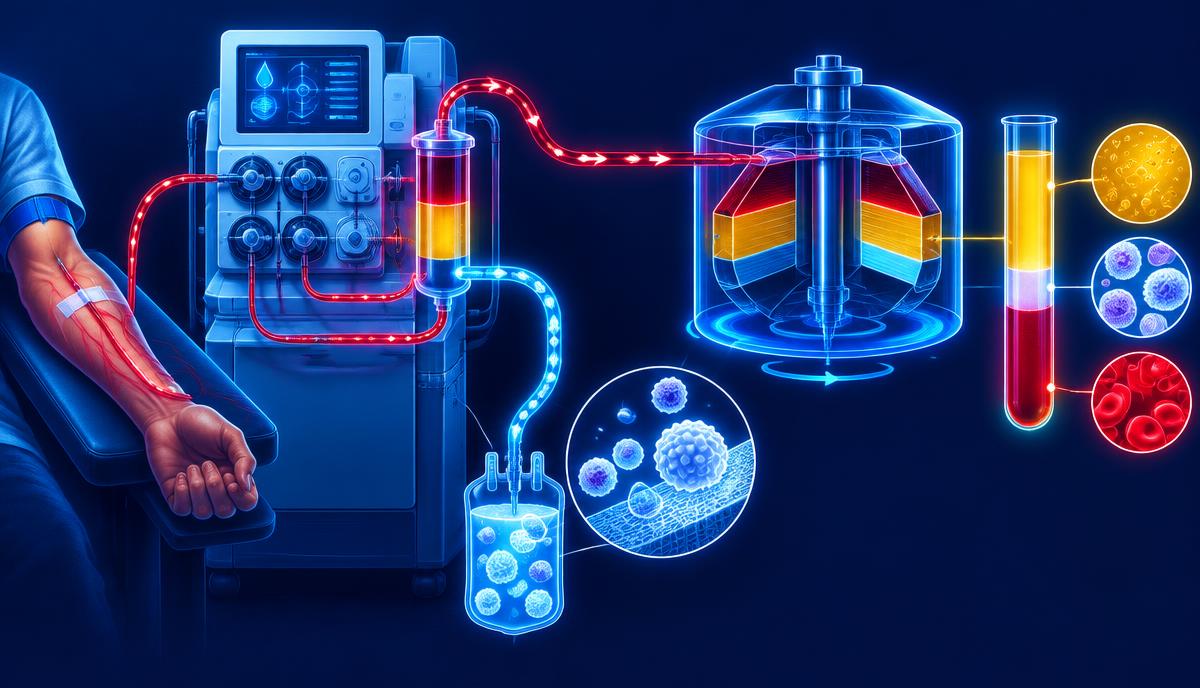
Leukapheresis is a blood-filtering procedure, not a surgery. A patient is connected to a cell-separator machine through two IV lines — one arm, or occasionally a temporary central venous catheter placed in the chest if arm veins can't sustain adequate flow. Blood is drawn out through one line and run through the machine, which spins it in a centrifuge to separate it by density into layers: red blood cells, plasma, platelets, and the white blood cell layer that contains lymphocytes, including the T cells the process is after. The machine skims off that white blood cell layer — along with an anticoagulant, usually citrate-based, to keep the blood from clotting in the tubing — while the red blood cells, plasma, and most platelets are continuously returned to the patient through the second line. According to Memorial Sloan Kettering Cancer Center's patient education materials, the collection itself typically takes about three to five hours and is done on an outpatient basis at a dedicated apheresis unit; the American Cancer Society similarly describes the process as usually taking several hours, and notes that it sometimes needs to be repeated over more than one day if the first collection doesn't yield enough cells.
Why This Is the Critical First Step for CAR-T Specifically
CAR-T therapy works by genetically re-engineering a patient's own T cells to express a chimeric antigen receptor (CAR) that recognizes a specific marker on cancer cells — commonly CD19 in certain B-cell leukemias and lymphomas. That engineering can only happen to T cells that have already been collected outside the body. Once apheresis is complete, the collected white blood cells are frozen or refrigerated and shipped to a manufacturing facility, where technicians isolate the T cells, introduce the CAR gene using a modified virus or other gene-delivery method, and expand the engineered cells to the billions needed for an infusion — a process the National Cancer Institute describes as taking several weeks per patient, since only a limited number of facilities are equipped to do it. Only after that manufacturing is complete does the patient receive lymphodepleting chemotherapy to make room for the new cells, followed by the CAR-T infusion itself. Every one of those downstream steps depends entirely on having collected an adequate starting number of viable T cells at apheresis — there is no substitute step if collection comes up short.
Real Risks and Side Effects of the Procedure
Apheresis is generally considered low-risk and manageable, but it is not without side effects. The most common issue is a drop in blood calcium (hypocalcemia) caused by the citrate anticoagulant used during processing; this can cause tingling or numbness around the mouth or fingertips, and sometimes muscle cramping, which is treated with calcium replacement during the procedure. Other reported adverse events include fatigue, lightheadedness or fainting, low blood pressure, nausea, and vomiting. When a central venous catheter is needed, there is added risk associated with the line itself, including infection, bleeding, or clotting at the insertion site. A review of leukapheresis practices published in Cytotherapy summarizes that these adverse events are generally manageable and do not typically prevent patients from proceeding with CAR-T therapy, though they require monitoring by trained apheresis staff throughout the collection.
Not Every Patient Collects Enough — A Clinically Important Caveat
A less-discussed but clinically significant reality is that apheresis does not always yield enough good-quality T cells to manufacture a product. Patients who have already been through multiple rounds of chemotherapy — a very common situation for those eligible for CAR-T, since it is typically offered after other treatments have failed — often have lymphopenia, meaning abnormally low circulating lymphocyte counts, along with T cells that are more exhausted and less able to expand and function once engineered. A review in Frontiers in Immunology on challenges in CAR-T therapy notes that "many patients suffer from lymphopenia after previous therapy, leading to insufficient numbers of T cells" for collection. A 2025 analysis from the UK National CAR T Panel, published in Blood Cancer Journal, examined manufacturing failures in large B-cell lymphoma patients and found an overall manufacturing failure rate of about 3.9%, with prior treatment using the chemotherapy drug bendamustine within six months of apheresis standing out as the strongest identified risk factor — manufacturing failed in roughly 24% of patients with recent bendamustine exposure versus 0% of matched controls without it. Guidance published in Cytotherapy recommends specific "washout" windows before apheresis — as long as eight to twelve weeks after bendamustine, fludarabine, or other T-cell-depleting drugs — precisely because T-cell fitness and collection success decline with recent, heavy chemotherapy exposure. When collection is inadequate, options are limited: centers may attempt a second, later apheresis after a longer drug washout period, or process a larger blood volume over a longer session. For patients who genuinely cannot generate enough of their own T cells, allogeneic ("off-the-shelf") CAR-T products — manufactured in advance from healthy donor T cells — are an active area of clinical development intended to sidestep the collection bottleneck, though these remain largely investigational rather than routinely available outside clinical trials.
Bottom Line
Apheresis is a several-hour, outpatient blood-filtering procedure with real but generally manageable side effects — mainly citrate-related calcium drops and, if a central line is used, catheter-related risks. It is the mandatory starting gate for CAR-T therapy because the patient's own T cells must be physically collected before they can be genetically engineered, expanded, and eventually infused back. What makes this step more than a routine formality is that collection success is not guaranteed: heavily pretreated, lymphopenic patients can and do sometimes fail to yield enough viable T cells, which is why apheresis timing, prior chemotherapy history, and collection planning are treated as clinically consequential decisions rather than administrative ones.
Sources
- CAR T-cell Therapy and Its Side Effects — American Cancer Society, 2025 — https://www.cancer.org/cancer/treatment-types/immunotherapy/car-t-cell.html
- NCI Aims to Boost CAR T-Cell Therapy Clinical Trials — National Cancer Institute, 2020 — https://www.cancer.gov/news-events/cancer-currents-blog/2020/car-t-cell-nci-manufacturing-clinical-trials
- About Your T Cell Collection — Memorial Sloan Kettering Cancer Center, 2024 — https://www.mskcc.org/cancer-care/patient-education/about-car-t-cell-therapy
- Risk factors for CAR T-cell manufacturing failure and patient outcomes in large B-cell lymphoma: a report from the UK National CAR T Panel — Blood Cancer Journal (Nature), 2025 — https://www.nature.com/articles/s41408-025-01225-9
- Leukapheresis guidance and best practices for optimal chimeric antigen receptor T-cell manufacturing — Cytotherapy (ScienceDirect), 2023 — https://www.sciencedirect.com/science/article/pii/S1465324922006417
- Challenges and strategies associated with CAR-T cell therapy in blood malignancies — Frontiers in Immunology (PMC), 2023 — https://pmc.ncbi.nlm.nih.gov/articles/PMC10893672/
Related Articles
- Fundamentals
Autologous vs. Allogeneic CAR-T: What's the Difference?
All six FDA-approved CAR-T products are made from the patient's own cells. Off-the-shelf donor CAR-T is faster and cheaper in theory — and still investigational.
- Fundamentals
What Is a Cancer Vaccine? Preventive vs. Therapeutic Vaccines Explained
Preventive HPV and hepatitis B vaccines are proven cancer-prevention tools. Therapeutic cancer vaccines are a harder, mostly still-investigational problem.
- Fundamentals
CAR-T Therapy vs. Bone Marrow Transplant: What's the Difference?
Both give patients cells back, but a transplant rebuilds a destroyed blood system while CAR-T arms the existing immune system — different risks, different candidates, and increasingly used in sequence.