What Is COPD?
What this article covers
- What This Article Covers
- Chronic obstructive pulmonary disease (COPD) is one of the most common serious lung conditions in the world, yet it's often diagnosed late because early symptoms get mistaken for normal aging. This article covers what COPD is, its causes, symptoms, diagnosis, standard treatment, and prevalence — closing with an honest look at where stem cell research stands today, a field still experimental and unapproved.
- What Is COPD?
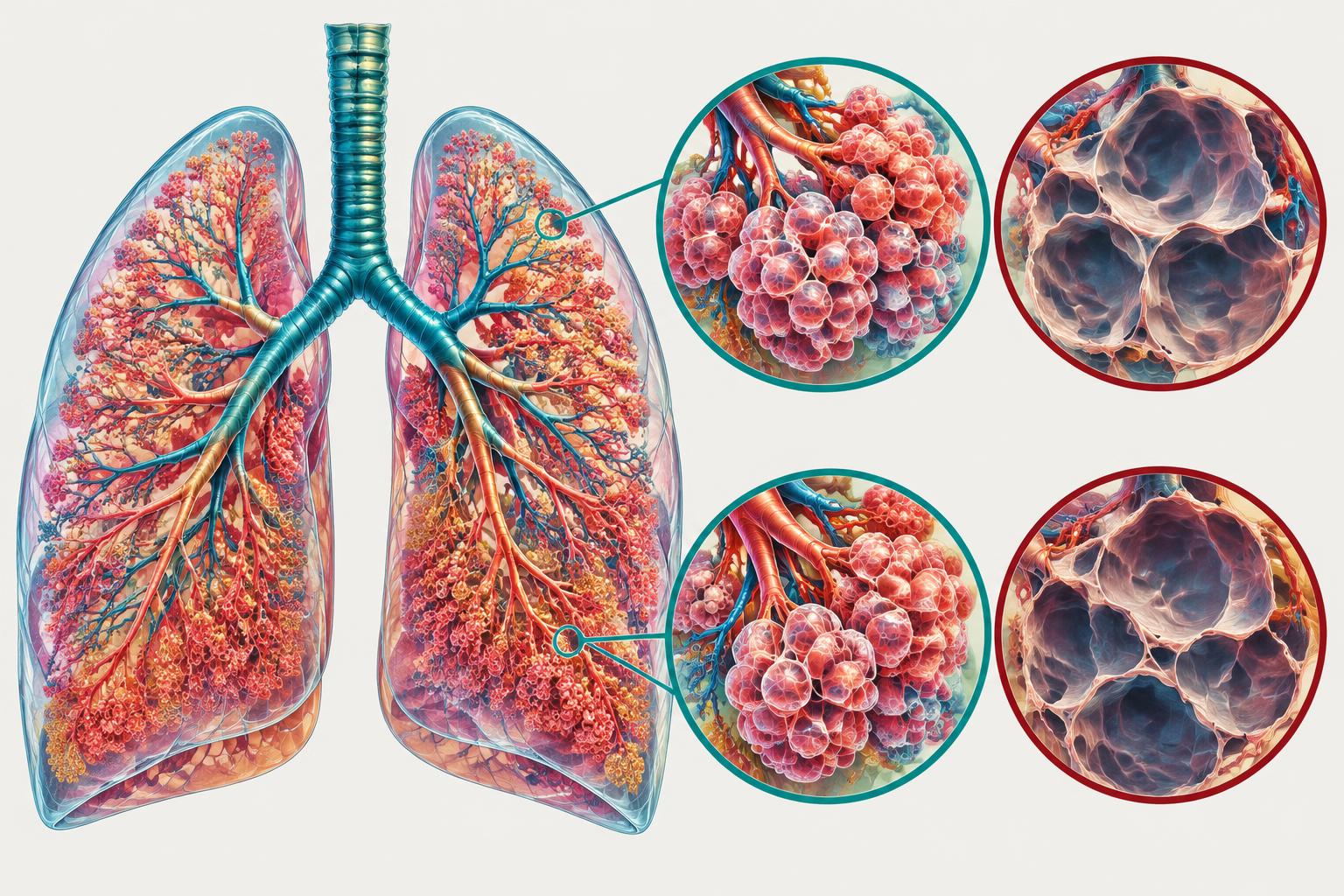
- COPD is an umbrella term for progressive lung diseases that make breathing increasingly difficult. It usually combines emphysema, in which the lungs' tiny air sacs (alveoli) are damaged and lose elasticity, and chronic bronchitis, in which the airways are chronically inflamed and produce excess mucus.
- Causes and Risk Factors
- S. and other high-income countries; most people with COPD smoke or formerly smoked.
- Symptoms
- Symptoms usually develop gradually over years and are easy to dismiss at first: worsening shortness of breath with activity, a chronic mucus-producing cough, wheezing, chest tightness, frequent respiratory infections, and fatigue. In advanced disease, basic activities like walking or self-care become difficult.
- How It's Diagnosed
- The core diagnostic test is spirometry: a person exhales forcefully into a tube connected to a machine measuring airflow. 70 confirms persistent airflow limitation consistent with COPD.
What This Article Covers
Chronic obstructive pulmonary disease (COPD) is one of the most common serious lung conditions in the world, yet it's often diagnosed late because early symptoms get mistaken for normal aging. This article covers what COPD is, its causes, symptoms, diagnosis, standard treatment, and prevalence — closing with an honest look at where stem cell research stands today, a field still experimental and unapproved.
What Is COPD?
COPD is an umbrella term for progressive lung diseases that make breathing increasingly difficult. It usually combines emphysema, in which the lungs' tiny air sacs (alveoli) are damaged and lose elasticity, and chronic bronchitis, in which the airways are chronically inflamed and produce excess mucus. Most people with COPD have features of both. Because the airway damage is largely permanent, COPD is lifelong and progressive rather than something that resolves on its own.
Causes and Risk Factors
Cigarette smoking (including secondhand smoke) is the dominant cause in the U.S. and other high-income countries; most people with COPD smoke or formerly smoked. Air pollution, including indoor smoke from burning biomass fuels, is a major cause worldwide, especially in lower-income countries. Long-term exposure to workplace dust and chemical fumes can also cause COPD in nonsmokers, as can alpha-1 antitrypsin deficiency, a genetic condition that leaves the lungs poorly protected, including in younger people. Childhood respiratory infections and underdeveloped lungs can raise later risk too.
Symptoms
Symptoms usually develop gradually over years and are easy to dismiss at first: worsening shortness of breath with activity, a chronic mucus-producing cough, wheezing, chest tightness, frequent respiratory infections, and fatigue. In advanced disease, basic activities like walking or self-care become difficult. Because decline is gradual, many people unconsciously limit activity to avoid breathlessness rather than seek a diagnosis — one reason COPD is widely underdiagnosed.
How It's Diagnosed
The core diagnostic test is spirometry: a person exhales forcefully into a tube connected to a machine measuring airflow. Clinicians check the ratio of forced expiratory volume in one second to forced vital capacity (FEV1/FVC); a postbronchodilator ratio below 0.70 confirms persistent airflow limitation consistent with COPD. The GOLD (Global Initiative for Chronic Obstructive Lung Disease) 2026 report recommends interpreting results alongside symptoms and exacerbation history, and urges proactive testing of current or former smokers and anyone with unexplained breathlessness or chronic cough, since COPD is so often missed until fairly advanced.
Standard Treatment Today
There is no cure for COPD, but established treatments ease symptoms, reduce flare-ups ("exacerbations"), and sometimes slow progression. Smoking cessation is the single most effective step. Inhaled bronchodilators (long-acting beta-agonists and muscarinic antagonists) are the foundation of maintenance therapy, often combined with an inhaled corticosteroid as "triple therapy" for frequent exacerbations, particularly with elevated blood eosinophils. Biologics such as dupilumab and mepolizumab are FDA-approved for COPD patients with type 2 (eosinophilic) airway inflammation and reduce exacerbations in that subgroup. Other core elements: pulmonary rehabilitation (supervised exercise, education, breathing techniques), supplemental oxygen for low blood oxygen, vaccination against flu, pneumococcal disease, and COVID-19, and, in select severe cases, lung volume reduction surgery or transplantation.
Epidemiology
COPD is extremely common. A 2023 CDC data brief found about 3.8% of U.S. adults have diagnosed COPD, rising sharply with age — from under 1% among 18-24-year-olds to roughly 10.5% among those 75 and older — and higher among women and lower-income households. NHLBI puts the total above 14 million U.S. adults, with many more believed undiagnosed, and notes COPD ranks among the leading causes of death and disability nationally. Globally, tobacco use and, in lower-income regions, air pollution drive its status as a top cause of death worldwide.
Where Stem Cell Research Stands
Stem cell therapy for COPD remains experimental and is not FDA-approved. Most research has used mesenchymal stem cells (MSCs) — from bone marrow, fat, or umbilical cord tissue — given intravenously for their anti-inflammatory signaling, not a proven ability to regenerate destroyed lung tissue.
The most-cited trial, a placebo-controlled study published in CHEST in 2013, randomized 62 patients with moderate-to-severe COPD to four monthly infusions of allogeneic MSCs or placebo over two years. Safety was reassuring — no infusion-related toxicities or serious adverse events — but lung function, quality of life, and exacerbation rates didn't differ significantly between groups; a drop in the inflammatory marker CRP among patients with elevated baseline levels was flagged as a signal worth exploring, not evidence of benefit. A smaller 2020 pilot study of 20 men using umbilical cord-derived MSCs likewise found no serious safety concerns over six months, with improved breathlessness scores and fewer exacerbations but no significant change in lung function or walk distance.
Together, this evidence shows a consistent safety profile for MSC infusions but inconsistent, generally modest efficacy, especially on objective measures like lung function. Regulators and researchers don't consider current data sufficient to support stem cell therapy as standard care; larger, controlled trials are needed before any cell-based therapy could be considered for routine use.
Bottom Line
COPD is a common, serious, largely preventable lung disease rooted overwhelmingly in smoking and other inhaled irritants, diagnosed through spirometry and managed with bronchodilators, inhaled steroids, biologics for select patients, pulmonary rehabilitation, and oxygen therapy. Stem cell research has produced encouraging safety data and occasional symptom-level improvements, but not yet the consistent lung-function benefit needed to support use outside a formal clinical trial. Anyone considering an unproven cell-based treatment for COPD should discuss it with a pulmonologist and view it as experimental, not a substitute for guideline-based care.
Key Questions Answered
- How is COPD diagnosed?
- Spirometry checks airflow. A postbronchodilator FEV1/FVC ratio below 0.70 confirms persistent airflow limitation consistent with COPD, interpreted alongside symptoms and exacerbation history.
- What established treatments help COPD?
- Smoking cessation, inhaled bronchodilators, selected inhaled steroids or biologics, pulmonary rehabilitation, oxygen when indicated and vaccinations form core care. There is no cure.
- Is stem cell therapy established for COPD?
- No. It remains experimental and is not FDA-approved. Trials have shown reassuring safety findings but inconsistent symptom benefits and no consistent significant lung-function improvement sufficient for routine care.
Sources
- COPD — National Heart, Lung, and Blood Institute (NHLBI), NIH — 2024 — https://www.nhlbi.nih.gov/health/copd
- Chronic Obstructive Pulmonary Disease in Adults Age 18 and Older: United States, 2023 — CDC/National Center for Health Statistics, Data Brief No. 529 — 2024 — https://www.cdc.gov/nchs/products/databriefs/db529.htm
- What Is COPD? Fact Sheet — COPD Foundation — https://www.copdfoundation.org/pdfs/What-is-COPD-Fact-Sheet.pdf
- GOLD 2026: Updates in Global Strategy for Diagnosis, Management, and Prevention of COPD — Chest Physician/MDedge, summarizing the GOLD 2026 Report — 2026 — https://www.chestphysician.org/gold-2026-updates-in-global-strategy-for-diagnosis-management-and-prevention-of-copd/
- A Placebo-Controlled, Randomized Trial of Mesenchymal Stem Cells in COPD — CHEST / PubMed (Weiss DJ et al.) — 2013 — https://pubmed.ncbi.nlm.nih.gov/23172272/
- Allogeneic Umbilical Cord-Derived Mesenchymal Stem Cell Transplantation for Treating Chronic Obstructive Pulmonary Disease: A Pilot Clinical Study — Stem Cell Research & Therapy — 2020 — https://doi.org/10.1186/s13287-020-1583-4
Related Articles
- Fundamentals
Types of Kidney Disease: Which Ones Are Being Studied With Stem Cell Therapy?
Kidney stem cell research varies sharply by disease: small human signals in diabetic disease and lupus nephritis, a negative AKI trial, and preclinical PKD work.
- Fundamentals
Protecting Vision Health As You Age: What the Evidence Actually Shows
What AREDS2, diet research and eye-health guidance show about lowering vision-loss risk through smoking cessation, metabolic control, UV protection and exams.
- Fundamentals
What Is Umbilical Cord Blood Banking? What Newborn Stem Cells Can (and Can't) Actually Treat
Cord blood banking explained: established transplant uses, public versus private storage, and the low odds of a healthy child using their own banked cells.