What Is CRISPR Gene Editing, and How Does It Intersect With Stem Cell Therapy?
What this article covers
- What This Article Covers
- CRISPR is a tool for making precise, targeted edits to DNA, and stem cells are often the cells scientists choose to edit with it. This article explains what CRISPR gene editing is and how it works at a basic level, then focuses on where it actually meets stem cell science: the one FDA-approved therapy combining the two (a CRISPR-edited blood stem cell treatment for sickle cell disease and beta-thalassemia), how CRISPR is used to correct mutations in induced pluripotent stem cells (iPSCs) for research, and early work exploring editing stem cells directly inside the body.
- What CRISPR Actually Is
- CRISPR, short for "Clustered Regularly Interspaced Short Palindromic Repeats," began as part of how certain bacteria defend against viruses. Scientists adapted it into a laboratory tool for editing DNA in essentially any living cell.
- Why Stem Cells Are a Natural Match
- Many genetic diseases trace back to a single faulty gene, and stem cells regenerate tissue for a lifetime. Correct the gene in a stem cell rather than a short-lived mature cell, and the fix can, in principle, carry forward through every new cell that stem cell produces.
- The Real, Approved Example: Casgevy
- The clearest intersection of CRISPR and stem cell therapy approved for patients is Casgevy (exagamglogene autotemcel), from Vertex Pharmaceuticals and CRISPR Therapeutics. S.
- Where Research Stands: iPSCs and Disease Modeling
- Beyond blood disorders, much CRISPR-stem cell research today isn't treating patients directly — it's using edited stem cells to understand disease. A common approach: take iPSCs from a patient with a genetic disease, use CRISPR to correct the mutation in a lab dish, then compare corrected and uncorrected cells side by side.
What This Article Covers
CRISPR is a tool for making precise, targeted edits to DNA, and stem cells are often the cells scientists choose to edit with it. This article explains what CRISPR gene editing is and how it works at a basic level, then focuses on where it actually meets stem cell science: the one FDA-approved therapy combining the two (a CRISPR-edited blood stem cell treatment for sickle cell disease and beta-thalassemia), how CRISPR is used to correct mutations in induced pluripotent stem cells (iPSCs) for research, and early work exploring editing stem cells directly inside the body. One approved therapy exists today; most other CRISPR-stem cell combinations remain experimental, with real safety questions still being studied.
What CRISPR Actually Is
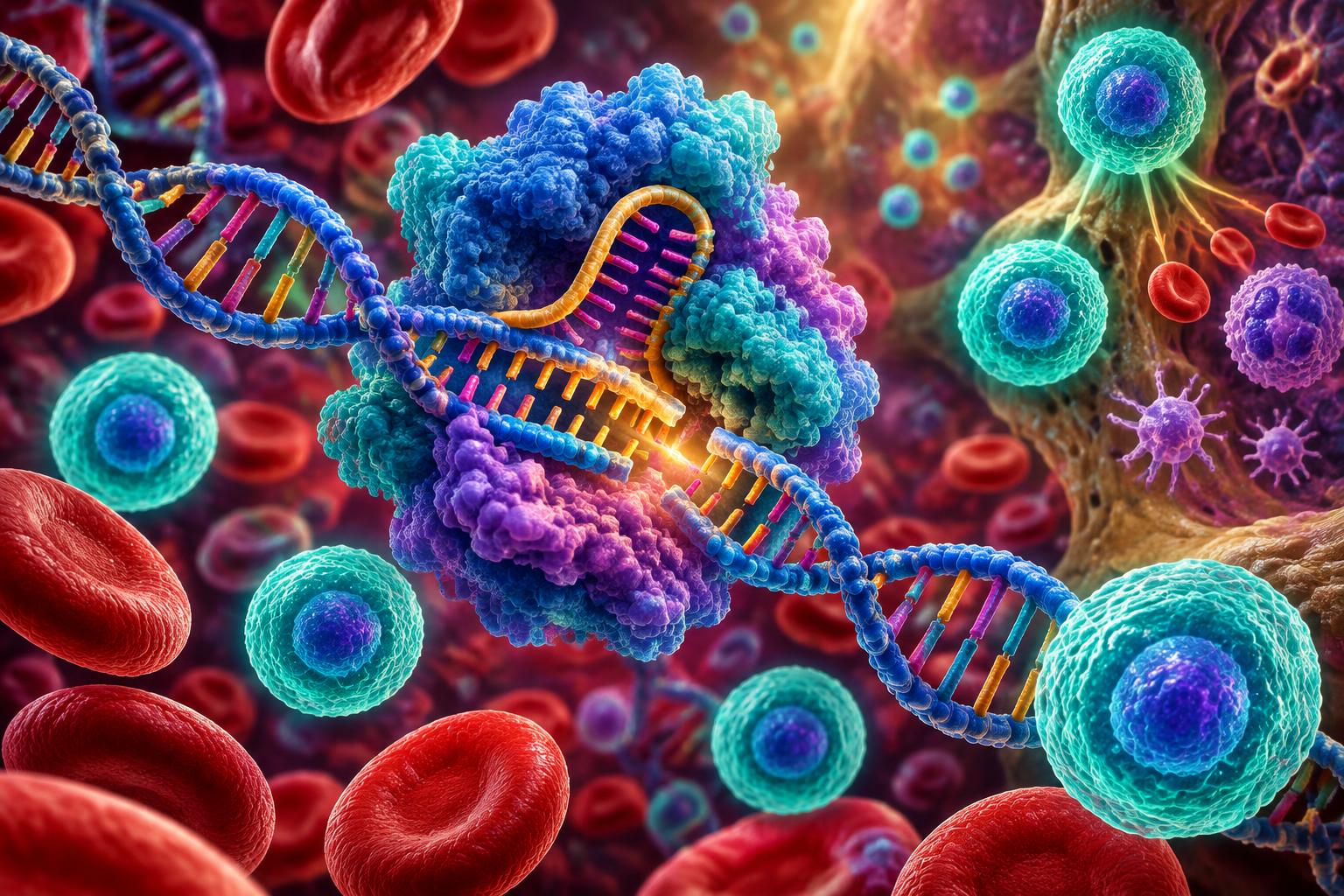
CRISPR, short for "Clustered Regularly Interspaced Short Palindromic Repeats," began as part of how certain bacteria defend against viruses. Scientists adapted it into a laboratory tool for editing DNA in essentially any living cell. The most common version, CRISPR-Cas9, has two core parts: a "guide RNA" custom-built to match a specific DNA sequence, and the Cas9 enzyme, which acts like molecular scissors. The guide RNA locates the matching spot in the genome, and Cas9 cuts the DNA there, according to the National Human Genome Research Institute (NHGRI). From that cut, the cell's repair process can disable a gene, or researchers can supply new DNA so the repair stitches in a correction instead. Because a guide RNA is cheap and fast to design for a new target, CRISPR made targeted editing far more accessible than older tools — a big reason it moved from a niche technique to the basis of an approved therapy in roughly a decade.
Why Stem Cells Are a Natural Match
Many genetic diseases trace back to a single faulty gene, and stem cells regenerate tissue for a lifetime. Correct the gene in a stem cell rather than a short-lived mature cell, and the fix can, in principle, carry forward through every new cell that stem cell produces. Hematopoietic (blood-forming) stem cells are especially attractive targets: they're relatively easy to collect from blood or bone marrow, can be edited outside the body, and are already routinely transplanted in medicine. It also helps to separate terms here: gene therapy broadly covers treatments that add, remove, or alter genetic material, including older methods that deliver a healthy gene via a virus. CRISPR gene editing is a more specific tool within that category — rather than adding a gene, it typically cuts, disables, or rewrites one directly, which is the approach behind the one approved CRISPR-stem cell therapy described below.
The Real, Approved Example: Casgevy
The clearest intersection of CRISPR and stem cell therapy approved for patients is Casgevy (exagamglogene autotemcel), from Vertex Pharmaceuticals and CRISPR Therapeutics. The FDA first approved it on December 8, 2023 for sickle cell disease in patients 12 and older with recurrent vaso-occlusive crises — the first CRISPR-based therapy for a genetic disease approved in the U.S. — and extended approval to transfusion-dependent beta-thalassemia on January 16, 2024. In mid-2026, the FDA expanded the approval further, to patients as young as 2 years old for both conditions, based on pediatric trial data in which the large majority of evaluable children met the trials' primary endpoints: freedom from severe pain crises, or freedom from transfusions, sustained for a year or more.
The process: doctors collect a patient's own blood stem cells, then use CRISPR-Cas9 in the lab to switch off part of the BCL11A gene, which normally suppresses fetal hemoglobin after infancy. Dialing it down lets edited cells produce more fetal hemoglobin once returned to the body, preventing the sickling behind sickle cell disease and raising hemoglobin enough to end transfusion dependence in beta-thalassemia. Before infusion, patients undergo high-intensity myeloablative chemotherapy to clear existing marrow so edited cells can engraft — a demanding step with real side effects, including mucositis and febrile neutropenia, and labeled warnings for engraftment failure, delayed platelet recovery, and off-target genome editing. It's given once, as a single infusion. Casgevy is a genuine, working example of gene-edited stem cells treating real patients with strong early results — and also an intensive therapy for two specific blood diseases, not a template yet extended to most other conditions.
Where Research Stands: iPSCs and Disease Modeling
Beyond blood disorders, much CRISPR-stem cell research today isn't treating patients directly — it's using edited stem cells to understand disease. A common approach: take iPSCs from a patient with a genetic disease, use CRISPR to correct the mutation in a lab dish, then compare corrected and uncorrected cells side by side. Because both lines come from the same person and differ only at the edited gene, this helps confirm a mutation actually causes a disease's cellular effects and lets researchers test treatments against each version. Published work has demonstrated this for beta-thalassemia, correcting patient-derived iPSC mutations with CRISPR/Cas9 alongside other tools. This remains largely a research and drug-discovery method, not a source of cells currently approved for transplantation.
Where Research Stands: Editing Inside the Body
A separate, earlier-stage frontier is "in vivo" editing — altering stem cells directly inside the body rather than removing, editing, and reinfusing them. Researchers published proof-of-concept work in Science using lipid nanoparticles designed to home in on blood stem cells and deliver gene-editing mRNA without removing cells from the body. The team also explored clearing marrow space for new cells without chemotherapy or radiation, which, if it eventually works in humans, could reduce the toxicity and cost of treatments like Casgevy. The researchers describe this as preclinical; it hasn't been tested in humans, and most such proof-of-concepts never become approved treatments.
Risks and Open Questions
A few limitations recur across this field. Off-target editing remains a recognized risk of CRISPR and is explicitly flagged in Casgevy's own prescribing information; refining guide RNA design to reduce it is an active research focus. Ex vivo approaches like Casgevy also depend on intensive conditioning chemotherapy with serious short-term risks of its own. And most CRISPR-stem cell research — corrected iPSC models, in vivo delivery, edits for other inherited conditions — remains in laboratory or early clinical stages, where promising animal or cell-culture results often take years to test in people and frequently don't pan out. That's the expected shape of a field where one approach has reached approval while many related ones are still being tested.
Bottom Line
CRISPR gives researchers a precise way to disable or rewrite genes, and stem cells are one of the most promising cell types to apply that precision to, since they regenerate tissue over a lifetime. That combination is no longer purely theoretical: Casgevy, an FDA-approved CRISPR-edited blood stem cell therapy, is treating sickle cell disease and beta-thalassemia today, with its approval recently extended to young children. At the same time, most other CRISPR-stem cell work — corrected iPSCs for research, and in vivo editing attempts — remains in earlier stages, with open questions about off-target effects and delivery still being studied. Anyone evaluating a claim about "CRISPR stem cell therapy" should ask which condition it treats, whether it's actually approved, and what stage of research it's really at.
Key Questions Answered
- How does CRISPR-Cas9 edit DNA?
- A guide RNA locates a matching DNA sequence and Cas9 cuts it. The cell's repair process can disable a gene or incorporate a supplied correction.
- Why edit blood stem cells rather than mature cells?
- An edit in a stem cell can, in principle, carry forward into the new cells it produces. Blood stem cells can also be collected, edited outside the body and transplanted.
- Is in vivo stem cell editing established treatment?
- No. The proof-of-concept described here is preclinical, not tested in humans. Delivery, off-target editing and conditioning risks remain important questions.
Sources
- FDA Approves First Gene Therapy for Young Children With Sickle Cell Disease — U.S. Food and Drug Administration (2026) — https://www.fda.gov/news-events/press-announcements/fda-approves-first-gene-therapy-young-children-sickle-cell-disease
- Casgevy FDA Approval History — Drugs.com, compiled from FDA records (2026) — https://www.drugs.com/history/casgevy.html
- How Genome Editing Works — National Human Genome Research Institute, NIH (2024) — https://www.genome.gov/about-genomics/policy-issues/Genome-Editing/How-genome-editing-works
- Seamless Gene Correction of β-Thalassemia Mutations in Patient-Specific iPSCs Using CRISPR/Cas9 and piggyBac — Genome Research, via PubMed/NIH (2014) — https://pubmed.ncbi.nlm.nih.gov/25096406/
- In Vivo Hematopoietic Stem Cell Modification by mRNA Delivery — based on study published in Science (2023) — https://www.chop.edu/news/researchers-develop-vivo-gene-editing-model-blood-disorders
- CRISPR Off-Target Effects: A Persistent Hurdle in Genome Editing — Frontiers in Bioengineering and Biotechnology (2023) — https://www.frontiersin.org/journals/bioengineering-and-biotechnology/articles/10.3389/fbioe.2023.1339189/full
- U.S.-First Gene Therapies for Sickle Cell Disease Approved by FDA — American Society of Gene & Cell Therapy (2023) — https://www.asgct.org/news-publications/asgct-news/u-s-first-gene-therapies-for-sickle-cell-disease-approved-by-fda
Related Articles
- Fundamentals
Types of Kidney Disease: Which Ones Are Being Studied With Stem Cell Therapy?
Kidney stem cell research varies sharply by disease: small human signals in diabetic disease and lupus nephritis, a negative AKI trial, and preclinical PKD work.
- Fundamentals
Protecting Vision Health As You Age: What the Evidence Actually Shows
What AREDS2, diet research and eye-health guidance show about lowering vision-loss risk through smoking cessation, metabolic control, UV protection and exams.
- Fundamentals
What Is COPD?
COPD causes, symptoms, spirometry diagnosis and established care, plus why reassuring MSC safety data have not established stem cell treatment efficacy.