What Is Epigenetics, and How Does It Decide What a Stem Cell Becomes?
What this article covers
- The DNA Sequence Isn't the Whole Story
- " Instead, small chemical tags attach to DNA itself or to the proteins DNA is wrapped around, and those tags change how tightly or loosely a gene's instructions can be read — essentially turning genes up, down, or off.
- Why This Matters for Stem Cells Specifically
- A liver cell and a neuron both contain the genetic instructions to build the other — but the epigenetic marks in a liver cell keep "neuron genes" switched off, and vice versa. This is exactly the mechanism that underlies cell differentiation: when a stem cell commits to becoming bone, cartilage, or blood, what's actually changing is which genes its epigenome allows to be expressed.
- The Discovery That Won a Nobel Prize
- For decades, biologists assumed this process was a one-way street — that once a cell's epigenetic marks locked it into becoming, say, a skin cell, that commitment was permanent. In 2012, the Nobel Prize in Physiology or Medicine went jointly to Sir John Gurdon and Shinya Yamanaka "for the discovery that mature cells can be reprogrammed to become pluripotent," according to the official Nobel Prize summary.
- "Epigenetic Memory": The Reset Isn't Always Complete
- Here's where the story gets genuinely interesting — and where researchers found a wrinkle worth understanding rather than glossing over. In 2010, a team led by Konrad Hochedlinger at a Boston academic medical center's regenerative medicine research center, with Jose Polo as lead author, published findings in Nature Biotechnology showing that reprogrammed iPSCs don't always fully erase their past.
- Why Should a Patient or Research-Follower Care?
- You won't find "epigenetics" on a clinic brochure, but it sits underneath several things you might actually encounter when reading about stem cell science:
Every cell in your body — a stem cell, a skin cell, a neuron — carries essentially the same DNA. What makes them different isn't the genetic code itself, but a separate layer of chemical instructions sitting on top of it, deciding which genes get read and which stay silent. That layer is called epigenetics, and it is one of the most important — and least explained — concepts in stem cell science. This article walks through what epigenetics actually is, how it steers a stem cell toward becoming one tissue type rather than another, and why a landmark discovery about "cellular memory" changed how scientists think about lab-made stem cells.
The DNA Sequence Isn't the Whole Story
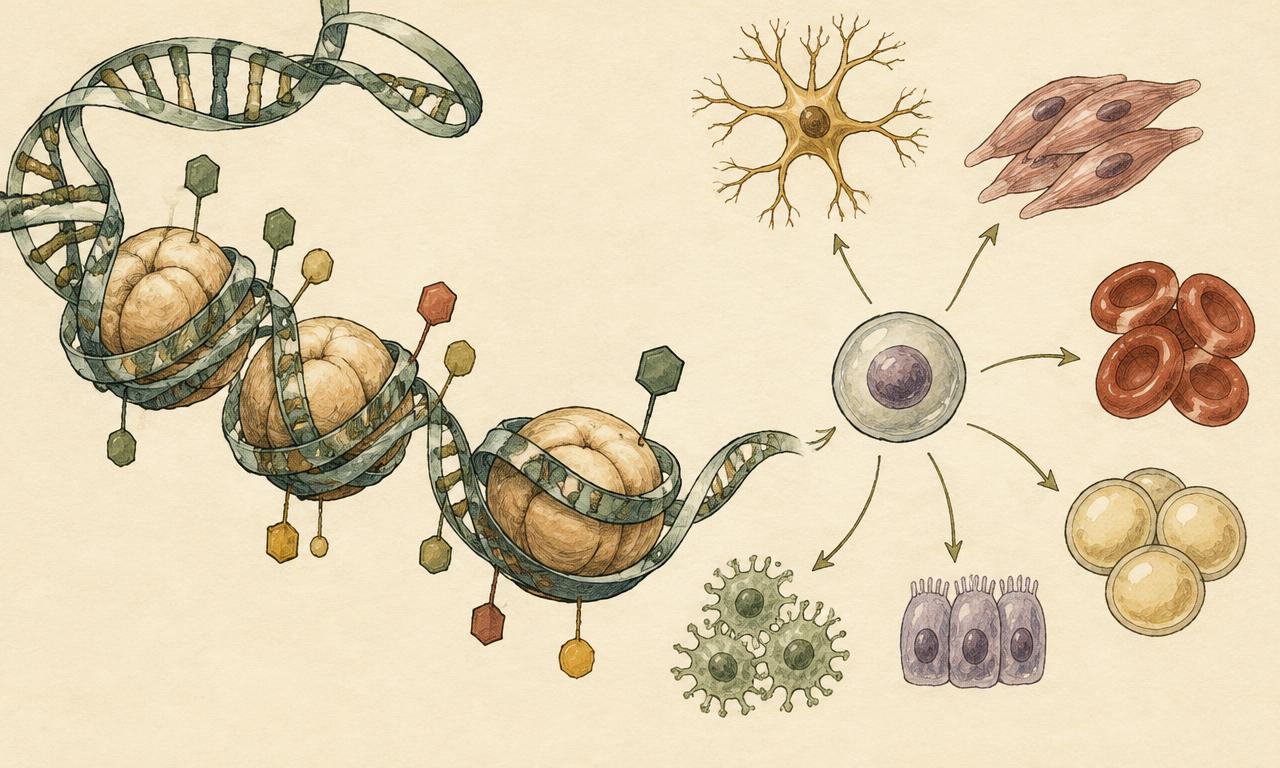
According to the National Human Genome Research Institute (NHGRI), epigenetics is "a field of study focused on changes in DNA that do not involve alterations to the underlying sequence." Instead, small chemical tags attach to DNA itself or to the proteins DNA is wrapped around, and those tags change how tightly or loosely a gene's instructions can be read — essentially turning genes up, down, or off. The two best-studied mechanisms are:
- DNA methylation — small chemical tags attached directly to DNA, usually silencing the gene nearby.
- Histone modification — chemical changes to the spool-like proteins DNA wraps around, loosening or tightening how accessible a gene is to the cellular machinery that reads it.
The NHGRI notes that these marks can be copied from a parent cell to its daughter cells during division, and the full collection of a cell's epigenetic marks is called its "epigenome." It's worth pausing on how elegant this is: it means one genome can generate hundreds of distinct cell identities, because each cell type carries its own unique pattern of switches, not its own unique genetic code.
Why This Matters for Stem Cells Specifically
A liver cell and a neuron both contain the genetic instructions to build the other — but the epigenetic marks in a liver cell keep "neuron genes" switched off, and vice versa. This is exactly the mechanism that underlies cell differentiation: when a stem cell commits to becoming bone, cartilage, or blood, what's actually changing is which genes its epigenome allows to be expressed. The stem cell isn't gaining new genetic material to become a specialized cell — it's having certain genes unlocked and others locked down, often permanently.
This also explains why a stem cell's broad developmental potential narrows as it matures. An embryonic stem cell's epigenome is kept relatively open, consistent with its ability to become almost any cell type in the body. As a cell differentiates, its epigenetic marks progressively lock it into its final identity.
The Discovery That Won a Nobel Prize
For decades, biologists assumed this process was a one-way street — that once a cell's epigenetic marks locked it into becoming, say, a skin cell, that commitment was permanent. In 2012, the Nobel Prize in Physiology or Medicine went jointly to Sir John Gurdon and Shinya Yamanaka "for the discovery that mature cells can be reprogrammed to become pluripotent," according to the official Nobel Prize summary. Yamanaka's work showed that introducing four specific genes into an adult cell could strip away its mature epigenetic marks and reset the cell back to an embryonic-like, pluripotent state — creating what are now called induced pluripotent stem cells (iPSCs). In effect, epigenetic reprogramming is the mechanism that makes iPSC technology possible at all: it's not genetic rewriting, it's resetting the switches.
"Epigenetic Memory": The Reset Isn't Always Complete
Here's where the story gets genuinely interesting — and where researchers found a wrinkle worth understanding rather than glossing over. In 2010, a team led by Konrad Hochedlinger at a Boston academic medical center's regenerative medicine research center, with Jose Polo as lead author, published findings in Nature Biotechnology showing that reprogrammed iPSCs don't always fully erase their past. Cells reprogrammed from blood or muscle progenitor cells retained faint epigenetic traces of their tissue of origin, and this measurably affected what they were good at becoming next: iPSCs made from blood-related cells were coaxed back into blood progenitor cells more readily than iPSCs made from skin cells. The researchers found these origin-linked differences faded with continued culturing over time, but the discovery — quickly nicknamed "epigenetic memory" — showed that reprogramming resets a cell's identity far more completely than scientists once assumed, even if not always perfectly on the first attempt.
That's a remarkable finding on its own terms: cells can be coaxed back to a near-blank developmental slate at all. It also gave researchers a practical, measurable variable to account for when optimizing how iPSCs are produced and standardized for research and future therapeutic use.
Why Should a Patient or Research-Follower Care?
You won't find "epigenetics" on a clinic brochure, but it sits underneath several things you might actually encounter when reading about stem cell science:
- Manufacturing consistency — epigenetic variability between cell batches is one reason researchers study donor source and cell processing carefully when developing standardized therapies.
- Why source matters — it helps explain, mechanistically, why a stem cell's tissue of origin can influence how it behaves in the lab.
- Reading research claims — "fully reprogrammed" or "epigenetically reset" cells are real, measurable scientific claims, not just marketing language, when they come from peer-reviewed characterization data.
Bottom Line
Epigenetics is the layer of chemical switches that turns one shared genome into every different cell type in the body, and it's the mechanism that makes both natural stem cell differentiation and lab-based cell reprogramming possible. The 2012 Nobel Prize-winning discovery that mature cells can be reset to a pluripotent state was, at its core, a discovery about epigenetics — and the follow-up finding that some "memory" of a cell's origin can linger afterward is a reminder that this field is still actively being mapped, not a finished textbook chapter. Understanding this layer doesn't change what any specific stem cell therapy has or hasn't been proven to do, but it does explain, at a mechanistic level, why cell source and processing are such carefully studied variables in regenerative medicine research.
Key Questions Answered
- What is epigenetics?
- Per the NHGRI, changes in DNA that do not alter the underlying sequence: chemical tags such as DNA methylation and histone modifications that turn genes up, down or off.
- How does epigenetics decide what a stem cell becomes?
- Differentiation changes which genes the epigenome allows to be expressed, unlocking some and locking down others, so one shared genome yields many distinct cell types.
- What is "epigenetic memory" in iPSCs?
- A 2010 Nature Biotechnology study found reprogrammed iPSCs retained faint marks of their tissue of origin, affecting what they became next; the differences faded with continued culturing.
Sources
- Epigenetics, Genetics Glossary, National Human Genome Research Institute (NHGRI), 2024, https://www.genome.gov/genetics-glossary/Epigenetics
- The Nobel Prize in Physiology or Medicine 2012, The Nobel Prize (NobelPrize.org), 2012, https://www.nobelprize.org/prizes/medicine/2012/summary
- Reprogrammed Cells "Remember," Retain Characteristics of Their Cells of Origin, ScienceDaily (reporting on Polo et al., Nature Biotechnology), 2010, https://www.sciencedaily.com/releases/2010/07/100719134139.htm
- Two HSCI Groups Find Residual Genetic "Memory" in iPS Cells, Harvard Stem Cell Institute, 2010, https://www.hsci.harvard.edu/two-hsci-groups-find-residual-genetic-%E2%80%98memory%E2%80%99-ips-cells
- Epigenetic Memory in Induced Pluripotent Stem Cells, California Institute for Regenerative Medicine (CIRM), https://www.cirm.ca.gov/about-cirm/publications/epigenetic-memory-induced-pluripotent-stem-cells/
Related Articles
- Fundamentals
What Is Angiogenesis, and Why Does It Matter for Stem Cell Therapy?
New blood vessels don't just show up — they're built, through a process called angiogenesis. Here's what it is, why the body depends on it for healing, and why so much stem cell research is focused on helping it along.
- Fundamentals
Myth: If a Treatment Is Listed on ClinicalTrials.gov, It Must Be Safe and Effective
Seeing a treatment listed on ClinicalTrials.gov can feel like a stamp of approval — but registering a trial costs nothing, requires no proof the treatment works, and isn't vetted by the government for safety or scientific quality.
- Fundamentals
What Are Organoids, and How Are They Grown From Stem Cells?
Organoids are tiny, self-organizing models grown from stem cells. They help study human biology and drug responses but are not complete transplant-ready organs.