What Is Multiple Sclerosis?
What this article covers
- What This Article Covers
- Multiple sclerosis (MS) is a chronic autoimmune disease in which the body's immune system mistakenly attacks the protective coating around nerve fibers in the brain and spinal cord, disrupting communication between the brain and the rest of the body. This article explains what MS is, what causes it, how it typically progresses, the disease subtypes clinicians use to guide treatment, and where standard-of-care disease-modifying therapies stand today — closing with a brief look at where stem cell and cell-based research, including autologous hematopoietic stem cell transplantation (AHSCT), currently fits into the picture.
- What Happens in MS?
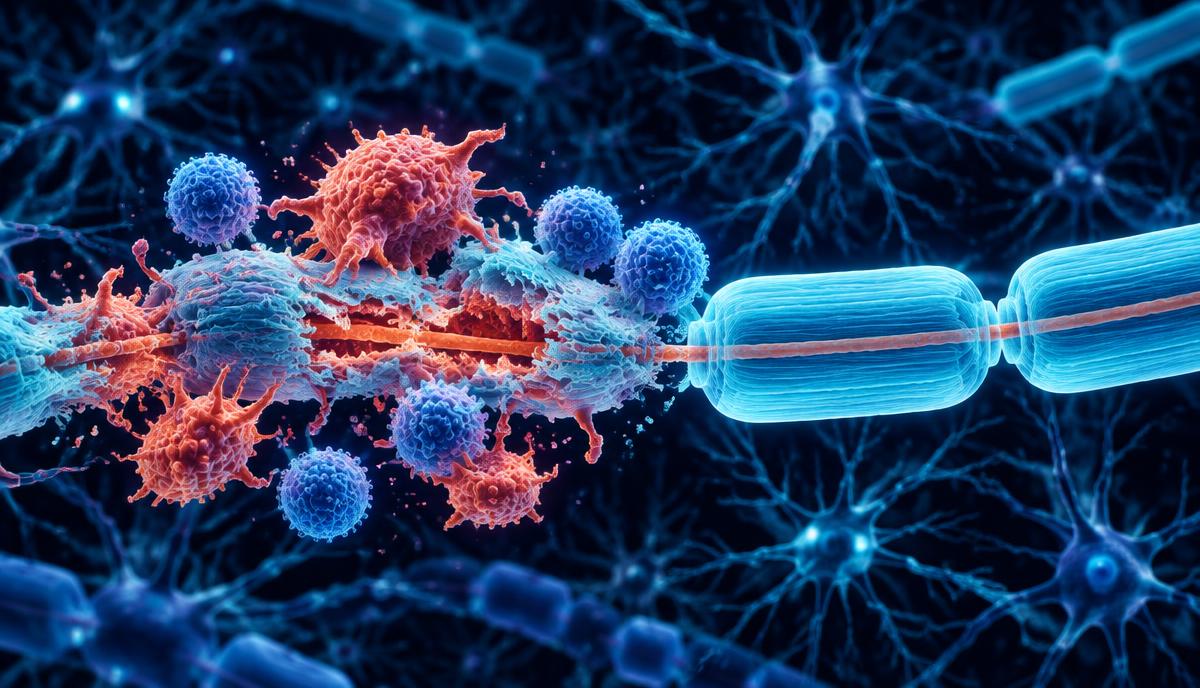
- MS damages myelin, the fatty insulating sheath that wraps around nerve fibers in the central nervous system (the brain, spinal cord, and optic nerves) and allows electrical signals to travel quickly and efficiently. In MS, immune cells mistakenly target myelin as if it were a foreign invader, causing inflammation and scarring (sclerosis) at multiple sites — hence the name.
- What Causes MS?
- The exact cause of MS is not fully understood, but researchers believe it results from a combination of genetic susceptibility and environmental triggers rather than any single cause.
- Symptoms and Disease Course
- Because MS can affect any part of the central nervous system, symptoms vary widely from person to person and can change over time.
- Types of MS
- - Relapsing-Remitting MS (RRMS) — The most common form at diagnosis, marked by clearly defined relapses (flare-ups of new or worsening symptoms) followed by periods of partial or complete recovery, with no disease progression between attacks. - Secondary Progressive MS (SPMS) — Many people initially diagnosed with RRMS eventually transition to a phase of steadily worsening disability, with or without occasional relapses.
What This Article Covers
Multiple sclerosis (MS) is a chronic autoimmune disease in which the body's immune system mistakenly attacks the protective coating around nerve fibers in the brain and spinal cord, disrupting communication between the brain and the rest of the body. This article explains what MS is, what causes it, how it typically progresses, the disease subtypes clinicians use to guide treatment, and where standard-of-care disease-modifying therapies stand today — closing with a brief look at where stem cell and cell-based research, including autologous hematopoietic stem cell transplantation (AHSCT), currently fits into the picture.
What Happens in MS?
MS damages myelin, the fatty insulating sheath that wraps around nerve fibers in the central nervous system (the brain, spinal cord, and optic nerves) and allows electrical signals to travel quickly and efficiently. In MS, immune cells mistakenly target myelin as if it were a foreign invader, causing inflammation and scarring (sclerosis) at multiple sites — hence the name. Depending on where in the central nervous system these lesions form, patients experience a wide range of neurological symptoms. Over time, the underlying nerve fibers themselves can also become damaged, which is a major driver of permanent disability.
What Causes MS?
The exact cause of MS is not fully understood, but researchers believe it results from a combination of genetic susceptibility and environmental triggers rather than any single cause. Key factors under active study include:
- Genetics — MS is not directly inherited, but having a close relative with MS raises risk, pointing to a genetic susceptibility component.
- Epstein-Barr virus (EBV) — This extremely common virus appears to be nearly a prerequisite for developing MS in genetically susceptible people, and is one of the most compelling risk factors identified in recent years.
- Vitamin D and sunlight exposure — Low vitamin D levels are associated with higher MS risk, and MS is more common at higher latitudes farther from the equator.
- Smoking — Cigarette smoking is linked to increased MS risk and faster disease progression, particularly in women.
- Other factors under investigation — Childhood obesity, diet, and the gut microbiome are also being studied as possible contributors.
Symptoms and Disease Course
Because MS can affect any part of the central nervous system, symptoms vary widely from person to person and can change over time. Common symptoms include:
- Fatigue
- Numbness or tingling, often in the face, body, or limbs
- Vision problems (blurred or double vision, eye pain)
- Muscle weakness, stiffness, or spasms
- Problems with balance, coordination, and dizziness
- Bladder and bowel dysfunction
- Difficulties with memory, concentration, or processing speed
- Pain
Symptoms can appear as discrete "relapses" or "attacks" that improve afterward, or as slow, continuous worsening — the pattern of which defines the disease subtypes below.
Types of MS
- Relapsing-Remitting MS (RRMS) — The most common form at diagnosis, marked by clearly defined relapses (flare-ups of new or worsening symptoms) followed by periods of partial or complete recovery, with no disease progression between attacks. - Secondary Progressive MS (SPMS) — Many people initially diagnosed with RRMS eventually transition to a phase of steadily worsening disability, with or without occasional relapses. - Primary Progressive MS (PPMS) — A less common form (roughly 10-15% of cases) in which disability worsens steadily from the onset, without distinct relapses or remissions.
Who Gets MS?
MS is typically diagnosed between ages 20 and 40, though it can occur in children and older adults. It disproportionately affects women, and that gap has been widening for decades: a North American MS registry study of more than 30,000 patients found women made up about 72.5% of cases, and the female-to-male ratio has climbed from roughly 2-to-1 around 1940 to roughly 4-to-1 by 2000 — an increase researchers attribute at least partly to environmental and lifestyle factors rather than genetics alone. In the United States, a landmark epidemiological study commissioned by the National MS Society estimated that roughly 900,000 adults (a range of about 851,700-913,900) were living with MS, a prevalence of about 362 per 100,000 people — notably higher than earlier estimates, reflecting improved diagnostic tools and case-finding methods rather than necessarily a true rise in new cases. Globally, the Atlas of MS estimates more than 2.8 million people live with the disease worldwide.
Standard Treatment Today
There is no cure for MS, but the treatment landscape has been transformed over the past three decades. Disease-modifying therapies (DMTs) — a class of FDA-approved drugs delivered by injection, oral pill, or infusion — reduce the frequency and severity of relapses, slow accumulation of new MRI lesions, and can slow disability progression for many patients. More than two dozen DMTs are now approved across these delivery categories, giving neurologists substantial flexibility to tailor treatment to a patient's disease activity, subtype, and tolerance for side effects. DMT options are generally more numerous and better-validated for relapsing forms of MS than for primary progressive disease, where only a limited number of therapies have shown benefit. Beyond DMTs, care typically includes treating relapses with corticosteroids and managing individual symptoms (fatigue, spasticity, bladder issues) with targeted therapies and rehabilitation.
Where Stem Cell Research Stands
Because standard DMTs work by modulating rather than resetting the immune system, researchers have explored more aggressive cell-based approaches for people whose MS remains highly active despite treatment. The most studied is autologous hematopoietic stem cell transplantation (AHSCT), in which a patient's own blood-forming stem cells are collected, the existing immune system is depleted with chemotherapy, and the stem cells are reinfused to rebuild a new immune system. Recent cohort data have been genuinely encouraging: one European study following patients for a minimum of two years found that over 80% achieved "NEDA" status — no evidence of disease activity (no relapses, no disability worsening, no new MRI lesions) — with the strongest results in relapsing-remitting patients who were younger, earlier in their disease course, and met specific eligibility criteria. However, AHSCT is an intensive, higher-risk procedure involving immune-depleting chemotherapy, and it is not a first-line or universal treatment. It is generally reserved for aggressive relapsing MS that hasn't responded to standard DMTs, and evidence for its benefit in primary progressive MS is considerably weaker, with progressive patients more likely to experience continued gradual worsening even after transplant. We cover the clinical trial evidence for AHSCT in MS in much greater depth in a dedicated article on this site; this section is meant only as an orientation to where that research currently stands.
Bottom Line
MS is a lifelong autoimmune disease of the central nervous system with a highly variable course, but it is far from untreatable: modern disease-modifying therapies have fundamentally changed outcomes for most patients with relapsing forms of the disease, and ongoing research — including AHSCT — is expanding options for people with aggressive disease that doesn't respond to standard care. That said, cell-based approaches remain intensive, carry real risks, and are not appropriate for everyone or every subtype. Anyone considering them should do so through a qualified neurologist or MS specialist as part of a carefully evaluated treatment plan, not as a substitute for established, FDA-approved standard-of-care treatment.
Sources
- Newly Published NMSS Study Confirms Nearly 1 Million Americans Have MS, Multiple Sclerosis News Today, 2019 — https://multiplesclerosisnewstoday.com/2019/02/15/newly-published-nmss-study-confirms-nearly-1-million-americans-live-with-ms/
- Updated Atlas of MS Shows Over 2.8 Million People Worldwide Live with MS, National Multiple Sclerosis Society — https://www.nationalmssociety.org/About-the-Society/News/Updated-Atlas-of-MS-Shows-Over-2-8-million-People
- AAN: Gender Gap Widens in Multiple Sclerosis, Patient Care Online — https://patientcareonline.com/view/aan-gender-gap-widens-multiple-sclerosis
- Possible Causes of Multiple Sclerosis, Multiple Sclerosis Association of America (MSAA) — https://mymsaa.org/ms-information/overview/possible-causes/
- Multiple Sclerosis (MS) Symptoms and Signs, MS Society (UK) — https://www.mssociety.org.uk/about-ms/signs-and-symptoms
- Disease-Modifying Therapies, Multiple Sclerosis International Federation (MSIF) — https://www.msif.org/about-ms/treatments/disease-modifying-therapies/
- Stem Cell Transplant Pauses MS Activity for Most Patients for at Least 2 Years, Multiple Sclerosis News Today, 2026 — https://ms-uk.org/news/stem-cell-transplant-pauses-ms-activity-for-most-patients-for-years/
- Hematopoietic Stem Cell Transplantation Shown to Benefit MS Prognoses, AJMC, 2024 — https://www.ajmc.com/view/hematopoietic-stem-cell-transplantation-shown-to-benefit-ms-prognoses
Related Articles
- Fundamentals
Types of Neurodegenerative Disease: Which Ones Are Being Studied With Stem Cell Therapy?
Compare stem cell research across Parkinson’s, Huntington’s, ALS, Alzheimer’s, MSA and dementias by trial phase, evidence quality and treatment status.
- Fundamentals
Preventing Sarcopenia: What the Evidence Says About Preserving Muscle Health As You Age
Resistance training, protein and activity help preserve muscle as we age; satellite cells remain responsive, while cell therapies for sarcopenia are unproven.
- Fundamentals
What Is a "Potency Assay"? How Scientists Confirm a Cell Therapy Actually Does Its Job
A potency assay tests whether each batch of cell therapy has its intended biological activity. Why living cells make this hard, and what regulators require.