What Is Rheumatoid Arthritis?
What this article covers
- What This Article Covers
- Rheumatoid arthritis (RA) is a chronic autoimmune disease in which the immune system attacks the lining of the joints, causing pain, swelling, and, over time, joint damage. This article explains what causes RA, how it's diagnosed and treated, and why — despite genuine excitement about regenerative medicine in other fields — stem cell therapy remains an early-stage research question for RA rather than an established treatment.
- What Causes Rheumatoid Arthritis
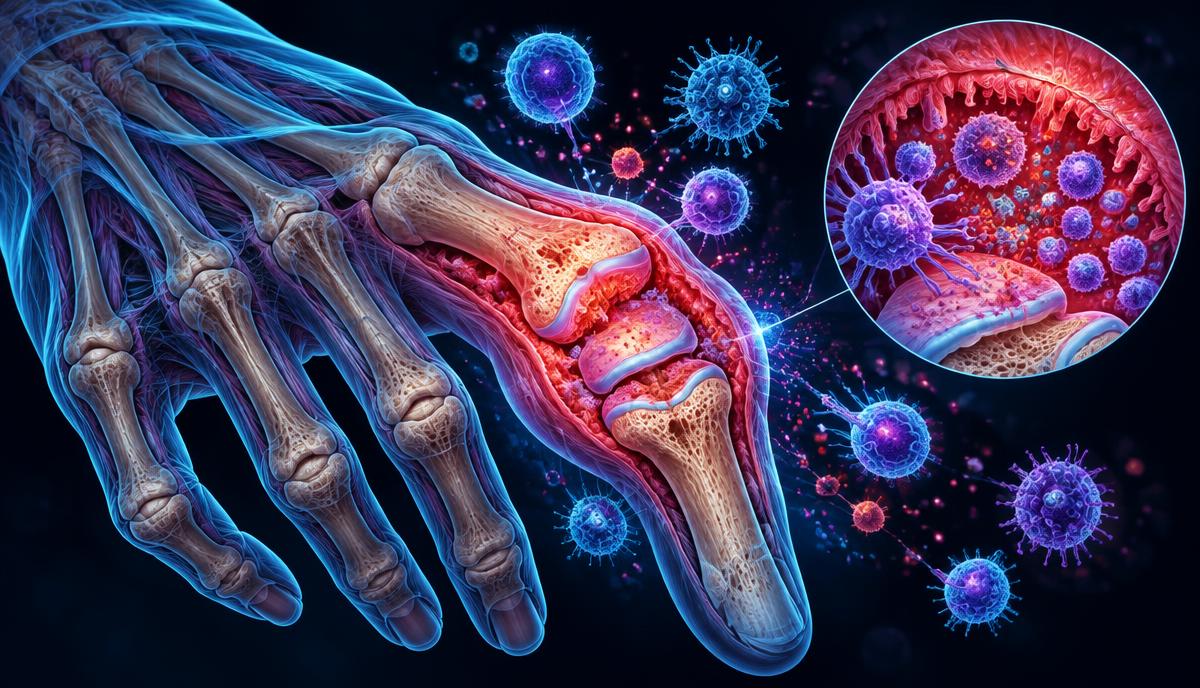
- RA is an autoimmune disease: the body's immune system mistakenly attacks its own joint tissue. According to the National Institute of Arthritis and Musculoskeletal and Skin Diseases (NIAMS), immune cells cause inflammation in the synovium — the thin lining of the joint capsule.
- Symptoms and Diagnosis
- RA typically causes joint pain, tenderness, swelling, and warmth, often affecting the same joints on both sides of the body — a pattern called symmetric involvement that helps distinguish it from other forms of arthritis. A hallmark feature is morning stiffness lasting more than 30 minutes.
- Standard Treatment Today
- RA treatment has changed dramatically over the past two decades, and this is a genuine success story in modern medicine. The 2021 American College of Rheumatology (ACR) guideline strongly recommends methotrexate — a conventional disease-modifying antirheumatic drug (DMARD) — as the preferred first-line therapy for patients with moderate-to-high disease activity, based on decades of evidence and its comparatively low cost.
- Where Stem Cell Research Currently Stands
- Cell-based approaches for RA are a distinct and much earlier-stage line of research from the biologic drugs described above, and it's important not to conflate the two. Most stem cell investigation in RA involves mesenchymal stem/stromal cells (MSCs), studied for their potential to modulate an overactive immune response rather than to regenerate joint tissue directly.
What This Article Covers
Rheumatoid arthritis (RA) is a chronic autoimmune disease in which the immune system attacks the lining of the joints, causing pain, swelling, and, over time, joint damage. This article explains what causes RA, how it's diagnosed and treated, and why — despite genuine excitement about regenerative medicine in other fields — stem cell therapy remains an early-stage research question for RA rather than an established treatment. Modern drug therapy, not cell therapy, is what has transformed outcomes for most people with RA today.
What Causes Rheumatoid Arthritis
RA is an autoimmune disease: the body's immune system mistakenly attacks its own joint tissue. According to the National Institute of Arthritis and Musculoskeletal and Skin Diseases (NIAMS), immune cells cause inflammation in the synovium — the thin lining of the joint capsule. Left uncontrolled, this inflammation becomes chronic, and the thickened, inflamed synovium can invade and destroy nearby cartilage and bone. The exact trigger isn't fully understood, but researchers believe RA arises from a combination of genetic susceptibility and environmental factors, including smoking, obesity, and gum disease, which appear to increase risk. RA affects roughly 0.6% to 1% of the U.S. population and is markedly more common in women, who make up about three-quarters of cases. It most often develops between ages 30 and 50, though it can begin at any age.
Symptoms and Diagnosis
RA typically causes joint pain, tenderness, swelling, and warmth, often affecting the same joints on both sides of the body — a pattern called symmetric involvement that helps distinguish it from other forms of arthritis. A hallmark feature is morning stiffness lasting more than 30 minutes. RA can also cause systemic symptoms such as fatigue, low-grade fever, and loss of appetite, reflecting the fact that it's a body-wide inflammatory disease, not just a joint problem. Diagnosis typically combines a physical exam, blood tests (such as rheumatoid factor and anti-CCP antibodies, along with inflammatory markers like CRP and ESR), and imaging to assess joint damage. Early diagnosis matters: starting effective treatment before significant joint erosion occurs is strongly associated with better long-term outcomes.
Standard Treatment Today
RA treatment has changed dramatically over the past two decades, and this is a genuine success story in modern medicine. The 2021 American College of Rheumatology (ACR) guideline strongly recommends methotrexate — a conventional disease-modifying antirheumatic drug (DMARD) — as the preferred first-line therapy for patients with moderate-to-high disease activity, based on decades of evidence and its comparatively low cost. When methotrexate alone isn't sufficient, guidelines support adding a biologic DMARD, most often a TNF inhibitor, or in some cases other biologics targeting pathways like IL-6, or a JAK inhibitor (a class of oral targeted synthetic DMARDs). Corticosteroids can help control flares in the short term, but the ACR guideline strongly recommends against long-term steroid use, given their side-effect burden, favoring adjustments to DMARD therapy instead. The overarching strategy is "treat-to-target": clinicians and patients set a specific goal — usually low disease activity or remission — and adjust medications until it's reached. For many patients, this approach genuinely controls inflammation, prevents joint damage, and allows a return to normal function — outcomes that were far less attainable a generation ago.
Where Stem Cell Research Currently Stands
Cell-based approaches for RA are a distinct and much earlier-stage line of research from the biologic drugs described above, and it's important not to conflate the two. Most stem cell investigation in RA involves mesenchymal stem/stromal cells (MSCs), studied for their potential to modulate an overactive immune response rather than to regenerate joint tissue directly. A 2023 systematic review and meta-analysis published in PLOS One identified only four clinical studies of MSC therapy for RA — three randomized controlled trials and one non-randomized study, together enrolling 358 patients, with trial phases ranging from Phase I/II to Phase Ib/IIa. The review reported a favorable short-term safety profile, with no life-threatening adverse events, and some signal of reduced disease activity and inflammatory markers in treated patients. But the results were mixed and inconsistent across studies, and the authors noted that measured improvements were not sustained beyond 12 months without repeat treatment, concluding that any trend toward efficacy must be confirmed through larger, high-quality randomized trials with extended follow-up before MSC therapy could be considered anything beyond a last-resort research option. A 2024 review in Advanced Science similarly frames MSC-based strategies for RA as a developing research area, discussing proposed mechanisms and preclinical work rather than a ready-to-use clinical treatment. In short, stem cell therapy for RA remains investigational, confined mostly to small early-phase trials, and is not part of any current rheumatology treatment guideline.
Bottom Line
Rheumatoid arthritis is a serious, lifelong autoimmune disease, but it is also one where standard care — methotrexate, biologic and targeted synthetic DMARDs, and a treat-to-target strategy — has meaningfully improved outcomes for many patients. Stem cell therapy is not currently part of that standard of care. The available clinical evidence is limited to small, early-phase trials with mixed and short-lived results, and researchers themselves describe the field as preliminary. Anyone considering a cell-based therapy for RA outside of a registered clinical trial should discuss it carefully with a rheumatologist, understanding that it remains an open research question rather than a proven treatment option.
Sources
- Rheumatoid Arthritis — NIAMS, National Institutes of Health, 2024 — https://www.niams.nih.gov/health-topics/rheumatoid-arthritis
- 2021 American College of Rheumatology Guideline for the Treatment of Rheumatoid Arthritis — Arthritis Care & Research (Wiley/ACR), 2021 — https://acrjournals.onlinelibrary.wiley.com/doi/10.1002/acr.24596
- Rheumatoid Arthritis Treatment Guidelines — Arthritis Foundation — https://www.arthritis.org/diseases/more-about/rheumatoid-arthritis-treatment-guidelines
- Safety and efficacy of mesenchymal stem cells therapy in the treatment of rheumatoid arthritis disease: A systematic review and meta-analysis of clinical trials — PLOS One, 2023 — https://journals.plos.org/plosone/article?id=10.1371%2Fjournal.pone.0284828
- Mesenchymal Stem Cells‐Involved Strategies for Rheumatoid Arthritis Therapy — Advanced Science, 2024 — https://advanced.onlinelibrary.wiley.com/doi/full/10.1002/advs.202305116
Related Articles
- Fundamentals
Types of Cartilage Damage: What Regenerative Options Exist for Each?
Focal cartilage defects, osteochondritis dissecans, osteoarthritis and meniscus tears need different evidence. Where MACI is approved and where MSCs remain experimental.
- Fundamentals
Can Exercise Boost Your Body's Own Stem Cell Activity? What the Evidence Actually Shows
Exercise activates muscle satellite cells and temporarily mobilizes blood progenitors. What human and animal studies show—and what they cannot yet prove about regeneration.
- Fundamentals
How Are Stem Cells Delivered? IV Infusion, Injection, and Implantation Compared
IV infusion, local injection, and surgical implantation send stem cells to very different places. How each delivery route works, what it's used for, and why the lungs trap most IV-infused cells.