What Is Sjögren's Syndrome?
What this article covers
- What Is Sjögren's Syndrome?
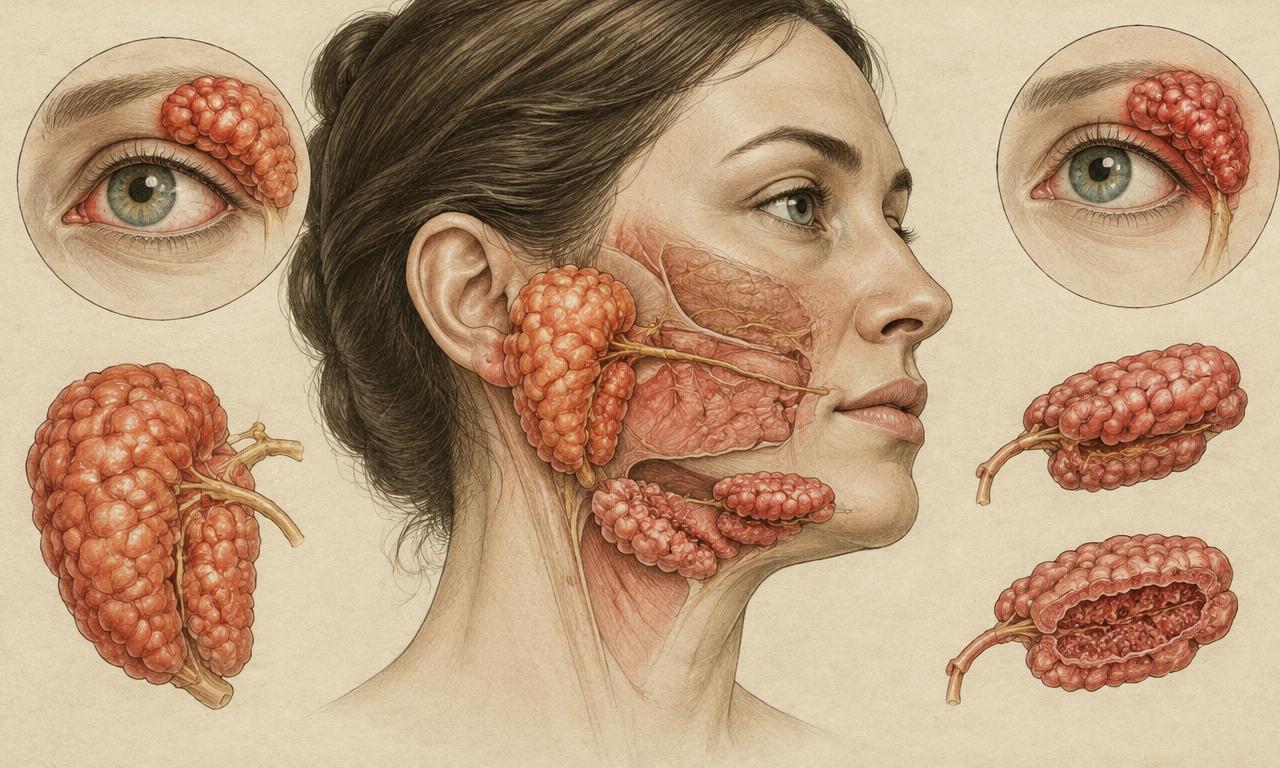
- Sjögren's is a systemic autoimmune disease in which the immune system mistakenly attacks the body's moisture-producing glands, primarily the tear glands and salivary glands, according to the National Institute of Arthritis and Musculoskeletal and Skin Diseases (NIAMS). It's the second most common rheumatic autoimmune disease in the United States, affecting as many as 4 million Americans — roughly three times more people than lupus or multiple sclerosis, per the Sjögren's Foundation.
- What Causes It?
- The exact trigger isn't known. NIAMS and Mayo Clinic both point to a combination of genetic susceptibility — variations in several immune-related genes raise risk — and an environmental trigger, possibly a viral or bacterial infection, that sets the immune attack in motion.
- How Is It Diagnosed?
- There's no single test that confirms Sjögren's. NIAMS describes a diagnostic process built from several pieces: a detailed history focused on eye and mouth dryness, specialized eye tests (checking tear production and corneal damage), salivary gland function tests, and blood work looking for characteristic autoantibodies and inflammation markers.
- Standard Care Today
- There is no cure for Sjögren's, and treatment focuses on managing symptoms and preventing complications. Rheumatologists typically lead care, working alongside dentists, ophthalmologists, and primary care physicians.
- Where Does Stem Cell Research Stand?
- This is genuinely early, investigational territory — and it's worth being clear-eyed about that while also noting real signs of movement. Researchers have been exploring mesenchymal stem/stromal cells (MSCs) as a way to potentially calm the immune attack and support damaged gland tissue, with small trials and case series conducted mostly outside the US, including allogeneic MSC studies for Sjögren's-related dry eye in Denmark.
Sjögren's syndrome (increasingly called Sjögren's disease) is a chronic autoimmune condition best known for causing dry eyes and dry mouth, but it can affect the whole body, from joints to lungs to nerves. This article explains what causes it, how it shows up and gets diagnosed, what standard treatment looks like today, and where early-stage stem cell and cell-therapy research for Sjögren's currently stands. A companion article on this site, "Stem Cell Therapy for Sjögren's Syndrome," goes deeper into that research specifically.
What Is Sjögren's Syndrome?
Sjögren's is a systemic autoimmune disease in which the immune system mistakenly attacks the body's moisture-producing glands, primarily the tear glands and salivary glands, according to the National Institute of Arthritis and Musculoskeletal and Skin Diseases (NIAMS). It's the second most common rheumatic autoimmune disease in the United States, affecting as many as 4 million Americans — roughly three times more people than lupus or multiple sclerosis, per the Sjögren's Foundation. About 90% of those diagnosed are women, and most people are diagnosed in their 40s or 50s, though it can occur at any age, including in children.
What Causes It?
The exact trigger isn't known. NIAMS and Mayo Clinic both point to a combination of genetic susceptibility — variations in several immune-related genes raise risk — and an environmental trigger, possibly a viral or bacterial infection, that sets the immune attack in motion. Sjögren's can occur on its own ("primary" Sjögren's) or alongside another autoimmune condition such as rheumatoid arthritis or lupus ("secondary" Sjögren's); the Sjögren's Foundation notes that about 30% of people with Sjögren's also have lupus, and roughly half show features of another autoimmune disease even without a formal diagnosis.
Symptoms and Complications
The hallmark symptoms are dryness:
- Dry, burning, itchy, or gritty-feeling eyes, sometimes with blurred vision or light sensitivity
- Dry mouth that makes chewing, swallowing, or speaking difficult, with a higher risk of cavities and oral thrush
- Dry skin, chronic cough, and vaginal dryness
But Sjögren's is genuinely systemic. Many patients also experience profound fatigue, joint pain and swelling, swollen salivary glands, and peripheral neuropathy (numbness or tingling in the hands and feet). Less commonly, it can involve the lungs, kidneys, or liver. One statistic worth taking seriously: people with Sjögren's are roughly 44 times more likely to develop lymphoma than the general population, per the Sjögren's Foundation — still an uncommon outcome overall, but a reason ongoing monitoring matters.
How Is It Diagnosed?
There's no single test that confirms Sjögren's. NIAMS describes a diagnostic process built from several pieces: a detailed history focused on eye and mouth dryness, specialized eye tests (checking tear production and corneal damage), salivary gland function tests, and blood work looking for characteristic autoantibodies and inflammation markers. Because symptoms overlap with many other conditions and patients often see multiple specialists, diagnosis can take years — a frustration the Sjögren's Foundation flags as especially common in men, children, and younger women, who don't fit the "older woman" stereotype clinicians are trained to expect.
Standard Care Today
There is no cure for Sjögren's, and treatment focuses on managing symptoms and preventing complications. Rheumatologists typically lead care, working alongside dentists, ophthalmologists, and primary care physicians. Approaches include:
- At-home measures: humidifiers, preservative-free eye drops, sugar-free gum, and frequent water sipping
- Prescription medications to stimulate tear and saliva production, plus anti-inflammatory eye drops
- Immune-modulating or immunosuppressive drugs for patients with more severe systemic involvement
- Avoiding medications known to worsen dryness
Notably, the Sjögren's Foundation states plainly that no FDA-approved disease-modifying therapies currently exist for Sjögren's — current care treats symptoms, not the underlying autoimmune process.
Where Does Stem Cell Research Stand?
This is genuinely early, investigational territory — and it's worth being clear-eyed about that while also noting real signs of movement. Researchers have been exploring mesenchymal stem/stromal cells (MSCs) as a way to potentially calm the immune attack and support damaged gland tissue, with small trials and case series conducted mostly outside the US, including allogeneic MSC studies for Sjögren's-related dry eye in Denmark.
What's encouraging is that this research has now reached a US-based, FDA-cleared clinical trial: in 2023, the FDA cleared a Phase 1 study at a US academic medical center (NCT06392711) testing a patient's own bone-marrow-derived mesenchymal stromal cells, activated with interferon gamma, injected directly into the salivary glands of people with xerostomia (severe dry mouth) from Sjögren's or graft-versus-host disease. The first participant received treatment in early 2025, with the trial aiming to enroll up to 36 adults. Importantly, this is a safety-focused Phase 1 trial — it is designed to assess tolerability, not to prove the therapy works, and results are not yet available.
No stem cell therapy is FDA-approved for Sjögren's syndrome, and none should be assumed safe or effective outside a properly regulated clinical trial. Anyone considering experimental cell therapy for Sjögren's should discuss it with their rheumatologist and verify a trial's legitimacy through official registries like ClinicalTrials.gov.
Bottom Line
Sjögren's syndrome is a common but often under-recognized autoimmune disease that goes well beyond "just" dry eyes and mouth — it can affect joints, nerves, and organs, and carries a meaningfully elevated lymphoma risk. Today's standard care manages symptoms rather than reversing the underlying disease, since no FDA-approved disease-modifying or stem cell therapy yet exists. Early research into mesenchymal stem cells, including a newly launched US Phase 1 trial, represents a genuinely promising scientific direction worth watching — but it remains firmly in the investigational stage, and patients should approach any stem cell therapy claims for Sjögren's with informed caution.
Key Questions Answered
- What is Sjögren's syndrome?
- A systemic autoimmune disease in which the immune system attacks moisture-producing glands, mainly tear and salivary glands. It affects up to 4 million Americans, about 90% of them women.
- Is there a cure or disease-modifying treatment for Sjögren's?
- No. Care focuses on managing dryness and complications; the Sjögren's Foundation states no FDA-approved disease-modifying therapies exist.
- Where does stem cell research for Sjögren's stand?
- It is investigational. An FDA-cleared US Phase 1 safety trial (NCT06392711) of patients' own activated bone-marrow MSCs injected into salivary glands treated its first participant in early 2025.
Sources
- Sjögren's Disease Fact Sheet, Sjögren's Foundation, 2024 — https://sjogrens.org/sites/default/files/inline-files/Sj%C3%B6gren%27s%20Disease%20Fact%20Sheet%20-%20Sj%C3%B6gren%27s%20Foundation.pdf
- Sjogren's disease - Symptoms and causes, Mayo Clinic, 2024 — https://www.mayoclinic.org/diseases-conditions/sjogrens-syndrome/symptoms-causes/syc-20353216
- Sjögren's Disease, National Institute of Arthritis and Musculoskeletal and Skin Diseases (NIAMS) — https://www.niams.nih.gov/health-topics/sjogrens-disease
- Overview of Sjögren's Disease: Diagnosis, Treatment and Steps to Take, NIAMS — https://www.niams.nih.gov/health-topics/sjogrens-syndrome/basics/diagnosis-treatment-and-steps-to-take
- First Sjögren's patient receives stem cell therapy for xerostomia, Sjögren's Syndrome News, 2025 — https://sjogrenssyndromenews.com/news/first-sjogrens-patient-receives-stem-cell-therapy-xerostomia/
- Dose-Escalation Trial of Mesenchymal Stromal Cells in Patients With Medical Xerostomia (NCT06392711), ClinicalTrials.gov — https://clinicaltrials.gov/study/NCT06392711
Related Articles
- Fundamentals
What Is Angiogenesis, and Why Does It Matter for Stem Cell Therapy?
New blood vessels don't just show up — they're built, through a process called angiogenesis. Here's what it is, why the body depends on it for healing, and why so much stem cell research is focused on helping it along.
- Fundamentals
Myth: If a Treatment Is Listed on ClinicalTrials.gov, It Must Be Safe and Effective
Seeing a treatment listed on ClinicalTrials.gov can feel like a stamp of approval — but registering a trial costs nothing, requires no proof the treatment works, and isn't vetted by the government for safety or scientific quality.
- Fundamentals
What Are Organoids, and How Are They Grown From Stem Cells?
Organoids are tiny, self-organizing models grown from stem cells. They help study human biology and drug responses but are not complete transplant-ready organs.