What Is Somatic Cell Nuclear Transfer? The Science Behind "Therapeutic Cloning"
What this article covers
- What This Article Covers
- Somatic cell nuclear transfer (SCNT) — the technique behind Dolly the sheep and, decades later, "therapeutic cloning" research in humans — is one of the foundational tools scientists have used to understand how a cell's identity can be reset. This article explains how SCNT works, traces its path from a Scottish sheep barn in 1996 to a genuine scientific breakthrough (and a notorious fraud) in human cells, and clarifies what the technique actually is and isn't used for today.
- The Basic Idea: Swapping Out a Cell's Instructions
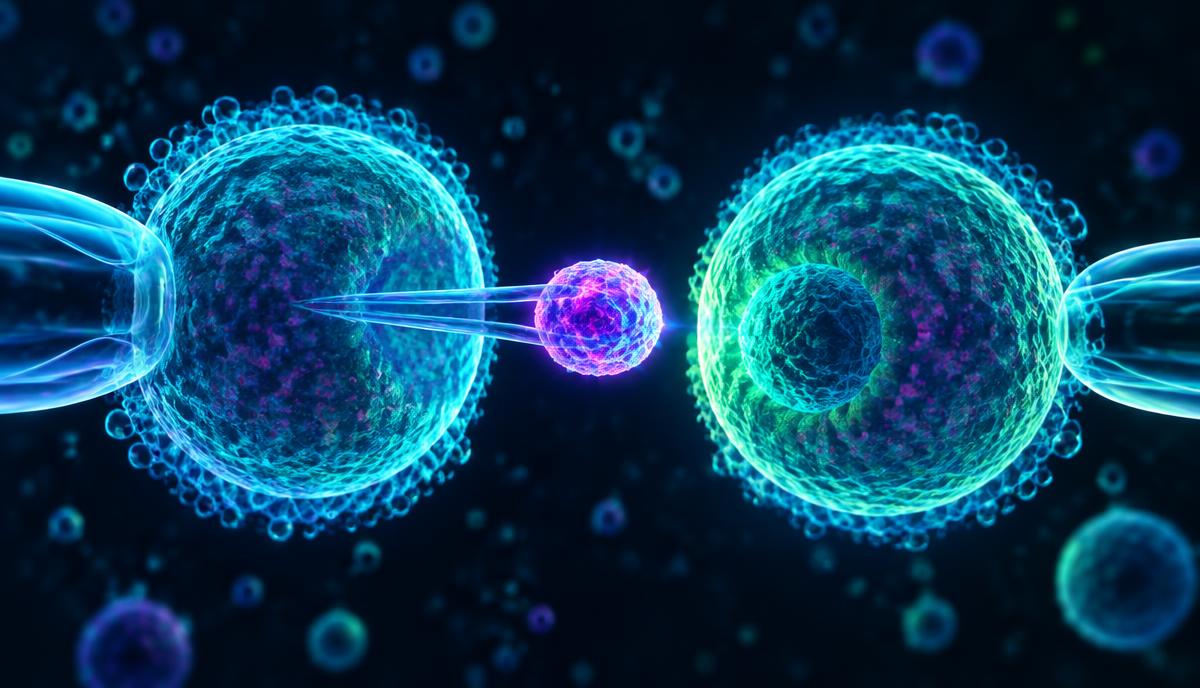
- At its core, SCNT is a kind of cellular transplant. Scientists take an egg cell (oocyte) and remove its own nucleus — the structure holding its DNA.
- Dolly the Sheep and the 1996 Breakthrough
- SCNT became world-famous in July 1996, when researchers Ian Wilmut and Keith Campbell at the Roslin Institute, near Edinburgh, used it to create Dolly, the first mammal ever cloned from an adult body cell. Dolly's genetic donor was a mammary gland cell from a six-year-old Finn Dorset ewe; the egg came from a Scottish Blackface ewe, who also carried the resulting pregnancy.
- Two Very Different Goals: Reproductive vs. "Therapeutic" Cloning
- Dolly's creation was reproductive cloning: the cloned embryo was implanted into a surrogate and carried to birth. SCNT can also be aimed at an entirely different, non-reproductive goal, often called therapeutic cloning or research cloning.
- A False Start, Then a Real One
- Human therapeutic cloning had a rocky history. In 2004 and 2005, South Korean researcher Hwang Woo-suk and colleagues published papers in the journal Science claiming to have created the first cloned human embryos and patient-specific human embryonic stem cell lines — a sensation at the time.
What This Article Covers
Somatic cell nuclear transfer (SCNT) — the technique behind Dolly the sheep and, decades later, "therapeutic cloning" research in humans — is one of the foundational tools scientists have used to understand how a cell's identity can be reset. This article explains how SCNT works, traces its path from a Scottish sheep barn in 1996 to a genuine scientific breakthrough (and a notorious fraud) in human cells, and clarifies what the technique actually is and isn't used for today.
The Basic Idea: Swapping Out a Cell's Instructions
At its core, SCNT is a kind of cellular transplant. Scientists take an egg cell (oocyte) and remove its own nucleus — the structure holding its DNA. They then insert the nucleus from an ordinary "somatic" (body) cell, such as a skin cell, into that emptied egg. With the right chemical or electrical nudge, the egg behaves as though it had just been fertilized: it begins dividing and developing, but using the genetic blueprint of the somatic cell's donor rather than that of a sperm and egg combined. The resulting embryo is, genetically, a near-match to whoever donated the somatic cell.
This matters because egg cells contain a remarkable natural ability: the proteins and molecular machinery inside them can "reset" a mature cell's DNA back to an embryonic-like state, unlocking developmental potential that an adult skin or blood cell has long since given up.
Dolly the Sheep and the 1996 Breakthrough
SCNT became world-famous in July 1996, when researchers Ian Wilmut and Keith Campbell at the Roslin Institute, near Edinburgh, used it to create Dolly, the first mammal ever cloned from an adult body cell. Dolly's genetic donor was a mammary gland cell from a six-year-old Finn Dorset ewe; the egg came from a Scottish Blackface ewe, who also carried the resulting pregnancy. The achievement, announced to the public in February 1997, overturned a long-standing assumption in biology: that once a cell matured into a specific type, its development could never be reversed. Dolly proved otherwise, and in doing so opened the door to decades of reprogramming research, including the iPSC technology later developed by Shinya Yamanaka. Dolly lived six years before being euthanized after being diagnosed with a progressive lung disease; whether cloning itself accelerated her aging was debated for years, and the Roslin Institute has said no solid evidence tied her illness directly to the cloning process.
Two Very Different Goals: Reproductive vs. "Therapeutic" Cloning
Dolly's creation was reproductive cloning: the cloned embryo was implanted into a surrogate and carried to birth. SCNT can also be aimed at an entirely different, non-reproductive goal, often called therapeutic cloning or research cloning. Here, the cloned embryo is never implanted in a womb. Instead, it's grown in a lab dish only to the blastocyst stage — a ball of roughly 100–200 cells — at which point scientists extract its inner cell mass to derive embryonic stem cells. Because those stem cells share the nuclear DNA of the original donor, the idea is that they could, in principle, be used to study a patient's own disease in a dish, or someday generate replacement cells with a much lower risk of immune rejection. The embryo itself does not survive the process, which is a central reason the technique remains ethically contested and tightly regulated. Reproductive human cloning is widely opposed and prohibited in most places; research (therapeutic) cloning is treated very differently by different countries' laws.
A False Start, Then a Real One
Human therapeutic cloning had a rocky history. In 2004 and 2005, South Korean researcher Hwang Woo-suk and colleagues published papers in the journal Science claiming to have created the first cloned human embryos and patient-specific human embryonic stem cell lines — a sensation at the time. An investigation later found the results were fabricated, and Science formally retracted both papers in January 2006. It was a painful setback for the field and public trust in stem cell science.
The real milestone came almost a decade later. In May 2013, Masahito Tachibana, Shoukhrat Mitalipov, and colleagues at Oregon Health & Science University published genuine, verified proof in the journal Cell that human embryonic stem cell lines could be derived via SCNT, using skin cells as the nucleus donor. A key technical fix — adding caffeine during the procedure to prevent the egg from activating prematurely, a problem that had derailed earlier attempts — finally made the process reliable enough to work in human cells.
Where SCNT Stands Today
SCNT remains an important research tool, particularly for studying early human development, mitochondrial biology, and the reprogramming process itself. But it has not become a mainstream path to patient therapies. It requires donor human eggs, which are difficult to obtain in large numbers, and it still involves creating and then dismantling human embryos — ethical and logistical hurdles that iPSC technology (which reprograms adult cells directly, without an egg or an embryo) largely sidesteps. In the United States, federal funding restrictions under the Dickey-Wicker Amendment have also shaped where and how this research can be done. As of today, no SCNT-derived cell therapy has reached approved clinical use; its legacy is mainly as a proof of concept that helped scientists understand just how flexible a cell's identity really is.
Bottom Line
Somatic cell nuclear transfer is one of the most consequential techniques in developmental biology — it gave the world Dolly the sheep, survived a major scientific fraud scandal, and still produced a genuine, hard-won breakthrough in human cells in 2013. It remains a valuable research tool for understanding cellular reprogramming, but practical and ethical constraints mean it has not become a standard route to stem cell therapies, a role increasingly filled by iPSC technology instead.
Sources
- The Life of Dolly — The Roslin Institute, University of Edinburgh — https://vet.ed.ac.uk/roslin/about/history/dolly/facts/life-of-dolly
- Tachibana M, et al. "Human Embryonic Stem Cells Derived by Somatic Cell Nuclear Transfer" — Cell, 2013 (PMC author manuscript, NIH) — https://pmc.ncbi.nlm.nih.gov/articles/PMC3772789
- "Scientist's Stem Cell Claims Investigated" / Hwang affair coverage — Nature News, December 2005 — https://nature.com/news/2005/051219/full/news051219-3.html
- Dickey-Wicker Amendment, 1996 — Embryo Project Encyclopedia, Arizona State University — https://embryo.asu.edu/pages/dickey-wicker-amendment-1996
- "Cloning" — Stanford Encyclopedia of Philosophy — https://plato.stanford.edu/archives/spr2013/entries/cloning/
Related Articles
- Fundamentals
Myth: All Stem Cell Clinics Are the Same
Stem cell clinics are not interchangeable. Compare approved therapies, supervised trials and unapproved injections by oversight, evidence and safety.
- Fundamentals
Types of Blood Cancer: Which Ones Are Treated With Stem Cell Transplant or CAR-T Therapy?
Which blood cancers have approved CAR-T therapies, and where does stem cell transplant remain standard? A subtype-by-subtype guide.
- Fundamentals
Protecting Immune Health As You Age: What the Evidence Actually Shows
Exercise, nutrition, sleep and vaccination support immune health with age, but better immune markers do not guarantee disease prevention.