Stem Cell Therapy for Interstitial Cystitis (Bladder Pain Syndrome)
What this article covers
- How It's Thought to Work
- Most research has focused on mesenchymal stem cells (MSCs) — including bone marrow-derived MSCs and, more recently, MSCs derived from human embryonic stem cells (hESCs) — delivered either by injection directly into the bladder wall or intravenously. The working theory is that these cells don't need to permanently engraft to help; instead, they appear to act mainly through paracrine signaling, releasing anti-inflammatory and tissue-repair factors that quiet the overactive immune response in the bladder lining, reduce nerve irritation, and support healing of damaged urothelium (the bladder's inner lining).
- What the Evidence Shows
- The evidence base is real but early, and it's important to be precise about what kind of evidence it is. Most of it comes from animal models.
- Bottom Line
- There is a real and encouraging thread of research here: a plausible anti-inflammatory mechanism, consistently positive animal data, and — notably for such an early-stage therapy — a small human trial program that has so far reported a favorable safety profile along with meaningful symptom and lesion improvements compared to placebo. That combination is more than many early regenerative therapies can claim at this stage.
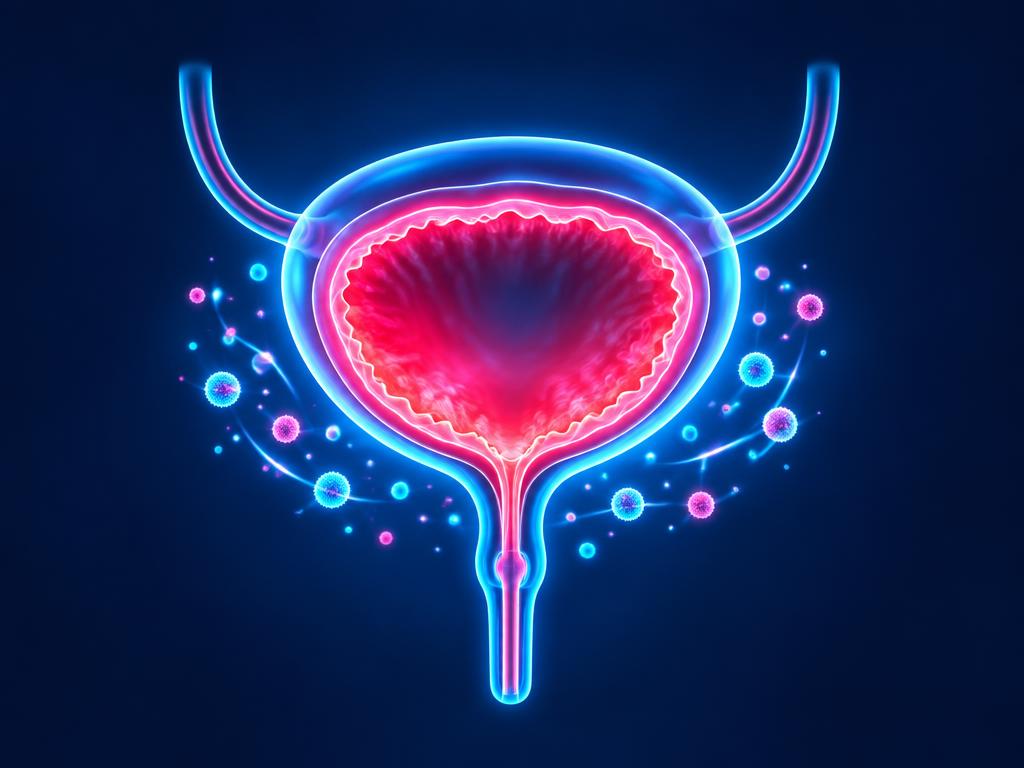
Interstitial cystitis/bladder pain syndrome (IC/BPS) is a chronic, often debilitating condition marked by bladder pain, urgency, and frequent urination, with no cure and treatments that frequently fall short. Stem cell therapy is being explored as a way to calm bladder inflammation and repair damaged tissue rather than just manage symptoms. This article lays out honestly where that research actually stands: encouraging signals in animal studies and a small run of early human trials, but nothing yet approved, standardized, or proven to work at scale.
How It's Thought to Work
Most research has focused on mesenchymal stem cells (MSCs) — including bone marrow-derived MSCs and, more recently, MSCs derived from human embryonic stem cells (hESCs) — delivered either by injection directly into the bladder wall or intravenously. The working theory is that these cells don't need to permanently engraft to help; instead, they appear to act mainly through paracrine signaling, releasing anti-inflammatory and tissue-repair factors that quiet the overactive immune response in the bladder lining, reduce nerve irritation, and support healing of damaged urothelium (the bladder's inner lining). This mechanism is plausible and consistent with how MSCs behave in other inflammatory conditions, but it is still being characterized rather than definitively proven in the human bladder.
What the Evidence Shows
The evidence base is real but early, and it's important to be precise about what kind of evidence it is. Most of it comes from animal models. In one notable study, researchers used a TLR7 agonist (loxoribine) to induce a Hunner-type IC-like condition in rats, then gave intravenous bone marrow-derived MSCs; treated animals showed significantly less bladder inflammation, preserved normal voiding patterns, and reduced pain-related freezing behavior compared to untreated animals (BMC Urology, 2021). Other rodent studies have shown similar reductions in bladder inflammation and overactivity after MSC injection.
On the human side, data is limited to small, early-phase trials — but the signal is genuinely promising. A Phase I safety study injected hESC-derived MSCs directly into the bladder wall of three women with Hunner-lesion IC; no cell-related adverse events occurred, pain scores improved in all three patients within a month, and one patient's Hunner lesion had fully disappeared by 12 months (Stem Cells Translational Medicine, 2022). Building on that, a subsequent single-center Phase 1/2a trial of the same hESC-derived MSC product (MR-MC-01) enrolled 22 patients and found no serious drug-related adverse events at the tested doses. At 6 months, the treated group showed larger reductions in validated symptom scores (ICQ and PUF) than placebo, 8 of 12 treated patients had Hunner lesions shrink or resolve, and more treated patients reported moderate-to-marked improvement on a global response assessment than those on placebo (Stem Cells Translational Medicine, 2026). A 2024 review in LUTS: Lower Urinary Tract Symptoms concluded that while multiple stem cell types show promise preclinically, human evidence remains preliminary, and larger controlled trials are needed before any real-world conclusions can be drawn.
Who Might Be a Candidate
- Right now, this is not a standard or FDA-approved treatment for IC/BPS — it exists only within formal clinical trials.
- The human studies so far have specifically enrolled patients with Hunner-lesion (ulcerative) IC, a subtype confirmed on cystoscopy — not the broader non-ulcerative IC/BPS population.
- Trial participants have generally been adults with IC/BPS lasting many months and inadequate relief from standard treatments (diet changes, oral medications, bladder instillations, hydrodistension).
- Anyone interested should look for actively enrolling trials on ClinicalTrials.gov and discuss eligibility, risks, and realistic expectations with a urologist experienced in IC/BPS.
- This is not something to pursue through unregulated stem cell clinics offering bladder "stem cell treatments" outside of a registered trial — those are not the same as the studied, cell-banked, quality-controlled products used in the research above.
Bottom Line
There is a real and encouraging thread of research here: a plausible anti-inflammatory mechanism, consistently positive animal data, and — notably for such an early-stage therapy — a small human trial program that has so far reported a favorable safety profile along with meaningful symptom and lesion improvements compared to placebo. That combination is more than many early regenerative therapies can claim at this stage. But it remains exactly that — early stage. The human efficacy data comes from a single research group's small, single-center trials that have not yet been replicated or confirmed in larger, independent studies, and stem cell therapy for IC/BPS is not an approved, mainstream, or widely available treatment. Anyone considering it should treat it as investigational, pursue it only through legitimate clinical trials, and stay in close contact with a urologist about proven treatment options in the meantime.
Sources
- Safety of Human Embryonic Stem Cell-derived Mesenchymal Stem Cells for Treating Interstitial Cystitis: A Phase I Study — Stem Cells Translational Medicine, 2022 — https://academic.oup.com/stcltm/article/11/10/1010/6693681
- A single-center, phase 1/2a trial of hESC-derived mesenchymal stem cells (MR-MC-01) for safety and efficacy in interstitial cystitis patients — Stem Cells Translational Medicine, 2026 — https://academic.oup.com/stcltm/article/14/5/szaf018/8137714
- Stem cell therapy for interstitial cystitis/bladder pain syndrome — LUTS: Lower Urinary Tract Symptoms (Wiley), 2024 — https://onlinelibrary.wiley.com/doi/10.1111/luts.12527
- Possible role of intravenous administration of mesenchymal stem cells to alleviate interstitial cystitis/bladder pain syndrome in a Toll-like receptor-7 agonist-induced experimental animal model in rat — BMC Urology, 2021 — https://link.springer.com/article/10.1186/s12894-021-00923-3
Related Articles
- Clinical Applications
Stem Cell Therapy for ALS
No stem cell therapy is FDA-approved for ALS. Here's what NurOwn's Phase 3 actually showed, why South Korea approved Neuronata-R, and what realistic candidacy looks like today.
- Clinical Applications
Stem Cell Therapy for Intraventricular Hemorrhage (IVH) in Premature Infants
Severe brain bleeds in extremely premature infants have no approved treatment. Cord blood-derived MSCs delivered into the ventricles have real safety data and some encouraging long-term signals — but the pivotal randomized trial missed its primary endpoint.
- Clinical Applications
Stem Cell Therapy for Meniscus and ACL Injuries
A Japanese phase III trial found large, durable knee-function gains when synovial MSCs were added to meniscal repair. For ACL surgery, systematic review evidence says cellular augmentation is not yet evidence-based.