Embryonic Stem Cells vs. Adult Stem Cells: What's the Difference?
What this article covers
- What Are Embryonic Stem Cells?
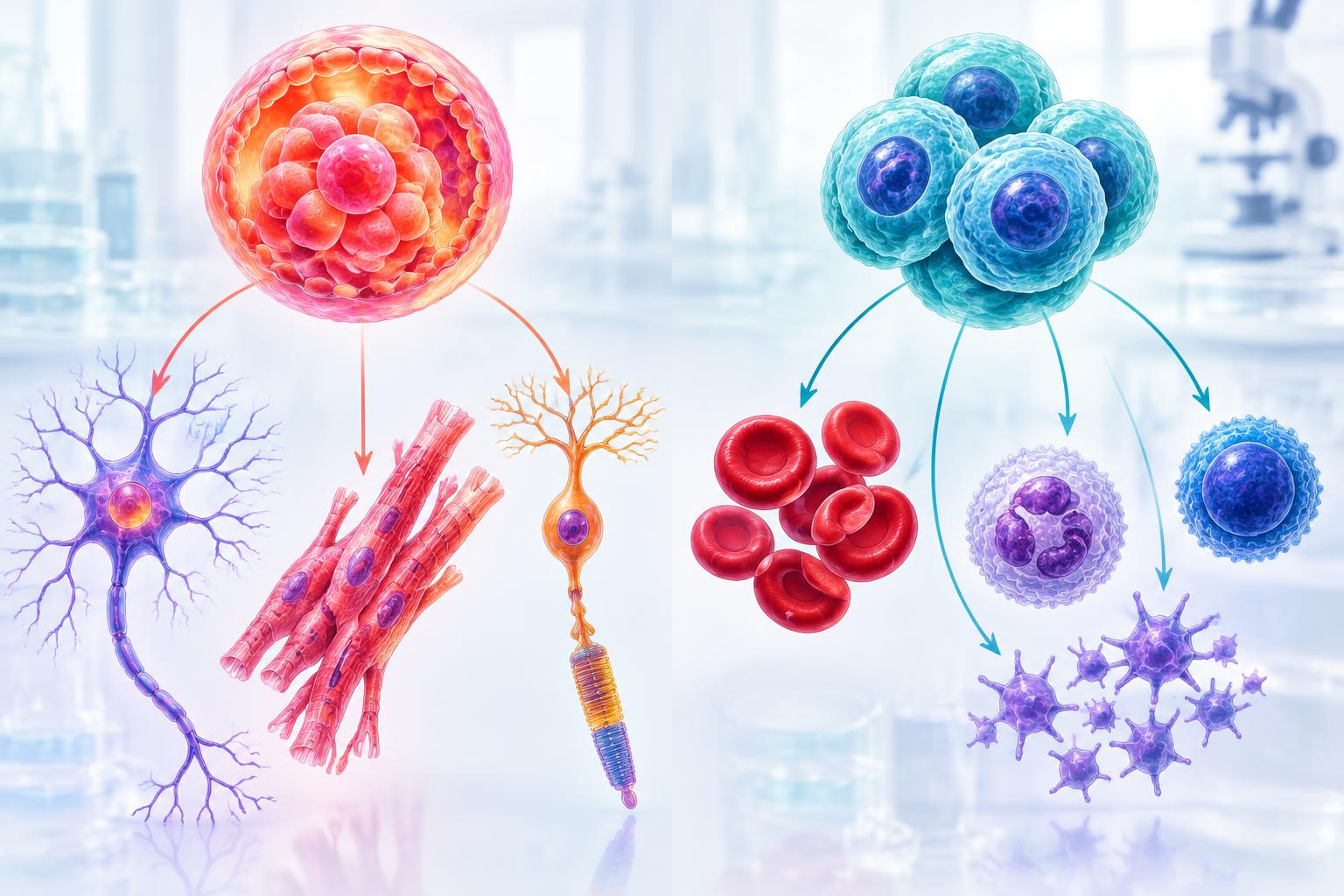
- Embryonic stem cells (ESCs) are derived from the inner cell mass of a blastocyst — an early-stage embryo, typically five to six days past fertilization, usually one left over from in vitro fertilization (IVF) procedures and donated with consent for research rather than implantation. The National Institutes of Health's Stem Cell Information resource describes these cells as pluripotent, meaning they have the ability to differentiate into essentially all of the roughly 200 cell types found in the adult body — nerve cells, heart muscle, pancreatic islet cells, retinal cells, and more.
- What Are Adult Stem Cells?
- Adult stem cells (also called somatic or tissue-specific stem cells) are found in small numbers throughout mature tissues and organs — bone marrow, blood, skin, fat, and the lining of the gut, among others. Unlike embryonic stem cells, they are not derived from an embryo; they can be collected from a child or adult's own tissue, from a matched donor, or from donated umbilical cord blood after birth.
- Key Differences in Potential and Use
- The core distinction is potency — the range of cell types a stem cell can become:
- The Ethical Debate, Briefly
- Because deriving new embryonic stem cell lines destroys the embryo used, the question of embryo moral status has made this one of the more politically contested areas of biomedical research. In the United States, the 1996 Dickey-Wicker Amendment barred federal funds from being used to create human embryos for research or for research that destroys, discards, or knowingly subjects embryos to risk of injury — a rider renewed annually in federal appropriations bills.
- Where the Science Stands Today
- Adult-stem-cell-derived treatments are the ones with a genuine, long-standing clinical track record. The FDA currently lists multiple approved hematopoietic progenitor cell (HPC) products derived from cord blood — including HEMACORD, ALLOCORD, CLEVECORD, and others — used in blood and immune system reconstitution procedures, building on decades of bone marrow and cord blood transplantation for leukemia, lymphoma, and related conditions.
"Stem cells" is often used as if it describes one thing, but it actually covers several very different cell types with different origins, different capabilities, and different places in medicine today. This article compares the two classic categories — embryonic stem cells and adult (somatic) stem cells — explaining what each one is, where it comes from, how much it can become, and where each stands in real clinical use and research as of late 2026, including a brief, even-handed look at the ethical debate that has shaped U.S. policy on embryonic stem cell research for nearly three decades.
What Are Embryonic Stem Cells?
Embryonic stem cells (ESCs) are derived from the inner cell mass of a blastocyst — an early-stage embryo, typically five to six days past fertilization, usually one left over from in vitro fertilization (IVF) procedures and donated with consent for research rather than implantation. The National Institutes of Health's Stem Cell Information resource describes these cells as pluripotent, meaning they have the ability to differentiate into essentially all of the roughly 200 cell types found in the adult body — nerve cells, heart muscle, pancreatic islet cells, retinal cells, and more. Deriving a human embryonic stem cell line currently requires removing the inner cell mass, which destroys the embryo's capacity to develop further. That single fact is the root of most of the ethical debate discussed below.
What Are Adult Stem Cells?
Adult stem cells (also called somatic or tissue-specific stem cells) are found in small numbers throughout mature tissues and organs — bone marrow, blood, skin, fat, and the lining of the gut, among others. Unlike embryonic stem cells, they are not derived from an embryo; they can be collected from a child or adult's own tissue, from a matched donor, or from donated umbilical cord blood after birth. According to NIH's Stem Cell Information resource, adult stem cells act as an internal repair system, generally limited to producing the specialized cell types of the tissue or organ in which they reside — for example, blood-forming (hematopoietic) stem cells in bone marrow give rise to red blood cells, white blood cells, and platelets, but not to neurons or heart cells.
Key Differences in Potential and Use
The core distinction is potency — the range of cell types a stem cell can become:
- Embryonic stem cells are pluripotent. They can, in principle, give rise to any cell type in the body, which makes them a powerful research tool for understanding development and disease, and a candidate source for regenerating many different tissues.
- Adult stem cells are more limited (often described as multipotent or unipotent). They typically differentiate only into the cell types of their tissue of origin, which makes them less flexible but also, in some respects, more predictable and easier to use safely.
- Availability and practicality differ too. Adult stem cells, especially hematopoietic stem cells from bone marrow or cord blood, have been collected, banked, and transplanted for decades. Embryonic stem cell lines are fewer in number, require specialized derivation and culture, and have historically been subject to additional regulatory and funding restrictions (see below).
- Clinical maturity differs sharply. Adult-stem-cell-based treatments — chiefly bone marrow and cord blood transplants — are established, FDA-licensed therapies for certain blood cancers and immune disorders. Embryonic-stem-cell-derived therapies remain, almost entirely, in clinical trials rather than approved use.
The Ethical Debate, Briefly
Because deriving new embryonic stem cell lines destroys the embryo used, the question of embryo moral status has made this one of the more politically contested areas of biomedical research. In the United States, the 1996 Dickey-Wicker Amendment barred federal funds from being used to create human embryos for research or for research that destroys, discards, or knowingly subjects embryos to risk of injury — a rider renewed annually in federal appropriations bills. Policy around which existing stem cell lines could be used with federal money has shifted with different administrations: President George W. Bush restricted federally funded research in 2001 to a limited set of already-existing lines, and President Obama's 2009 executive order lifted that restriction, though Dickey-Wicker's funding limits on new embryo destruction remain in place today. These policies affected federal funding eligibility, not whether privately funded embryonic stem cell research could occur at all. A related, less controversial development: in 2006–2007, Shinya Yamanaka's lab showed that adult cells could be reprogrammed in the lab into an embryonic-like pluripotent state — induced pluripotent stem cells, or iPSCs — without using embryos at all, work that earned Yamanaka a share of the 2012 Nobel Prize in Physiology or Medicine. iPSCs don't make embryonic or adult stem cells obsolete, and they bring their own research questions, but they're a widely used way to get pluripotent-type cells for research and emerging therapies while sidestepping the embryo-destruction issue — worth knowing as context, even though a full treatment of iPSCs is its own topic.
Where the Science Stands Today
Adult-stem-cell-derived treatments are the ones with a genuine, long-standing clinical track record. The FDA currently lists multiple approved hematopoietic progenitor cell (HPC) products derived from cord blood — including HEMACORD, ALLOCORD, CLEVECORD, and others — used in blood and immune system reconstitution procedures, building on decades of bone marrow and cord blood transplantation for leukemia, lymphoma, and related conditions. Embryonic-stem-cell-derived products, by contrast, remain investigational. One closely watched example is OpRegen, a one-time injection of embryonic-stem-cell-derived retinal pigment epithelial cells being studied for geographic atrophy, an advanced form of dry age-related macular degeneration; its Phase I/IIa trial is complete with encouraging long-term follow-up data, and a Phase II trial (GAlette) is now underway — promising, but not yet an approved treatment. Separately, stem-cell-derived islet cell therapies for type 1 diabetes, such as Vertex's zimislecel (VX-880), have shown notable early results — in a small cohort, treated patients regained their own insulin production and most were able to stop injected insulin — but this program, too, is still in Phase 3 trials, not an approved therapy. The pattern across the field is consistent: adult-stem-cell medicine is comparatively established for a narrow set of blood and immune conditions, while embryonic-stem-cell medicine is scientifically promising but still working through the trial process for a broader range of conditions.
Bottom Line
Embryonic and adult stem cells differ in where they come from and how much they can become: embryonic stem cells are pluripotent and derived from early embryos, while adult stem cells are more limited in what they can turn into and are drawn from existing tissues, including bone marrow and cord blood. Adult-stem-cell therapies, especially hematopoietic stem cell transplants, have decades of established clinical use and several FDA-approved products behind them. Embryonic-stem-cell-derived therapies remain earlier in development — genuinely promising in trials for conditions like geographic atrophy and type 1 diabetes, but not yet approved treatments. Understanding this distinction is a useful foundation for evaluating any specific claim you encounter about "stem cell" treatments, since the type of cell involved says a great deal about how established — or how experimental — a given therapy actually is.
Key Questions Answered
- How does embryonic stem cell potency differ from adult stem cell potency?
- Embryonic stem cells are pluripotent, able to become essentially all adult body cell types. Adult stem cells generally produce a narrower range of tissue-specific cells.
- Which stem cell treatments have established clinical use?
- Hematopoietic stem cell transplants from bone marrow or cord blood have decades of use for certain blood and immune conditions, with several FDA-approved cord blood products.
- Are OpRegen and zimislecel approved therapies?
- No. OpRegen and zimislecel remain investigational despite encouraging trial results; they are not approved treatments.
Sources
- Stem Cell Basics, NIH Stem Cell Information, National Institutes of Health — https://stemcells.nih.gov/info/basics/stc-basics
- Approved Cellular and Gene Therapy Products, U.S. Food and Drug Administration, 2025 — https://www.fda.gov/vaccines-blood-biologics/cellular-gene-therapy-products/approved-cellular-and-gene-therapy-products
- Dickey-Wicker Amendment, 1996, Embryo Project Encyclopedia, Arizona State University — https://embryo.asu.edu/pages/dickey-wicker-amendment-1996
- Shinya Yamanaka (1962- ), Embryo Project Encyclopedia, Arizona State University — https://embryo.asu.edu/pages/shinya-yamanaka-1962
- The Nobel Prize in Physiology or Medicine 2012 — Press Release, The Nobel Prize — https://www.nobelprize.org/prizes/medicine/2012/press-release/
- Lineage Cell Therapeutics' OpRegen Holds Potential to Become New Treatment Option for Geographic Atrophy, Clinical Trials Arena, 2025 — https://www.clinicaltrialsarena.com/analyst-comment/lineage-cell-therapeutics-promising-phase-i-iia-opregen-results-cts-2025
- Vertex Islet Cell Therapy VX-880 Restores Endogenous Insulin Secretion in Type 1 Diabetes, CGTLive, June 2025 — https://www.cgtlive.com/view/vertex-islet-cell-therapy-vx-880-restores-endogenous-insulin-secretion-type-1-diabetes
Related Articles
- Fundamentals
Myth: Testimonials and Before-and-After Photos Prove a Stem Cell Treatment Works
Patient stories can be sincere without proving efficacy. Learn how bias, placebo response and regression to the mean differ from controlled clinical evidence.
- Fundamentals
Types of Gastrointestinal Disease: Which Ones Are Being Studied With Stem Cell Therapy?
GI cell-therapy evidence varies sharply: Crohn’s fistula trials and early UC studies contrast with preclinical short bowel work and scarce IBS or celiac evidence.
- Fundamentals
Protecting Hearing Health As You Age: What the Evidence Actually Shows
Hearing protection and treatment support communication and social health; ACHIEVE’s cognitive benefit appeared in a higher-risk subgroup, not everyone.