Protecting Hearing Health As You Age: What the Evidence Actually Shows
What this article covers
- One of the Biggest Modifiable Levers We Have
- This deserves to be said plainly before any caveats: hearing loss is one of the most significant modifiable dementia risk factors identified in the research literature. The 2024 Lancet Commission on dementia prevention — a report from 27 experts, presented at the Alzheimer's Association International Conference — estimates that addressing 14 modifiable risk factors across life could prevent or delay nearly half of all dementia cases worldwide.
- What the ACHIEVE Trial Actually Found
- The best direct evidence comes from ACHIEVE, a randomized controlled trial of 977 adults aged 70–84 with untreated hearing loss, published in The Lancet in 2023.
- Noise Exposure: The Prevention You Control Earliest
- Cumulative noise damage is largely preventable at any age. The WHO estimates over 1 billion people aged 12–35 are at risk of hearing loss from unsafe recreational listening.
- Cardiovascular Health and the Inner Ear
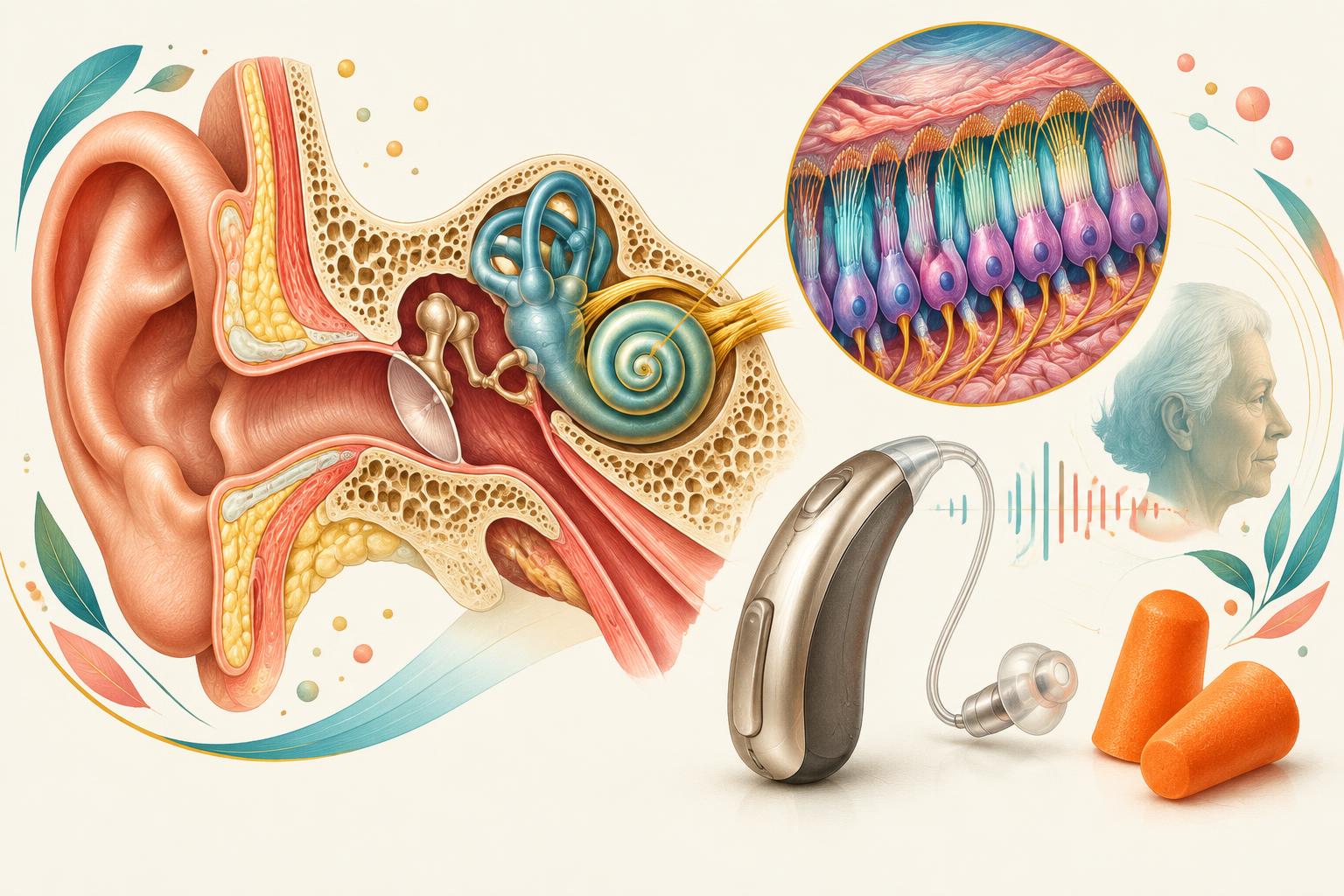
- The cochlea is tiny and highly vascular. Research — including an influential 2017 Lancet dementia-risk review — links cardiovascular risk factors like hypertension to higher rates of hearing loss, likely via reduced blood flow and oxygen to the ear's hair cells; sudden hearing loss has also been linked to elevated stroke risk.
- Ototoxic Medications
- Certain drugs carry documented ototoxicity risk, per Harvard Health: high-dose aspirin/salicylates, some chemotherapy agents (cisplatin, carboplatin), loop diuretics like furosemide, and some macrolide antibiotics at high or prolonged doses. This isn't a reason to avoid needed treatment — ask about monitoring, get a baseline hearing test before a known ototoxic drug when feasible, and report ringing, muffled hearing, or dizziness promptly.
Hearing loss is often treated as a minor, inevitable cost of aging. The research says otherwise. It's a documented contributor to cardiovascular and cognitive risk, and — critically — one of the few dementia risk factors people can actually act on. Here's what the WHO, the Lancet Commission on dementia, and the landmark ACHIEVE trial actually found, plus practical steps for protecting hearing at any age.
One of the Biggest Modifiable Levers We Have
This deserves to be said plainly before any caveats: hearing loss is one of the most significant modifiable dementia risk factors identified in the research literature. The 2024 Lancet Commission on dementia prevention — a report from 27 experts, presented at the Alzheimer's Association International Conference — estimates that addressing 14 modifiable risk factors across life could prevent or delay nearly half of all dementia cases worldwide. Midlife hearing impairment is one of those 14 factors, associated with roughly 7% of dementia cases globally — tied with high LDL cholesterol for the single largest share of any individual factor on the list. That's a striking number for something as manageable as a hearing test and, if needed, treatment.
What the ACHIEVE Trial Actually Found
The best direct evidence comes from ACHIEVE, a randomized controlled trial of 977 adults aged 70–84 with untreated hearing loss, published in The Lancet in 2023. The result is encouraging but nuanced:
- Across the full study population, hearing aids did not significantly slow cognitive decline overall versus a health-education control group.
- In a pre-specified subgroup of 238 participants from the Atherosclerosis Risk in Communities (ARIC) study — people with more cardiovascular/cognitive risk factors and faster baseline decline — hearing treatment slowed cognitive decline by 48% over three years.
- In both groups, treatment meaningfully improved communication, social functioning, and loneliness — real benefits in their own right.
Honest takeaway: the hearing-aid/dementia link is promising, not proven, and seems to matter most for people already at elevated risk. It's not settled science that hearing aids prevent dementia in everyone. But for older adults with cardiovascular or cognitive risk factors, treating hearing loss looks like a low-risk intervention with a measured upside.
Noise Exposure: The Prevention You Control Earliest
Cumulative noise damage is largely preventable at any age. The WHO estimates over 1 billion people aged 12–35 are at risk of hearing loss from unsafe recreational listening. NIOSH/CDC sets 85 decibels (averaged over eight hours) as the threshold requiring hearing protection, with safe exposure time roughly halving for every 3 dB increase above that.
- Follow the 60/60 rule for headphones: ~60% max volume, 60 minutes at a stretch, then rest your ears.
- Use earplugs at concerts, sporting events, or around loud machinery.
- Get a baseline hearing test in your 50s (earlier if noise-exposed work is involved), so later decline is measured against your own prior results.
Cardiovascular Health and the Inner Ear
The cochlea is tiny and highly vascular. Research — including an influential 2017 Lancet dementia-risk review — links cardiovascular risk factors like hypertension to higher rates of hearing loss, likely via reduced blood flow and oxygen to the ear's hair cells; sudden hearing loss has also been linked to elevated stroke risk. This is associative evidence, not proof of direct causation, but the same heart-protective habits (blood pressure control, not smoking, activity) plausibly protect hearing too.
Ototoxic Medications
Certain drugs carry documented ototoxicity risk, per Harvard Health: high-dose aspirin/salicylates, some chemotherapy agents (cisplatin, carboplatin), loop diuretics like furosemide, and some macrolide antibiotics at high or prolonged doses. This isn't a reason to avoid needed treatment — ask about monitoring, get a baseline hearing test before a known ototoxic drug when feasible, and report ringing, muffled hearing, or dizziness promptly.
Where Regenerative Research Stands
A brief, honest aside: researchers are actively studying whether stem cells can regenerate the inner ear's hair cells, which don't regenerate naturally in humans once lost. Progress exists in animal and cell models using induced pluripotent stem cells, but no stem-cell therapy currently restores human hearing in clinical use. For now, prevention and proven tools — hearing protection and hearing aids — remain the evidence-backed path.
Bottom Line
Hearing health is tied to cognitive, cardiovascular, and social outcomes, with real research behind each connection. Noise exposure is largely preventable with cheap, simple tools, and treating existing hearing loss — especially for those with elevated cardiovascular or cognitive risk — has shown a measured benefit in rigorous trials. But ACHIEVE didn't show a universal cognitive benefit, and the hearing-dementia link, while one of the strongest modifiable factors identified, doesn't guarantee treatment prevents dementia for every individual. Protect your ears now, get hearing checked regularly after 50, and treat hearing loss if it's found.
Key Questions Answered
- Did ACHIEVE show hearing aids prevent dementia for everyone?
- No. There was no significant overall cognitive benefit. A pre-specified higher-risk ARIC subgroup had 48% slower cognitive decline over three years, while communication and social benefits were also reported.
- How can people reduce noise-related hearing damage?
- Use earplugs around loud noise, moderate headphone volume, take listening breaks and consider a baseline hearing test in your 50s or earlier with occupational noise exposure.
- Can stem cells currently restore human hearing?
- No stem-cell therapy currently restores human hearing in clinical use. Hair-cell regeneration research remains in animal and cell models.
Sources
- Nearly half of dementia cases could be prevented or delayed by tackling 14 risk factors, UCL News, 31 July 2024 — https://www.ucl.ac.uk/news/2024/jul/nearly-half-dementia-cases-could-be-prevented-or-delayed-tackling-14-risk-factors
- Hearing aids slow cognitive decline in older adults with hearing loss and at risk for cognitive decline, UNC Gillings School of Global Public Health (ACHIEVE trial, published in The Lancet, July 2023) — https://sph.unc.edu/?p=407322
- Making listening safe, World Health Organization — https://www.who.int/activities/making-listening-safe
- Noise-Induced Hearing Loss, NIOSH / CDC — https://www.cdc.gov/niosh/noise/about/noise.html
- Ototoxic drugs: Medications that may harm hearing, Harvard Health Publishing — https://www.health.harvard.edu/staying-healthy/ototoxic-drugs-medications-that-may-harm-hearing
- How Hearing Loss Is Associated with Hypertension, Heart Disease, and Stroke, HearingTracker (citing Livingston et al., The Lancet, 2017) — https://www.hearingtracker.com/de/stories/hearing-loss/connections-between-hearing-loss-and-hypertension-heart-disease-and-stroke
Related Articles
- Fundamentals
Types of Gastrointestinal Disease: Which Ones Are Being Studied With Stem Cell Therapy?
GI cell-therapy evidence varies sharply: Crohn’s fistula trials and early UC studies contrast with preclinical short bowel work and scarce IBS or celiac evidence.
- Fundamentals
What Is Myasthenia Gravis?
Myasthenia gravis disrupts nerve-to-muscle signaling. Established therapies help many patients, while engineered T-cell approaches remain early-stage and unapproved.
- Fundamentals
What Are Yamanaka Factors? The Four Genes That Turn Adult Cells Into Stem Cells
Oct4, Sox2, Klf4, and c-Myc can reset adult cells to pluripotency. Their Nobel-winning discovery transformed research, but most iPSC-derived therapies remain investigational.