What Are Yamanaka Factors? The Four Genes That Turn Adult Cells Into Stem Cells
What this article covers
- The 2006 Discovery
- In August 2006, Shinya Yamanaka and Kazutoshi Takahashi at Kyoto University published a paper in the journal Cell describing how they screened 24 candidate genes known to be important in embryonic stem cells, searching for a minimal combination that could reprogram an ordinary adult cell back into a pluripotent, embryonic-like state. They started with mouse skin cells called fibroblasts and worked their way down to a specific combination of four genes that, together, proved sufficient.
- The Four Factors
- The combination Yamanaka's team landed on is often remembered by the shorthand "OSKM": Oct3/4 (also called Oct4), Sox2, Klf4, and c-Myc. Each plays a distinct role in resetting a cell's identity.
- Why This Discovery Mattered
- Before 2006, the only known way to get a pluripotent stem cell was to derive one from a human embryo, a path that raised significant ethical objections and legal restrictions in many countries, or to use a technique called somatic cell nuclear transfer (a separate reprogramming method sometimes described as "therapeutic cloning") that is technically demanding and also ethically contested. The Yamanaka factors offered something fundamentally different: a way to generate pluripotent cells genetically matched to any individual patient, starting from a simple skin or blood sample, without using an embryo at all.
- How the Technique Has Evolved
- The original method carried real limitations that researchers have spent nearly two decades working to address. c-Myc is a known cancer-associated gene, and viral delivery methods that permanently insert genetic material into a cell's genome raised concerns about unpredictable mutations and tumor risk — concerns that mattered enormously once scientists began considering iPSCs for actual patient treatment rather than laboratory research alone.
- What iPSCs Are Not
- It's worth being precise about what this technology does and doesn't mean for patients today. iPSC-derived therapies remain investigational for the overwhelming majority of conditions; very few iPSC-based treatments have reached regulatory approval anywhere in the world, and the ones furthest along are still working through controlled, carefully monitored clinical trials rather than routine clinical use.
In 2006, a Japanese research team discovered that ordinary adult skin cells could be reset to an embryonic-like state using just four genes — a finding so significant it earned a Nobel Prize within six years of publication. Those four genes are known today as the Yamanaka factors, and they are arguably the single most important discovery in modern stem cell biology. This article explains what the Yamanaka factors actually are, how reprogramming works, why the discovery mattered so much, and where the science stands today.
The 2006 Discovery
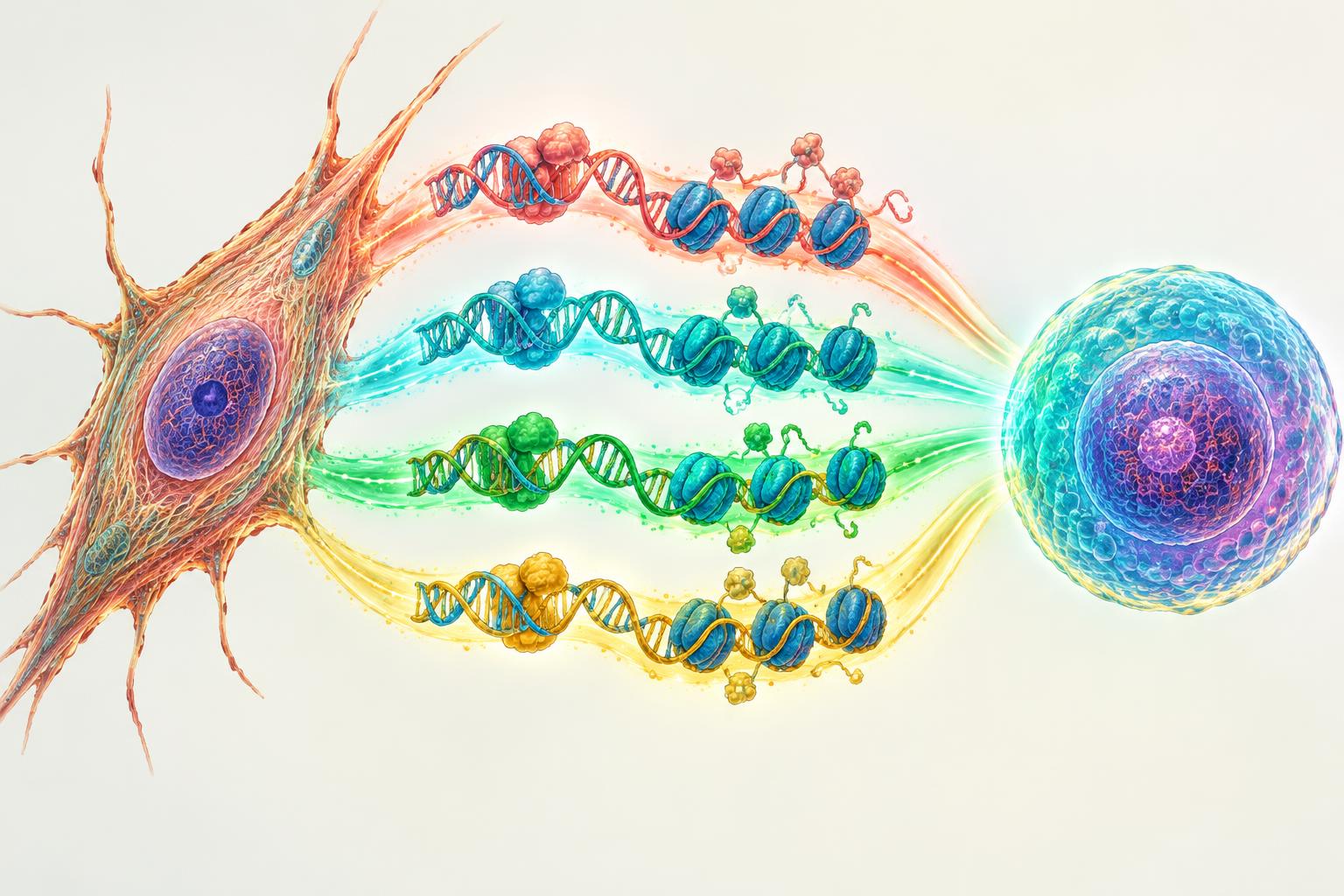
In August 2006, Shinya Yamanaka and Kazutoshi Takahashi at Kyoto University published a paper in the journal Cell describing how they screened 24 candidate genes known to be important in embryonic stem cells, searching for a minimal combination that could reprogram an ordinary adult cell back into a pluripotent, embryonic-like state. They started with mouse skin cells called fibroblasts and worked their way down to a specific combination of four genes that, together, proved sufficient. The resulting cells — dubbed "induced pluripotent stem cells," or iPSCs — showed the physical appearance, growth pattern, and genetic activity of true embryonic stem cells. When injected under the skin of mice, they formed tumors containing tissue from all three of the body's primary germ layers, a classic test of pluripotency. A year later, in 2007, Yamanaka's team and a separate group led by James Thomson at the University of Wisconsin independently showed the same basic approach worked on human cells.
The Four Factors
The combination Yamanaka's team landed on is often remembered by the shorthand "OSKM": Oct3/4 (also called Oct4), Sox2, Klf4, and c-Myc. Each plays a distinct role in resetting a cell's identity. Oct4 and Sox2 are core regulators of the gene networks that keep embryonic stem cells pluripotent — able, in principle, to become almost any cell type in the body. Klf4 works alongside them to help reactivate that network in a cell that has already specialized into something else, like skin. c-Myc is a well-known growth-promoting gene that boosts cell proliferation and helps loosen the chromatin (the tightly packaged form of DNA) enough for the other three factors to access genes that had been switched off. Introducing all four together — originally via viral vectors that inserted the genes into the cell's genome — was enough to gradually erase a mature cell's specialized identity and restore the broad developmental potential of an early embryonic cell.
Why This Discovery Mattered
Before 2006, the only known way to get a pluripotent stem cell was to derive one from a human embryo, a path that raised significant ethical objections and legal restrictions in many countries, or to use a technique called somatic cell nuclear transfer (a separate reprogramming method sometimes described as "therapeutic cloning") that is technically demanding and also ethically contested. The Yamanaka factors offered something fundamentally different: a way to generate pluripotent cells genetically matched to any individual patient, starting from a simple skin or blood sample, without using an embryo at all. That combination of patient-specific matching and no embryo requirement reshaped the stem cell field almost overnight. In 2012, Yamanaka shared the Nobel Prize in Physiology or Medicine with John Gurdon, whose earlier work on frog cells had shown that mature cell identity could, in principle, be reversed — a finding the Nobel committee credited as foundational to Yamanaka's discovery.
How the Technique Has Evolved
The original method carried real limitations that researchers have spent nearly two decades working to address. c-Myc is a known cancer-associated gene, and viral delivery methods that permanently insert genetic material into a cell's genome raised concerns about unpredictable mutations and tumor risk — concerns that mattered enormously once scientists began considering iPSCs for actual patient treatment rather than laboratory research alone. Since then, researchers have developed reprogramming methods that avoid permanently altering the genome altogether, using non-integrating viruses, synthetic mRNA, or small-molecule chemical cocktails, and some protocols now substitute less cancer-associated genes for c-Myc. iPSC technology is now used widely to create "disease in a dish" models for studying conditions in the lab, to screen drug candidates, and as a starting material for experimental cell therapies — including some of the autologous (patient's-own-cell) approaches now being tested in early clinical trials for conditions like Parkinson's disease.
What iPSCs Are Not
It's worth being precise about what this technology does and doesn't mean for patients today. iPSC-derived therapies remain investigational for the overwhelming majority of conditions; very few iPSC-based treatments have reached regulatory approval anywhere in the world, and the ones furthest along are still working through controlled, carefully monitored clinical trials rather than routine clinical use. A clinic advertising an "iPSC stem cell treatment" outside of a registered clinical trial should be treated with real skepticism — Yamanaka's discovery was a landmark in basic science and remains a vital research tool, but turning it into safe, effective, FDA-approved therapies is still very much a work in progress.
Bottom Line
The Yamanaka factors — Oct4, Sox2, Klf4, and c-Myc — gave scientists a way to reset a mature adult cell back to an embryonic-like, pluripotent state without using an embryo, a discovery that reshaped stem cell research and won the 2012 Nobel Prize. The technology remains primarily a research tool today, with genuine but still largely early-stage promise for future cell therapies.
Key Questions Answered
- What are the four Yamanaka factors?
- Oct3/4 (Oct4), Sox2, Klf4, and c-Myc, often abbreviated OSKM, can together reset adult cells to an embryonic-like, pluripotent state.
- Why did the discovery matter?
- It provided a way to generate patient-matched pluripotent cells from adult skin or blood without using an embryo, reshaping stem cell research.
- Are iPSC-derived treatments routine care today?
- For the overwhelming majority of conditions they remain investigational. Most are still being developed in controlled, monitored clinical trials rather than routine use.
Sources
- Takahashi K, Yamanaka S. "Induction of Pluripotent Stem Cells from Mouse Embryonic and Adult Fibroblast Cultures by Defined Factors." Cell, 2006.
- "Four Transcription Factors Convert Adult Cells Into Stem Cells" — ScienceDaily, August 2006, https://www.sciencedaily.com/releases/2006/08/060824222644.htm
- The Nobel Prize in Physiology or Medicine 2012 — NobelPrize.org, https://www.nobelprize.org/prizes/medicine/2012/
- Induced Pluripotent Stem Cell Experiments by Kazutoshi Takahashi and Shinya Yamanaka in 2006 and 2007 — Arizona State University Embryo Project Encyclopedia, https://embryo.asu.edu/pages/induced-pluripotent-stem-cell-experiments-kazutoshi-takahashi-and-shinya-yamanaka-2006-and
Related Articles
- Fundamentals
Myth: Younger Donor Stem Cells Are Always More Potent Than Your Own
Aging can reduce some stem cell functions, but tissue source, laboratory expansion, and actual potency testing matter more than a blanket younger-is-better claim.
- Fundamentals
Types of Bone and Skeletal Disease: Which Ones Are Being Studied With Stem Cell Therapy?
From osteoporosis to avascular necrosis and fracture non-union, stem cell research spans many bone diseases — but the depth of evidence varies enormously, and none has FDA approval.
- Fundamentals
Protecting Skin Health As You Age: What the Evidence Actually Shows
Sunscreen, retinoids, and vitamin C have real evidence behind them; exosome skincare does not. What controlled studies actually support for slowing visible skin aging.