Protecting Skin Health As You Age: What the Evidence Actually Shows
What this article covers
- Why Skin Ages: Two Processes, Not One
- The National Library of Medicine's MedlinePlus describes sun exposure as "a major cause of skin aging," and also names smoking as a contributor, noting that wrinkling tends to increase with the number of cigarettes and years smoked. Separately, skin ages intrinsically with time regardless of sun exposure — it thins, loses underlying fat, and becomes less plump and slower to heal.
- What the Evidence Actually Supports
- Sun protection has the strongest and most consistent evidence base of any skin-aging intervention. The American Academy of Dermatology recommends a broad-spectrum sunscreen (protecting against both UVA and UVB) of SPF 30 or higher, reapplied and chosen with water resistance (rated for either 40 or 80 minutes) in mind for activity in water or sweat.
- Where Regenerative Approaches Stand Today
- Stem cell-derived exosome and "secretome" serums have become common in aesthetic skincare marketing. Exosomes are real, well-characterized extracellular vesicles involved in cell-to-cell signaling, and that underlying biology is genuinely studied.
- What's Still Unproven or Overhyped
- Claims that topical exosome or "secretome" serums can regenerate skin, reverse aging, or substitute for sun protection and retinoids are not supported by current human trial evidence. The same caution applies to marketing language implying these products are medically equivalent to prescription treatments; cosmetic status specifically means they have not cleared that bar.
- Bottom Line
- The best-supported tools for visible skin aging remain unglamorous: daily broad-spectrum SPF 30+ sunscreen, and, for some people, prescription-strength retinoids used consistently over months. Topical vitamin C has promising but still limited human evidence.
Skin aging is driven by two largely separate processes — intrinsic aging (genetically programmed, time-dependent decline) and photoaging (cumulative UV damage) — and the distinction matters because only one of them is substantially preventable. This article reviews what controlled evidence actually supports for slowing visible skin aging: sun protection, topical retinoids, and antioxidants such as vitamin C. It also looks honestly at where regenerative-medicine-adjacent products — stem cell-derived exosome and "secretome" skincare — stand today, and why most of those claims currently outrun the data.
Why Skin Ages: Two Processes, Not One
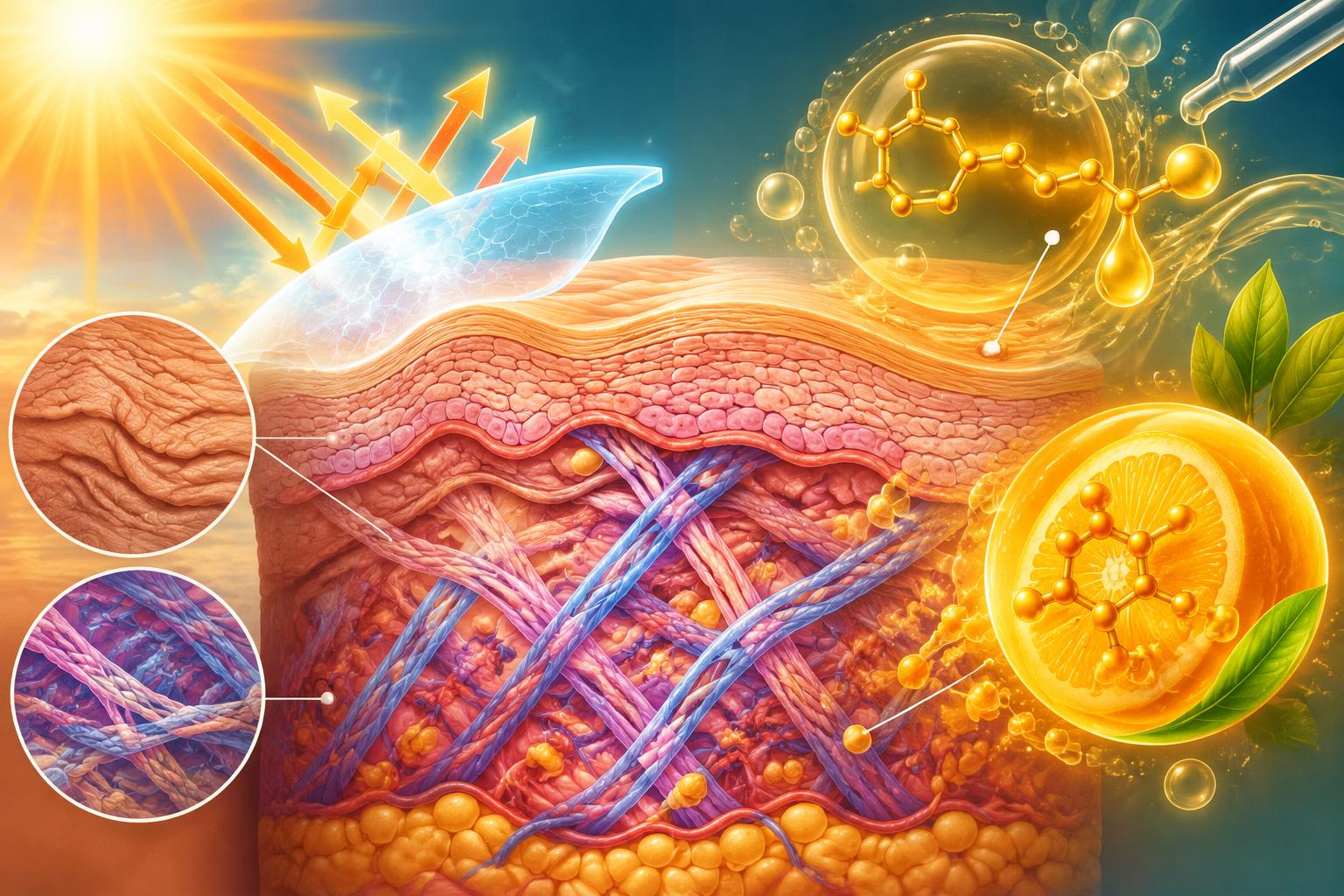
The National Library of Medicine's MedlinePlus describes sun exposure as "a major cause of skin aging," and also names smoking as a contributor, noting that wrinkling tends to increase with the number of cigarettes and years smoked. Separately, skin ages intrinsically with time regardless of sun exposure — it thins, loses underlying fat, and becomes less plump and slower to heal. Because photoaging is cumulative and largely avoidable, it is also the piece of the picture dermatology has the most leverage over.
What the Evidence Actually Supports
Sun protection has the strongest and most consistent evidence base of any skin-aging intervention. The American Academy of Dermatology recommends a broad-spectrum sunscreen (protecting against both UVA and UVB) of SPF 30 or higher, reapplied and chosen with water resistance (rated for either 40 or 80 minutes) in mind for activity in water or sweat. Because UVA wavelengths penetrate deeply and drive much of the collagen-damaging photoaging process, broad-spectrum coverage — not SPF alone — is the key label detail.
Retinoids are evidence-supported, but strength of evidence depends heavily on formulation. Prescription tretinoin (Renova) is FDA-approved as an adjunct therapy for mitigating fine wrinkles, mottled hyperpigmentation, and tactile roughness. In trials supporting that approval, moderate improvement in fine wrinkling occurred in 24% of tretinoin-treated patients versus 8% on vehicle over 24 weeks — real but modest, and the FDA label states tretinoin does not eliminate wrinkles or reverse photoaging. Over-the-counter retinol is a different story: a 2021 systematic review in The Journal of Clinical and Aesthetic Dermatology examined nine randomized, vehicle-controlled OTC retinol trials; four showed no significant benefit over vehicle, and the remaining five suggested only a possible mild effect on fine lines, with notable methodological limitations. The reviewer concluded there is "very little, if any, trustworthy evidence" for OTC retinol's anti-aging claims as currently studied — a more cautious verdict than retinoid marketing generally implies.
Topical antioxidants, particularly vitamin C, have biologically plausible, partially supported evidence. A review in The Journal of Clinical and Aesthetic Dermatology cites small placebo-controlled trials (10 to 20 subjects) showing protective effects against photoaging, while noting "clinical studies on the efficacy of topical formulations of vitamin C remain limited." The direction is favorable; the sample sizes are not yet large.
Where Regenerative Approaches Stand Today
Stem cell-derived exosome and "secretome" serums have become common in aesthetic skincare marketing. Exosomes are real, well-characterized extracellular vesicles involved in cell-to-cell signaling, and that underlying biology is genuinely studied. But clinical evidence for topical cosmetic exosome products in humans remains preclinical or early-phase: supporting data largely comes from cultured-cell and animal-skin studies, not large controlled human trials, and no exosome product currently holds FDA approval for any dermatologic or aesthetic use. The regulatory context matters here: most topical cosmetic products, including these, are marketed as cosmetics rather than drugs, so they are not required to demonstrate efficacy or undergo FDA drug review before sale. The FDA has separately warned that unapproved, injectable cell-derived products have been linked to serious adverse events — including a 2019 safety notification after reported infections in Nebraska — and continues issuing warning letters to manufacturers of unapproved cell-based products.
What's Still Unproven or Overhyped
Claims that topical exosome or "secretome" serums can regenerate skin, reverse aging, or substitute for sun protection and retinoids are not supported by current human trial evidence. The same caution applies to marketing language implying these products are medically equivalent to prescription treatments; cosmetic status specifically means they have not cleared that bar.
Bottom Line
The best-supported tools for visible skin aging remain unglamorous: daily broad-spectrum SPF 30+ sunscreen, and, for some people, prescription-strength retinoids used consistently over months. Topical vitamin C has promising but still limited human evidence. Regenerative-medicine-derived skincare — exosomes and secretomes — rests on real cell biology but has not yet produced the large, controlled human trials needed to support the claims often made for it, and buyers should understand that cosmetic marketing status means no efficacy review was required. Evidence-based skin aging prevention today is less about novel ingredients and more about consistency with the few interventions that have actually been tested.
Key Questions Answered
- What has the strongest evidence for slowing visible skin aging?
- Daily broad-spectrum SPF 30+ sunscreen has the strongest and most consistent evidence base, followed by prescription-strength retinoids used consistently over months. Topical vitamin C has promising but limited human evidence.
- Do over-the-counter retinol products work for wrinkles?
- A 2021 systematic review of nine randomized, vehicle-controlled OTC retinol trials found four showed no significant benefit and five suggested only a possible mild effect, concluding there is very little trustworthy evidence for anti-aging claims.
- Are exosome skincare products FDA-approved?
- No. No exosome product holds FDA approval for any dermatologic or aesthetic use, and most are marketed as cosmetics, which are not required to demonstrate efficacy or undergo FDA drug review before sale.
Sources
- How to select a sunscreen — American Academy of Dermatology, 2025 — https://www.aad.org/public/everyday-care/sun-protection/shade-clothing-sunscreen/how-to-select-sunscreen
- RENOVA (tretinoin cream) 0.05% prescribing label — U.S. Food and Drug Administration, 2000 — https://www.accessdata.fda.gov/drugsatfda_docs/label/2000/19963S5%2C7LBL.PDF
- Spierings NMK, "Evidence for the Efficacy of Over-the-counter Vitamin A Cosmetic Products in the Improvement of Facial Skin Aging: A Systematic Review" — The Journal of Clinical and Aesthetic Dermatology, 2021 — https://pmc.ncbi.nlm.nih.gov/articles/PMC8675340/
- Topical Vitamin C and the Skin: Mechanisms of Action and Clinical Applications — The Journal of Clinical and Aesthetic Dermatology, 2017 — https://pmc.ncbi.nlm.nih.gov/articles/PMC5605218/
- Skin Changes With Aging — MedlinePlus / National Library of Medicine — https://medlineplus.gov/skinaging.html
- FDA Sends Warning to Companies Offering Unapproved Umbilical Cord Blood Products That May Put Patients at Risk — U.S. Food and Drug Administration, 2020 — https://www.fda.gov/news-events/press-announcements/fda-sends-warning-companies-offering-unapproved-umbilical-cord-blood-products-may-put-patients-risk
- Social Media Mythbusters: Exosomes in Skin Care — Dermatology Times, 2026 — https://www.dermatologytimes.com/view/social-media-mythbusters-exosomes-in-skin-care
Related Articles
- Fundamentals
What Are Yamanaka Factors? The Four Genes That Turn Adult Cells Into Stem Cells
Oct4, Sox2, Klf4, and c-Myc can reset adult cells to pluripotency. Their Nobel-winning discovery transformed research, but most iPSC-derived therapies remain investigational.
- Fundamentals
Myth: Younger Donor Stem Cells Are Always More Potent Than Your Own
Aging can reduce some stem cell functions, but tissue source, laboratory expansion, and actual potency testing matter more than a blanket younger-is-better claim.
- Fundamentals
Types of Bone and Skeletal Disease: Which Ones Are Being Studied With Stem Cell Therapy?
From osteoporosis to avascular necrosis and fracture non-union, stem cell research spans many bone diseases — but the depth of evidence varies enormously, and none has FDA approval.