Myth: Younger Donor Stem Cells Are Always More Potent Than Your Own
What this article covers
- The Myth, Stated Honestly
- The claim shows up in different forms: that a 65-year-old's own mesenchymal stem cells (MSCs) are essentially too old to be worth using, that donor cells from a young, healthy source are automatically the more potent choice, or that chronological donor age alone is a reliable proxy for how well a stem cell sample will perform. It's an appealingly simple story, and it isn't pure fiction — but it overstates and oversimplifies what the research actually shows.
- What the Evidence Actually Shows
- " A 2014 study in PLOS ONE compared bone marrow-, muscle-, and adipose-derived MSCs taken from the same young versus old rabbits, allowing a matched, controlled comparison across tissue sources. The results were source-specific, not universal: bone marrow-derived cells from older donors showed meaningfully slower proliferation (36% slower doubling time) and a sharp decline in their capacity to form cartilage tissue (down to about 7% of young-donor levels), while muscle- and adipose-derived cells from the same older animals were largely unaffected on those same measures.
- Why This Matters for Evaluating a Treatment
- Donor age is also just one variable among several that affect how well a stem cell sample performs — culture conditions, how many times the cells have been expanded in the lab (passage number), the specific tissue source, and individual donor health all matter too. Reputable labs and researchers assess a cell sample's actual quality directly, through laboratory tests called potency assays, rather than relying on donor age as a stand-in for that assessment.
- Bottom Line
- Aging does affect mesenchymal stem cells in measurable, real ways — but the effect is source-specific and function-specific, not the sweeping, one-size-fits-all decline the "younger is always better" pitch implies. Donor age is one factor worth understanding, not a substitute for actual evidence that a given cell product and treatment protocol works for your condition.
It's a common pitch in the stem cell marketplace: donor cells from a young, healthy person are framed as categorically superior to a patient's own (autologous) cells, especially for older patients, on the simple logic that younger cells must be more vigorous. There's real science behind the idea that aging affects stem cells — but the actual research shows something more specific, and more useful, than a blanket "younger is always better" rule. Here's what the evidence actually supports.
The Myth, Stated Honestly
The claim shows up in different forms: that a 65-year-old's own mesenchymal stem cells (MSCs) are essentially too old to be worth using, that donor cells from a young, healthy source are automatically the more potent choice, or that chronological donor age alone is a reliable proxy for how well a stem cell sample will perform. It's an appealingly simple story, and it isn't pure fiction — but it overstates and oversimplifies what the research actually shows.
What the Evidence Actually Shows
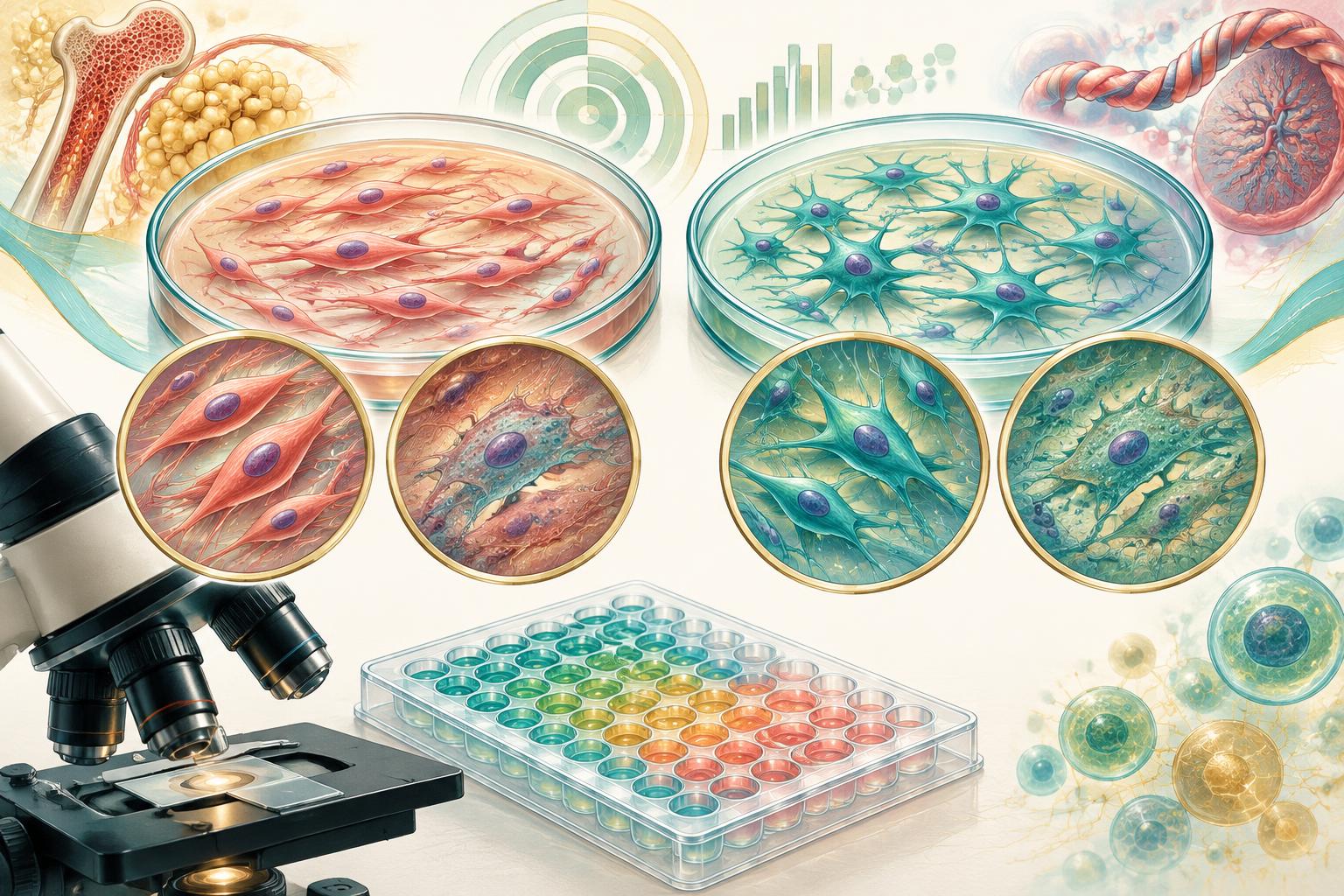
Aging does measurably affect mesenchymal stem cells, but the effect is neither uniform across all stem cell sources nor as simple as "older equals worse at everything." A 2014 study in PLOS ONE compared bone marrow-, muscle-, and adipose-derived MSCs taken from the same young versus old rabbits, allowing a matched, controlled comparison across tissue sources. The results were source-specific, not universal: bone marrow-derived cells from older donors showed meaningfully slower proliferation (36% slower doubling time) and a sharp decline in their capacity to form cartilage tissue (down to about 7% of young-donor levels), while muscle- and adipose-derived cells from the same older animals were largely unaffected on those same measures. Fat-forming (adipogenic) capacity declined with age across all three tissue sources, but to very different degrees — adipose-derived cells lost the most ground, while bone marrow and muscle-derived cells retained much more of their young-donor capacity. A separate 2014 study in the Journal of Translational Medicine similarly found that donor age negatively affected the expansion and differentiation capacity of adipose-derived stem cells — including reduced viability, more senescent features, and lower differentiation potential in cells from older donors — reinforcing that age-related decline is real for at least some stem cell properties and sources.
What this body of research supports is a more precise statement than the myth allows: aging can reduce specific stem cell functions, but which functions decline — and by how much — depends heavily on the tissue source and what the cells are being used for. A bone marrow sample from an older donor may be a meaningfully weaker choice for cartilage-focused applications specifically, while that same donor's adipose-derived cells might perform reasonably well on other measures. That's a very different, more useful claim than "younger cells are always more potent," which treats donor age as a single number that overrides everything else about a stem cell sample's actual biological quality.
Why This Matters for Evaluating a Treatment
Donor age is also just one variable among several that affect how well a stem cell sample performs — culture conditions, how many times the cells have been expanded in the lab (passage number), the specific tissue source, and individual donor health all matter too. Reputable labs and researchers assess a cell sample's actual quality directly, through laboratory tests called potency assays, rather than relying on donor age as a stand-in for that assessment. A clinic that cites a donor's age alone — without any cell-specific quality testing — as proof its product is superior is making a claim the science doesn't fully support. And for patients, the more important and far better-established question is usually not "how old was the donor" but whether the specific treatment, from either an autologous or allogeneic source, has actual clinical trial evidence behind it for the condition being treated.
Bottom Line
Aging does affect mesenchymal stem cells in measurable, real ways — but the effect is source-specific and function-specific, not the sweeping, one-size-fits-all decline the "younger is always better" pitch implies. Donor age is one factor worth understanding, not a substitute for actual evidence that a given cell product and treatment protocol works for your condition.
Key Questions Answered
- Are younger donor stem cells always more potent?
- No. Aging affects specific functions differently depending on tissue source and application. Donor age alone does not establish a cell product's quality or treatment effectiveness.
- What else influences stem cell quality?
- Tissue source, culture conditions, laboratory passage number and individual donor health also matter. Potency assays assess the sample directly rather than using age as a proxy.
- What is the more important question for patients?
- Whether the specific autologous or allogeneic treatment has clinical trial evidence for the condition being treated, rather than simply how old the donor was.
Sources
- Beane OS, Fonseca VC, Cooper LL, Koren G, Darling EM. "Impact of Aging on the Regenerative Properties of Bone Marrow-, Muscle-, and Adipose-Derived Mesenchymal Stem/Stromal Cells." PLOS ONE, 2014;9(12):e115963, https://journals.plos.org/plosone/article?id=10.1371%2Fjournal.pone.0115963
- Choudhery MS, Badowski M, Muise A, Pierce J, Harris DT. "Donor age negatively impacts adipose tissue-derived mesenchymal stem cell expansion and differentiation." Journal of Translational Medicine, 2014;12:8, https://translational-medicine.biomedcentral.com/articles/10.1186/1479-5876-12-8
- Lohmann M, et al. "Donor Age of Human Platelet Lysate Affects Proliferation and Differentiation of Mesenchymal Stem Cells." PLOS ONE, 2012;7(5):e37839, https://pmc.ncbi.nlm.nih.gov/articles/PMC3360602
Related Articles
- Fundamentals
What Are Yamanaka Factors? The Four Genes That Turn Adult Cells Into Stem Cells
Oct4, Sox2, Klf4, and c-Myc can reset adult cells to pluripotency. Their Nobel-winning discovery transformed research, but most iPSC-derived therapies remain investigational.
- Fundamentals
Types of Bone and Skeletal Disease: Which Ones Are Being Studied With Stem Cell Therapy?
From osteoporosis to avascular necrosis and fracture non-union, stem cell research spans many bone diseases — but the depth of evidence varies enormously, and none has FDA approval.
- Fundamentals
Protecting Skin Health As You Age: What the Evidence Actually Shows
Sunscreen, retinoids, and vitamin C have real evidence behind them; exosome skincare does not. What controlled studies actually support for slowing visible skin aging.