Types of Bone and Skeletal Disease: Which Ones Are Being Studied With Stem Cell Therapy?
What this article covers
- Osteoporosis and Low Bone Density
- S. 4 million living with low bone mass, and underlies roughly two million fractures a year, according to the Bone Health & Osteoporosis Foundation.
- Avascular Necrosis (Osteonecrosis)
- Avascular necrosis (AVN), most often affecting the femoral head, occurs when blood supply to a segment of bone is interrupted, causing the bone to die and eventually collapse. This is arguably the bone condition with the most substantial stem cell research behind it.
- Fracture Non-Union
- When a broken bone fails to heal on its own — a "non-union" — it can mean months or years of disability. Because MSCs are central to normal fracture repair, researchers have tested injecting bone-marrow-derived or concentrated cells, often combined with scaffolds or growth factors, directly into non-healing fracture sites.
- Osteogenesis Imperfecta
- Osteogenesis imperfecta (OI), or "brittle bone disease," is a rare genetic disorder of collagen production causing fragile, easily fractured bones. Because MSCs can differentiate into collagen-producing osteoblasts, pioneering trials have tested bone marrow and mesenchymal stromal cell transplantation in children, with some reports of modified growth and reduced fracture frequency in small cohorts.
- Osteoarthritis-Related Bone Changes
- Osteoarthritis is usually framed as a cartilage disease, but it also involves measurable changes in the underlying subchondral bone, including bone marrow lesions and altered bone remodeling. A separate strand of research — distinct from cartilage-focused MSC injections covered elsewhere — looks specifically at how subchondral bone MSC activity contributes to joint degeneration, raising the possibility of bone-targeted interventions.
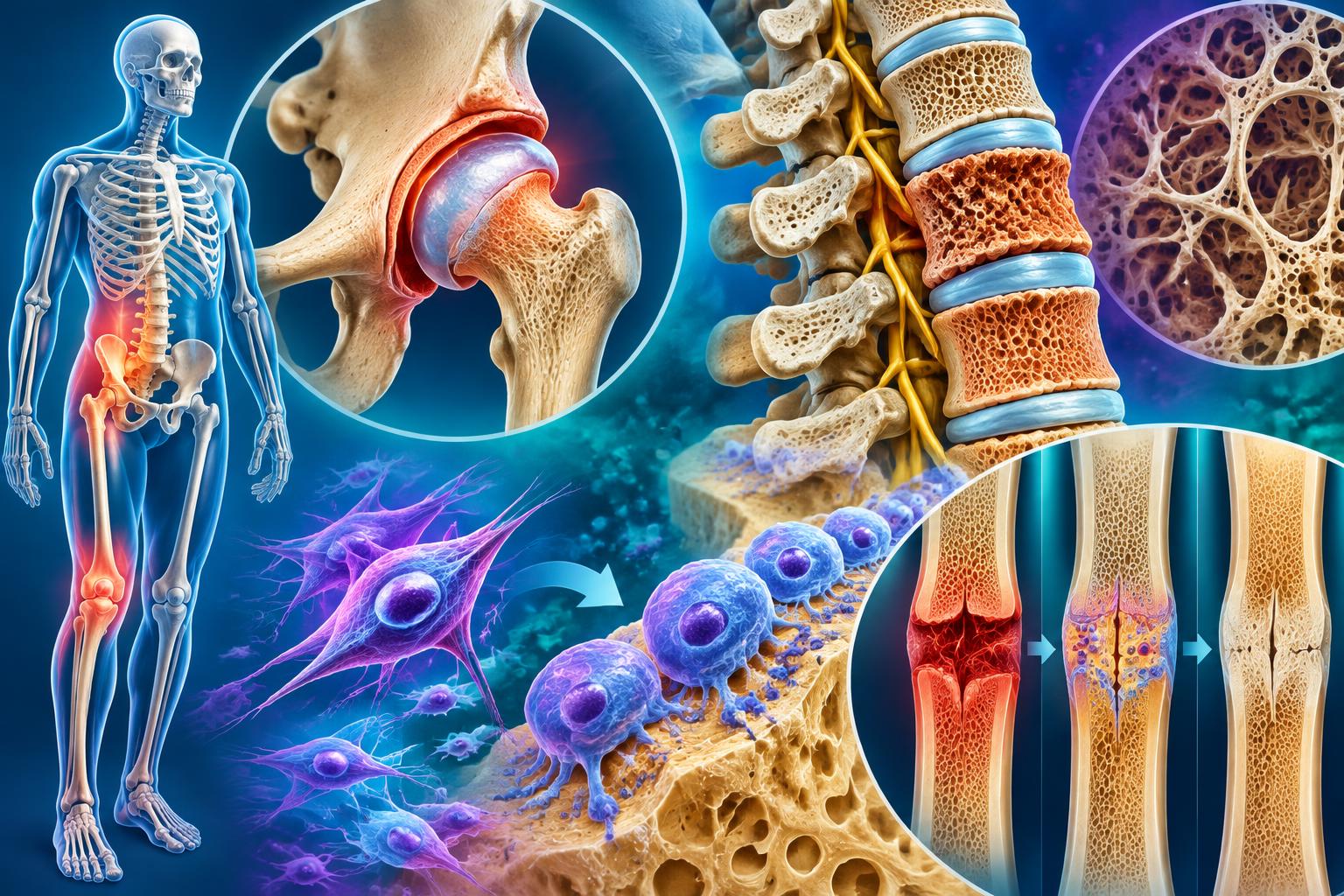
"Bone and skeletal disease" is not one condition but a family of different problems — some driven by systemic bone loss, some by a localized loss of blood supply, some by a genetic collagen defect, and some by a failure of normal healing after injury. Stem cell research has touched several of these subtypes, but the depth of evidence varies enormously: a handful have reached controlled human trials, others rest on small case series or animal models, and none has an FDA-approved stem cell product specifically for bone regeneration. This article walks through the main bone and skeletal disease categories, summarizes what is actually being studied for each, and flags where marketplace enthusiasm has outrun the science.
Osteoporosis and Low Bone Density
Osteoporosis affects an estimated 10.2 million U.S. adults over 50, with another 43.4 million living with low bone mass, and underlies roughly two million fractures a year, according to the Bone Health & Osteoporosis Foundation. Because osteoporosis reflects an imbalance between bone-building osteoblasts and bone-resorbing osteoclasts, researchers have long explored whether infusing mesenchymal stem cells (MSCs) — the marrow-derived cells that give rise to osteoblasts — could rebuild bone density systemically. Preclinical and early-phase work has examined MSC infusions for osteoporosis generally and, more specifically, for osteoporotic vertebral compression fractures, where cells or cell-derived factors might support both bone density and fracture healing. Several early-phase human trials are registered on ClinicalTrials.gov, including intravenous umbilical-cord-derived and other allogeneic MSC products tested in postmenopausal women at high fracture risk. This is genuine, active research — but it remains firmly experimental, with no systemic stem cell therapy approved or recommended for osteoporosis; current approved options remain bisphosphonates, denosumab, and anabolic agents like teriparatide.
Avascular Necrosis (Osteonecrosis)
Avascular necrosis (AVN), most often affecting the femoral head, occurs when blood supply to a segment of bone is interrupted, causing the bone to die and eventually collapse. This is arguably the bone condition with the most substantial stem cell research behind it. Multiple trials on ClinicalTrials.gov have tested autologous bone-marrow- or adipose-derived MSCs, typically injected into the femoral head alongside core decompression — a standard surgical procedure that drills out dead bone to relieve pressure and encourage new blood vessel growth. Published comparative studies suggest adding stem cells to core decompression may improve outcomes and, in patients caught at an early stage, may delay or reduce the need for hip replacement compared with decompression alone. That said, most studies are small, some retrospective, and results vary by how advanced the necrosis is at treatment; cell therapy does not reverse AVN once substantial collapse has occurred.
Fracture Non-Union
When a broken bone fails to heal on its own — a "non-union" — it can mean months or years of disability. Because MSCs are central to normal fracture repair, researchers have tested injecting bone-marrow-derived or concentrated cells, often combined with scaffolds or growth factors, directly into non-healing fracture sites. Systematic reviews and meta-analyses of MSC therapy for non-union fractures report generally favorable union rates across pooled studies, which is encouraging, but the authors also note that most underlying trials are small, heterogeneous in cell source and dose, and not uniformly controlled — pointing toward promise rather than proof. This is one of the more mechanistically logical applications of cell therapy in orthopedics, and it continues to draw both academic and commercial trial interest.
Osteogenesis Imperfecta
Osteogenesis imperfecta (OI), or "brittle bone disease," is a rare genetic disorder of collagen production causing fragile, easily fractured bones. Because MSCs can differentiate into collagen-producing osteoblasts, pioneering trials have tested bone marrow and mesenchymal stromal cell transplantation in children, with some reports of modified growth and reduced fracture frequency in small cohorts. This remains a rare-disease research niche: trials are small by necessity, follow-up is limited, and cell therapy is not a standard or approved treatment for OI, which is still managed primarily with bisphosphonates and orthopedic care.
Osteoarthritis-Related Bone Changes
Osteoarthritis is usually framed as a cartilage disease, but it also involves measurable changes in the underlying subchondral bone, including bone marrow lesions and altered bone remodeling. A separate strand of research — distinct from cartilage-focused MSC injections covered elsewhere — looks specifically at how subchondral bone MSC activity contributes to joint degeneration, raising the possibility of bone-targeted interventions. This is largely laboratory and mechanistic research at this stage, not something patients can access as an approved therapy.
Bottom Line
Across bone and skeletal disease, the strongest cell-therapy research sits with avascular necrosis and fracture non-union, where small human trials and meta-analyses show plausible benefit alongside standard surgical care. Osteoporosis, osteogenesis imperfecta, and the bone component of osteoarthritis are active but earlier-stage research areas, built mostly on small trials, case series, or lab studies. No stem cell product is FDA-approved for any of these bone conditions, and the FDA has repeatedly warned about clinics marketing unproven stem cell injections for orthopedic problems. Readers should treat bone-related stem cell claims with the same scrutiny as any other unapproved use, and look for peer-reviewed, controlled trial data before weighing it against established treatments.
Key Questions Answered
- Which bone diseases have the strongest stem cell research behind them?
- Avascular necrosis of the hip and fracture non-union have the most substantial research, with small human trials and meta-analyses showing plausible benefit alongside standard surgical care.
- Is any stem cell therapy FDA-approved for bone conditions?
- No. No stem cell product is FDA-approved for osteoporosis, avascular necrosis, fracture non-union, osteogenesis imperfecta, or any other bone condition.
- Can stem cell therapy reverse avascular necrosis?
- Not once substantial collapse has occurred. Studies suggest adding stem cells to core decompression may improve outcomes and delay hip replacement in early-stage patients, but results vary by how advanced the necrosis is.
Sources
- Osteoporosis Fast Facts — Bone Health & Osteoporosis Foundation (2023) — https://www.bonehealthandosteoporosis.org/wp-content/uploads/Osteoporosis-Fast-Facts-2.pdf
- Stem Cell and Regenerative Therapies for the Treatment of Osteoporotic Vertebral Compression Fractures — PMC (2024) — https://www.ncbi.nlm.nih.gov/pmc/articles/PMC11084822/
- The Therapeutic Potential of Mesenchymal Stem Cells in Treating Osteoporosis — PMC (2021) — https://www.ncbi.nlm.nih.gov/pmc/articles/PMC8686520/
- Evaluation of Mesenchymal Stem Cells to Treat Avascular Necrosis of the Hip — ClinicalTrials.gov, NCT02065167 — https://clinicaltrials.gov/study/NCT02065167
- Mesenchymal Stem Cells Therapy for the Treatment of Non-Union Fractures: A Systematic Review and Meta-Analysis — PMC (2024) — https://www.ncbi.nlm.nih.gov/pmc/articles/PMC11900535/
- Repeated Infusions of Mesenchymal Stromal Cells in Children With Osteogenesis Imperfecta — ClinicalTrials.gov, NCT01061099 — https://clinicaltrials.gov/study/NCT01061099
- Targeting Subchondral Bone Mesenchymal Stem Cell Activities for Intrinsic Joint Repair in Osteoarthritis — PMC — https://www.ncbi.nlm.nih.gov/pmc/articles/PMC5674229/
- FDA Continues Whack-A-Mole Efforts to Crack Down on Dangerous but Trendy Stem Cell Clinics — KFF Health News — https://kffhealthnews.org/OTM1NTgx
Related Articles
- Fundamentals
What Are Yamanaka Factors? The Four Genes That Turn Adult Cells Into Stem Cells
Oct4, Sox2, Klf4, and c-Myc can reset adult cells to pluripotency. Their Nobel-winning discovery transformed research, but most iPSC-derived therapies remain investigational.
- Fundamentals
Myth: Younger Donor Stem Cells Are Always More Potent Than Your Own
Aging can reduce some stem cell functions, but tissue source, laboratory expansion, and actual potency testing matter more than a blanket younger-is-better claim.
- Fundamentals
Protecting Skin Health As You Age: What the Evidence Actually Shows
Sunscreen, retinoids, and vitamin C have real evidence behind them; exosome skincare does not. What controlled studies actually support for slowing visible skin aging.