What Is Myasthenia Gravis?
What this article covers
- What Causes Myasthenia Gravis?
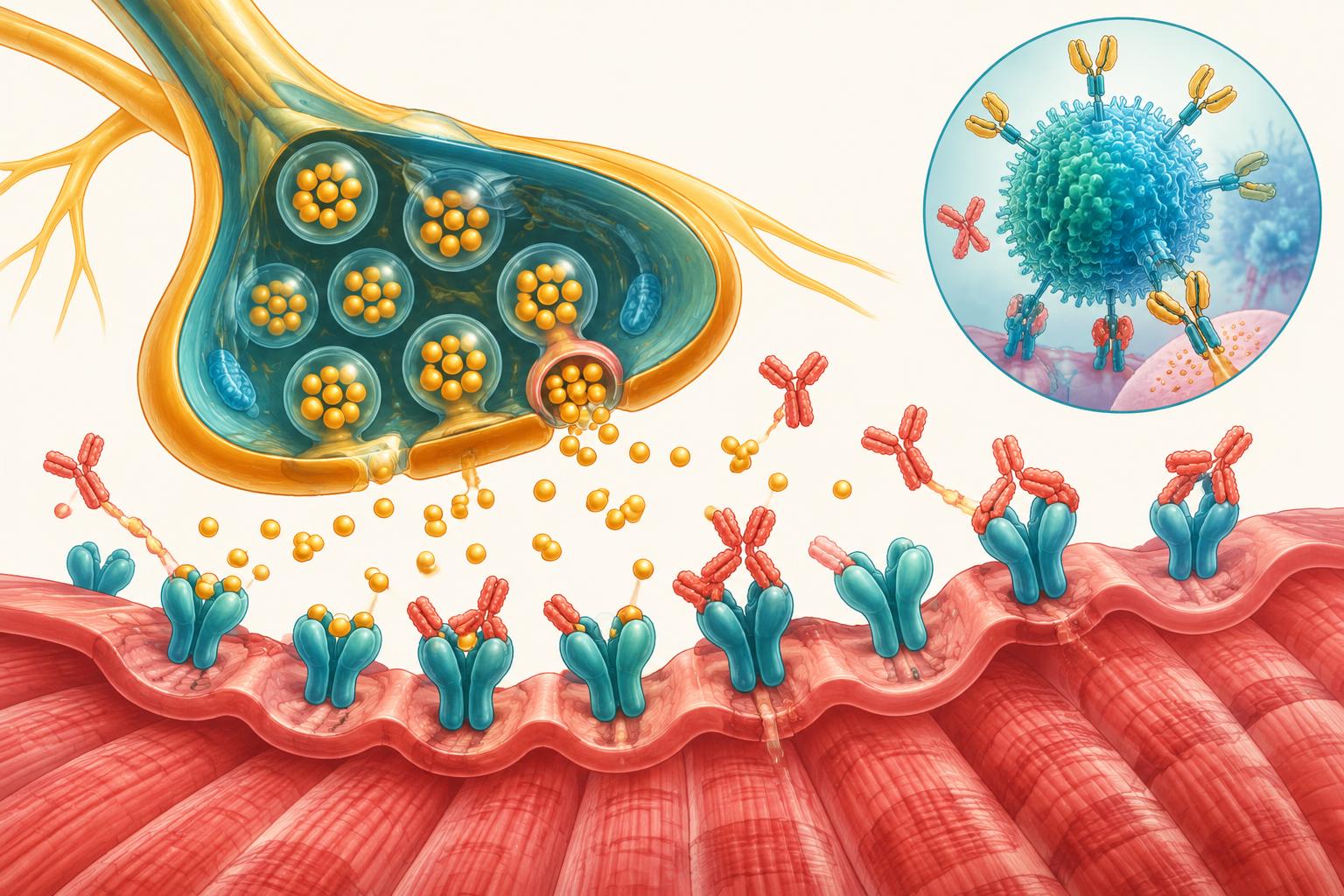
- MG occurs when the immune system mistakenly produces antibodies that attack the neuromuscular junction, the site where nerve signals tell muscles to contract. In roughly 80-85% of cases, these are antibodies against the acetylcholine receptor (AChR), which block or destroy the receptors muscles need to respond to nerve signals.
- Symptoms
- MG symptoms fluctuate and typically worsen with exertion, improving with rest.
- How It's Diagnosed
- Diagnosis combines a neurological exam with electrodiagnostic testing — repetitive nerve stimulation and single-fiber electromyography, the latter being especially sensitive for mild cases — plus blood tests for AChR or anti-MuSK antibodies. Imaging of the chest may be done to check for thymus abnormalities.
- Standard Treatment Today
- None of the established therapies for MG are stem-cell based, and for most patients they work well and allow a normal or near-normal life expectancy:
- Where Cell Therapy Research Stands
- A genuinely exciting area of research is now exploring CAR-T and CAAR-T (chimeric autoantibody receptor T-cell) therapy for MG — the same general strategy being tested in lupus and other antibody-driven autoimmune diseases. Unlike broad immunosuppression, these engineered T-cells are designed to seek out and eliminate only the specific B cells producing the harmful antibodies, in theory resetting the immune system more precisely.
Myasthenia gravis (MG) is a chronic autoimmune disease that disrupts communication between nerves and muscles, causing fluctuating weakness that often worsens with activity. This article explains what causes MG, how it presents and is diagnosed, the standard treatments that help most patients live full lives, and where early-stage cell-therapy research — including a genuinely promising but unproven CAR-T and CAAR-T approach — currently stands.
What Causes Myasthenia Gravis?
MG occurs when the immune system mistakenly produces antibodies that attack the neuromuscular junction, the site where nerve signals tell muscles to contract. In roughly 80-85% of cases, these are antibodies against the acetylcholine receptor (AChR), which block or destroy the receptors muscles need to respond to nerve signals. A smaller subset of patients instead produce antibodies against muscle-specific kinase (MuSK), a protein that helps organize AChRs at the junction; MuSK-positive MG tends to affect the face, throat, and breathing muscles more prominently. Some patients test negative for both antibodies ("seronegative" MG) but still have the disease. The thymus gland, which helps train immune cells, is often abnormal in MG — many patients have thymus enlargement or a thymoma (usually benign, though it can occasionally become cancerous).
Symptoms
MG symptoms fluctuate and typically worsen with exertion, improving with rest. Common patterns include:
- Drooping eyelids (ptosis) and double or blurred vision — often the first signs
- Difficulty swallowing, slurred speech, and changes in facial expression
- Weakness in the neck, arms, hands, or legs
- Shortness of breath or, in severe cases, a myasthenic crisis, in which breathing muscles fail and emergency ventilator support is needed
How It's Diagnosed
Diagnosis combines a neurological exam with electrodiagnostic testing — repetitive nerve stimulation and single-fiber electromyography, the latter being especially sensitive for mild cases — plus blood tests for AChR or anti-MuSK antibodies. Imaging of the chest may be done to check for thymus abnormalities.
Standard Treatment Today
None of the established therapies for MG are stem-cell based, and for most patients they work well and allow a normal or near-normal life expectancy:
- Pyridostigmine (Mestinon), an anticholinesterase inhibitor that boosts nerve-to-muscle signaling and is often the first-line symptom reliever
- Immunosuppressants such as prednisone, azathioprine, mycophenolate mofetil, and tacrolimus, which reduce autoantibody production but carry real risks, including infection susceptibility and other side effects that require ongoing monitoring
- Thymectomy, surgical removal of the thymus, which can reduce symptoms and in some studies has helped roughly half of appropriate patients achieve better long-term control
- Plasmapheresis and IVIG (intravenous immunoglobulin), used especially in severe flares or crisis, which remove or dilute harmful antibodies but produce effects that typically last only weeks to months
- Newer targeted biologics: efgartigimod (Vyvgart), an FcRn inhibitor FDA-approved in December 2021 that lowers circulating levels of disease-causing antibodies, and eculizumab (Soliris), a complement inhibitor approved in 2017 that blocks the terminal complement cascade that damages the neuromuscular junction. Both are approved specifically for AChR-antibody-positive generalized MG and represent a shift toward precisely targeting the autoimmune mechanism rather than broadly suppressing the immune system.
Where Cell Therapy Research Stands
A genuinely exciting area of research is now exploring CAR-T and CAAR-T (chimeric autoantibody receptor T-cell) therapy for MG — the same general strategy being tested in lupus and other antibody-driven autoimmune diseases. Unlike broad immunosuppression, these engineered T-cells are designed to seek out and eliminate only the specific B cells producing the harmful antibodies, in theory resetting the immune system more precisely. Early clinical data are encouraging: in a Phase 2b trial of the mRNA-based CAR-T therapy Descartes-08, Cartesian Therapeutics reported that in the pre-specified modified intent-to-treat population, 71% of treated patients (10 of 14) reached the primary efficacy endpoint at three months versus 25% on placebo (3 of 12), with p=0.018, and no cases of cytokine release syndrome or neurotoxicity reported. Separately, Cabaletta Bio is running a Phase 1 first-in-human safety trial of MuSK-CAART, a CAAR-T therapy designed to selectively deplete MuSK-antibody-producing B cells in MuSK-positive MG. These are important, legitimate signals of promise. But they remain early-stage research: trials to date involve small numbers of patients, longer-term safety and durability data are still accumulating, and no CAR-T or CAAR-T therapy is FDA-approved for myasthenia gravis or any autoimmune disease today.
Bottom Line
Myasthenia gravis is a treatable autoimmune disease, and most patients today manage it effectively with anticholinesterase drugs, immunosuppressants, thymectomy, and increasingly precise biologics like efgartigimod and eculizumab — none of which involve stem cells. Cell-based engineered T-cell therapies (CAR-T/CAAR-T) represent a scientifically promising frontier that could one day offer more targeted, longer-lasting remission, but this research is still in early human trials, unapproved, and not an available treatment option. Anyone considering any experimental therapy should discuss it with a qualified neurologist and verify trial legitimacy directly through registries like ClinicalTrials.gov.
Key Questions Answered
- What causes myasthenia gravis?
- Autoantibodies disrupt the neuromuscular junction, most often targeting acetylcholine receptors and sometimes MuSK. Symptoms typically worsen with activity and improve with rest.
- Are established myasthenia gravis treatments stem-cell based?
- No. Current care includes pyridostigmine, immunosuppressants, thymectomy, plasmapheresis, IVIG and targeted biologics such as efgartigimod and eculizumab.
- Are CAR-T or CAAR-T therapies approved for myasthenia gravis?
- No. Descartes-08 and MuSK-CAART show early research promise, but small trials and incomplete long-term safety and durability data mean these approaches remain investigational.
Sources
- Myasthenia Gravis, National Institute of Neurological Disorders and Stroke (NINDS), 2025 — https://www.ninds.nih.gov/health-information/disorders/myasthenia-gravis
- FDA Approves Vyvgart for Adults With Most Common Form of gMG, Myasthenia Gravis News, 2021 — https://myastheniagravisnews.com/news/fda-approves-vyvgart-for-adults-with-most-common-form-of-gmg/
- CAR-T Therapy Descartes-08 Demonstrates Efficacy, Safety in Phase 2 Trial for Myasthenia Gravis, NeurologyLive, 2025 — https://www.neurologylive.com/view/car-t-therapy-descartes-08-demonstrates-efficacy-safety-phase-2-trial-myasthenia-gravis
- Cartesian Therapeutics Announces Positive Topline Results from Phase 2b Trial of Descartes-08, Cartesian Therapeutics Investor Relations, 2024 — https://ir.cartesiantherapeutics.com/node/12926
- Phase 1 Trial of MuSK-CAART Therapy, Myasthenia Gravis News, 2023 — https://myastheniagravisnews.com/?p=79731
- Composition and Function of AChR Chimeric Autoantibody Receptor T Cells for Antigen-Specific B Cell Depletion in Myasthenia Gravis, PMC/NCBI, 2025 — https://www.ncbi.nlm.nih.gov/pmc/articles/PMC11870065/
- A Real-Life Experience with Eculizumab and Efgartigimod in Generalized Myasthenia Gravis Patients, Journal of Neurology, 2024 — https://link.springer.com/article/10.1007/s00415-024-12588-7
Related Articles
- Fundamentals
Types of Gastrointestinal Disease: Which Ones Are Being Studied With Stem Cell Therapy?
GI cell-therapy evidence varies sharply: Crohn’s fistula trials and early UC studies contrast with preclinical short bowel work and scarce IBS or celiac evidence.
- Fundamentals
Protecting Hearing Health As You Age: What the Evidence Actually Shows
Hearing protection and treatment support communication and social health; ACHIEVE’s cognitive benefit appeared in a higher-risk subgroup, not everyone.
- Fundamentals
What Are Yamanaka Factors? The Four Genes That Turn Adult Cells Into Stem Cells
Oct4, Sox2, Klf4, and c-Myc can reset adult cells to pluripotency. Their Nobel-winning discovery transformed research, but most iPSC-derived therapies remain investigational.