Sleep and Recovery: What the Evidence Shows About Immune and Joint Health
What this article covers
- How Sleep Loss Dysregulates the Immune System
- A 2021 review in Communications Biology synthesized experimental and epidemiological research on sleep deprivation and immune function. The findings are consistent across study types: losing sleep raises circulating pro-inflammatory cytokines and acute-phase proteins, shifts immune cell balance in ways that can blunt antiviral and anti-tumor responses, and is associated with greater infection susceptibility — in one cited cohort, people sleeping 6 hours or less were more likely to catch a cold than those sleeping 7 or more.
- The Sleep-Joint Connection: What the Research Shows
- Two studies ground the sleep-joint link in real patient data rather than speculation. A 2019 University of South Florida-led analysis of 2,562 men over 65 with osteoarthritis (OA) or rheumatoid arthritis (RA), published in Arthritis Care & Research, found that men with OA were more likely to report poor sleep, and poor sleep was in turn linked to higher blood levels of CRP and IL-6 — the same inflammatory markers implicated above.
- Can the Body "Catch Up" on Lost Sleep?
- Research on recovery sleep gives a mixed answer. Studies from sleep immunology research have found that inflammatory markers elevated by sleep restriction don't always fully normalize after a single recovery night — monocyte production of IL-6 and TNF-alpha has remained elevated even after catch-up sleep in some experiments.
- Why This Matters for Regenerative and Immune Health
- None of this research suggests sleep is a treatment for joint disease or a substitute for medical care. But the inflammatory and immune pathways these studies measure — cytokine signaling, innate immune cell activity, systemic inflammation — are the same biological systems that regenerative and immune-based therapies are designed to work within.
- Bottom Line
- The data on sleep and inflammation are some of the more consistently replicated findings in this area: short or disrupted sleep reliably correlates with elevated inflammatory markers and higher risk of several immune-related conditions, including osteoarthritis. What remains less settled is causation and reversibility — whether improving sleep actually lowers disease risk, and how much recovery sleep can undo.
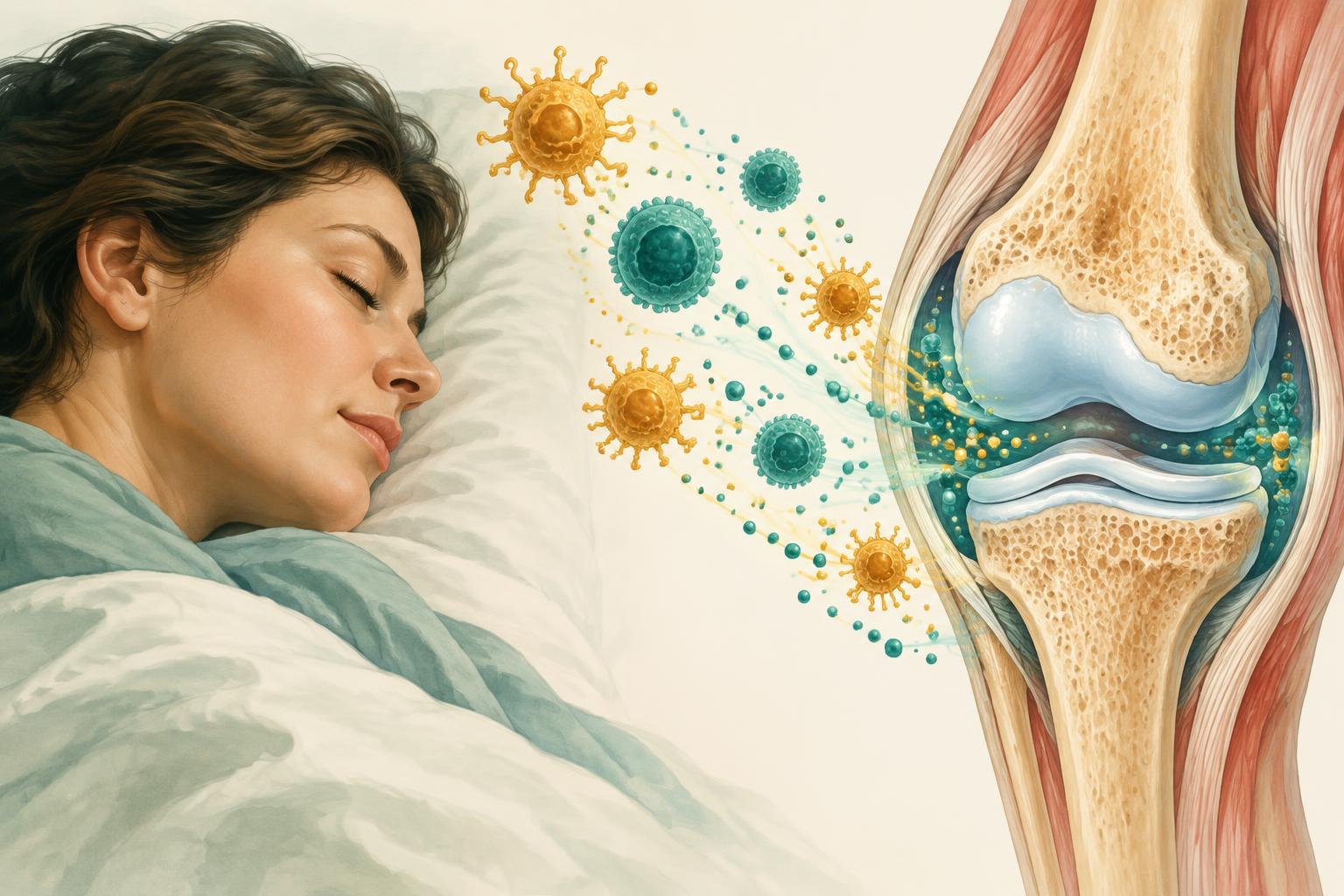
Sleep is often treated as a lifestyle afterthought, but a growing body of peer-reviewed research links short or disrupted sleep to measurable changes in inflammatory markers, immune cell behavior, and joint disease risk. This article walks through what the evidence actually shows — not generic "get more sleep" advice, but specific findings from immunology and rheumatology research, including what sleep loss has been associated with, and where the science is still correlational rather than proven cause-and-effect.
How Sleep Loss Dysregulates the Immune System
A 2021 review in Communications Biology synthesized experimental and epidemiological research on sleep deprivation and immune function. The findings are consistent across study types: losing sleep raises circulating pro-inflammatory cytokines and acute-phase proteins, shifts immune cell balance in ways that can blunt antiviral and anti-tumor responses, and is associated with greater infection susceptibility — in one cited cohort, people sleeping 6 hours or less were more likely to catch a cold than those sleeping 7 or more. The review also notes associations between chronic short sleep and higher incidence of certain cancers, autoimmune conditions such as rheumatoid arthritis and lupus, and neurodegenerative disease, though the authors are explicit that much of this is associational and mechanistic work in animal models, not proof that fixing sleep prevents these diseases in people.
Controlled sleep-restriction experiments support the cytokine piece directly: monocytes, immune cells central to innate immunity, have been shown to produce significantly more IL-6 and TNF-alpha after a single night of partial sleep loss — two cytokines that drive systemic inflammation when chronically elevated.
The Sleep-Joint Connection: What the Research Shows
Two studies ground the sleep-joint link in real patient data rather than speculation. A 2019 University of South Florida-led analysis of 2,562 men over 65 with osteoarthritis (OA) or rheumatoid arthritis (RA), published in Arthritis Care & Research, found that men with OA were more likely to report poor sleep, and poor sleep was in turn linked to higher blood levels of CRP and IL-6 — the same inflammatory markers implicated above. Better sleep also correlated with lower pain levels. Because the study was cross-sectional, it shows association, not that poor sleep causes the inflammation.
A larger, more recent study helps address that gap. A 2026 analysis of nearly 500,000 UK Biobank participants, published in Arthritis Care & Research, found that people sleeping under 6 hours a night or with frequent insomnia had roughly 20-40% higher risk of later developing hip or knee osteoarthritis than those sleeping around 7 hours — and the association held even among people with no joint pain at baseline, suggesting poor sleep may precede joint disease rather than simply result from it. Night shift workers had a 24% higher risk of knee OA and 28% higher risk of knee replacement surgery, a link that held after accounting for body weight and other health factors, pointing to circadian disruption, not just sleep duration, as relevant.
Can the Body "Catch Up" on Lost Sleep?
Research on recovery sleep gives a mixed answer. Studies from sleep immunology research have found that inflammatory markers elevated by sleep restriction don't always fully normalize after a single recovery night — monocyte production of IL-6 and TNF-alpha has remained elevated even after catch-up sleep in some experiments. Other work on napping and extended recovery sleep found that elevated white blood cell counts following sleep restriction returned closer to baseline with a daytime nap or longer recovery night than with a standard 8-hour night alone. The practical takeaway is modest: consistent, adequate sleep appears to matter more than occasional catch-up sleep for keeping inflammatory markers in range.
Why This Matters for Regenerative and Immune Health
None of this research suggests sleep is a treatment for joint disease or a substitute for medical care. But the inflammatory and immune pathways these studies measure — cytokine signaling, innate immune cell activity, systemic inflammation — are the same biological systems that regenerative and immune-based therapies are designed to work within. Chronic low-grade inflammation is a recognized factor in both joint tissue breakdown and immune cell dysfunction, which is part of why sleep keeps surfacing as a variable researchers control for in studies of these conditions.
Bottom Line
The data on sleep and inflammation are some of the more consistently replicated findings in this area: short or disrupted sleep reliably correlates with elevated inflammatory markers and higher risk of several immune-related conditions, including osteoarthritis. What remains less settled is causation and reversibility — whether improving sleep actually lowers disease risk, and how much recovery sleep can undo. Until controlled trials answer that more definitively, the honest summary is that sleep is a modifiable factor worth taking seriously, not a guaranteed fix.
Key Questions Answered
- How does partial sleep loss affect inflammatory signals?
- Controlled experiments have found increased monocyte production of IL-6 and TNF-alpha after a single night of partial sleep loss.
- Does poor sleep prove a person will develop osteoarthritis?
- No. Population studies associate short sleep, insomnia and night shift work with higher osteoarthritis risk, but association does not establish that improving sleep prevents joint disease.
- Can one recovery night reverse the immune effects of sleep restriction?
- Not reliably. Some experiments found inflammatory signals remained elevated after catch-up sleep; napping or longer recovery sleep brought certain measures closer to baseline in other work.
Sources
- Garbarino S, Lanteri P, Bragazzi NL, Magnavita N, Scoditti E. "Role of sleep deprivation in immune-related disease risk and outcomes." Communications Biology, 2021 — https://www.ncbi.nlm.nih.gov/pmc/articles/PMC8602722/
- Irwin MR. "Immune, inflammatory and cardiovascular consequences of sleep restriction and recovery." Sleep Medicine Clinics, 2010 — https://pubmed.ncbi.nlm.nih.gov/21835655/
- Lee S, et al. University of South Florida-led study on sleep, osteoarthritis/rheumatoid arthritis, and inflammatory biomarkers (CRP, IL-6), using data from the Osteoporotic Fractures in Men Study. Arthritis Care & Research, 2019 — https://www.usf.edu/news/2019/lee-sleep-study-oa.aspx
- Yanik EL, et al. "Associations of Sleep and Shift Work With Osteoarthritis Risk." Arthritis Care & Research, 2026. University press release — https://source.washu.edu/2026/06/poor-sleep-night-shift-work-linked-to-higher-risk-of-osteoarthritis/
- Cappuccio FP, Cooper D, D'Elia L, Strazzullo P, Miller MA. "Sleep duration predicts cardiovascular outcomes: a systematic review and meta-analysis of prospective studies." European Heart Journal, 2011 — https://academic.oup.com/eurheartj/article/32/12/1484/502022
Related Articles
- Fundamentals
Types of Diabetes and Diabetic Complications: Which Are Being Studied With Stem Cell Therapy?
Compare Type 1 and Type 2 diabetes cell-therapy research with gestational diabetes, MODY and complication studies, including trial results and approval limits.
- Fundamentals
What Is Crohn's Disease?
Crohn’s disease causes, symptoms, diagnosis and standard care, with darvadstrocel’s approval history, failed confirmatory trial and current cell-therapy limits.
- Fundamentals
Embryonic Stem Cells vs. Adult Stem Cells: What's the Difference?
Compare embryonic and adult stem cells by origin, potency, ethical considerations and clinical maturity, including investigational retinal and islet therapies.