What Is Crohn's Disease?
What this article covers
- What Is Crohn's Disease?
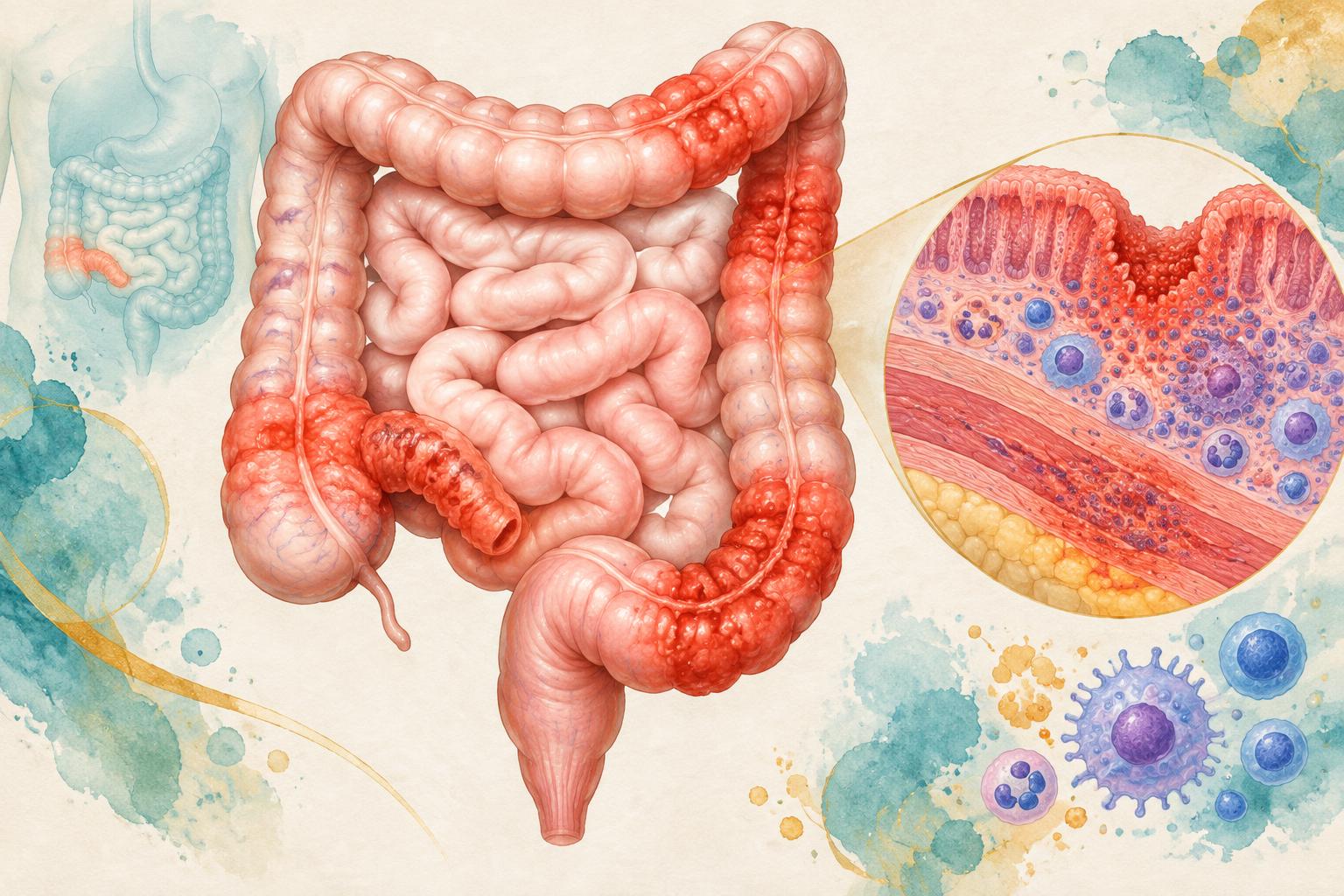
- Crohn's disease is a chronic inflammatory bowel disease (IBD) that can affect any part of the digestive tract, from the mouth to the anus, though it most often involves the end of the small intestine and the beginning of the colon. Unlike ulcerative colitis, which stays confined to the colon's inner lining, Crohn's inflammation can extend through the full thickness of the bowel wall.
- Symptoms and Complications
- Symptoms vary and typically follow a relapsing-remitting course, with flares interspersed by periods of relative quiet. Common symptoms include persistent diarrhea, abdominal cramping and pain, unintended weight loss, fatigue, and reduced appetite.
- How Crohn's Is Diagnosed and Treated Today
- There's no single test for Crohn's; diagnosis relies on a combination of medical history, blood and stool tests, endoscopy with biopsy, and cross-sectional imaging. Treatment goals are to reduce inflammation, induce remission, and keep the disease quiet over the long term.
- Where Stem Cell and Cell Therapy Research Stands
- This is where Crohn's disease occupies an unusual place in regenerative medicine: it's connected to one of the few cell therapies to actually reach regulatory approval for any indication tied to the disease. Darvadstrocel (brand name Alofisel), made from expanded allogeneic mesenchymal stem cells derived from donor fat tissue, is injected directly into complex perianal fistula tracts in adults with Crohn's disease.
- Bottom Line
- Crohn's disease remains a chronic, relapsing condition without a cure, and standard treatment — medication to control inflammation plus surgery when needed — still leaves many patients, especially those with complex perianal fistulas, without a durable fix. S.
Crohn's disease is a lifelong inflammatory bowel disease with no cure, managed today through a combination of medications, lifestyle support, and — for many patients — surgery. This article explains what causes it, how it presents, how doctors treat it now, and where cell-based research stands, including the one cell therapy that has actually cleared a major regulatory bar for a Crohn's-related complication, and the important caveats around where it is and isn't available.
What Is Crohn's Disease?
Crohn's disease is a chronic inflammatory bowel disease (IBD) that can affect any part of the digestive tract, from the mouth to the anus, though it most often involves the end of the small intestine and the beginning of the colon. Unlike ulcerative colitis, which stays confined to the colon's inner lining, Crohn's inflammation can extend through the full thickness of the bowel wall. According to the National Institute of Diabetes and Digestive and Kidney Diseases (NIDDK), the exact cause is unknown, but research points to a combination of genetics, an abnormal immune response, and disruptions in the gut microbiome. It's most commonly diagnosed between ages 20 and 29, though it can appear at any age. Federal survey data from 2023-2024 put diagnosed Crohn's disease at about 0.5% of U.S. adults — roughly 1.3 million people — within a broader IBD population of about 4.1 million Americans.
Symptoms and Complications
Symptoms vary and typically follow a relapsing-remitting course, with flares interspersed by periods of relative quiet. Common symptoms include persistent diarrhea, abdominal cramping and pain, unintended weight loss, fatigue, and reduced appetite. Over time, chronic inflammation can lead to complications: strictures (narrowed, scarred segments of bowel), abscesses, malnutrition, and fistulas — abnormal tunnels that form between the bowel and nearby organs or skin. Perianal fistulas, which connect the bowel to the skin near the anus, are among the most difficult Crohn's complications to treat and a major focus of the cell-therapy research discussed below.
How Crohn's Is Diagnosed and Treated Today
There's no single test for Crohn's; diagnosis relies on a combination of medical history, blood and stool tests, endoscopy with biopsy, and cross-sectional imaging. Treatment goals are to reduce inflammation, induce remission, and keep the disease quiet over the long term. Standard medical therapy progresses through several classes: anti-inflammatory drugs and corticosteroids for flares, immunomodulators (such as azathioprine or methotrexate) to tamp down immune activity, and biologics — anti-TNF drugs, anti-integrin agents, and IL-12/23 inhibitors — for moderate-to-severe or refractory disease. Nutritional support is often part of care as well. Even with modern biologics, a substantial share of Crohn's patients eventually need surgery to remove damaged bowel, drain abscesses, or repair fistulas — but surgery doesn't cure the disease, and recurrence at or near the surgical site is common. For complex perianal fistulas specifically, response to standard medical and surgical treatment is often poor, which is exactly the gap cell therapy research has tried to address.
Where Stem Cell and Cell Therapy Research Stands
This is where Crohn's disease occupies an unusual place in regenerative medicine: it's connected to one of the few cell therapies to actually reach regulatory approval for any indication tied to the disease. Darvadstrocel (brand name Alofisel), made from expanded allogeneic mesenchymal stem cells derived from donor fat tissue, is injected directly into complex perianal fistula tracts in adults with Crohn's disease. In its pivotal ADMIRE-CD trial, about half of treated patients achieved combined remission at 24 weeks, compared with roughly a third on placebo — results the European Medicines Agency judged clinically meaningful in patients who had already failed other options. The EMA approved Alofisel in March 2018, and for years it was marketed in the EU, UK, Switzerland, Israel, and Japan.
It was never approved in the United States, however. A larger confirmatory trial Takeda ran specifically to support a U.S. filing, ADMIRE-CD II, missed its primary endpoint in 2023 — combined remission was statistically indistinguishable from placebo. And in December 2024, the European Commission withdrew Alofisel's EU marketing authorization at Takeda's request, ending its availability in the market where it had been approved longest. The net picture today: a cell therapy for Crohn's-related perianal fistulas has cleared regulatory review before, with real trial data behind it, but none is currently approved or marketed anywhere, and none has ever been approved in the U.S. Beyond fistula-directed therapy, researchers have also studied systemic mesenchymal stem cell infusions and, in a small number of severe, treatment-refractory cases, hematopoietic stem cell transplantation — but these remain investigational, early-stage, and outside standard care. RegenMed Review covers the underlying clinical trial evidence for Crohn's and perianal fistula cell therapy in more depth elsewhere on the site.
Bottom Line
Crohn's disease remains a chronic, relapsing condition without a cure, and standard treatment — medication to control inflammation plus surgery when needed — still leaves many patients, especially those with complex perianal fistulas, without a durable fix. Cell therapy research has produced one of the field's clearest regulatory milestones in darvadstrocel, but its unwinding in Europe and failure to win U.S. approval is a useful reminder that early approval success doesn't guarantee a treatment stays available, or works, as later evidence accumulates. For now, stem cell approaches to Crohn's disease remain an active, promising, but still unsettled area of research rather than a mainstream option.
Key Questions Answered
- How does Crohn’s disease differ from ulcerative colitis?
- Crohn’s can affect any part of the digestive tract and extend through the full bowel wall. Ulcerative colitis remains confined to the colon’s inner lining.
- Does surgery cure Crohn’s disease?
- No. Surgery can address damaged bowel, abscesses or fistulas, but recurrence at or near the surgical site is common.
- What happened to darvadstrocel’s European authorization?
- Alofisel was approved in Europe in March 2018 for complex perianal fistulas. After ADMIRE-CD II missed its primary endpoint, the European Commission withdrew the EU authorization in December 2024 at Takeda’s request. It was never approved in the United States.
Sources
- Crohn's Disease, National Institute of Diabetes and Digestive and Kidney Diseases (NIDDK) — https://www.niddk.nih.gov/health-information/digestive-diseases/crohns-disease
- Inflammatory Bowel Disease Among Adults Age 18 and Older: United States, 2023-2024, National Center for Health Statistics (NCHS) Health E-Stat 122, 2026 — https://cdc.gov/nchs/data/hestat/hestat122.htm
- New medicine to treat perianal fistulas in patients with Crohn's disease, European Medicines Agency, 2017 — https://www.ema.europa.eu/en/news/new-medicine-treat-perianal-fistulas-patients-crohns-disease
- Alofisel, European Medicines Agency EPAR (authorization and withdrawal record), 2018/2024 — https://www.ema.europa.eu/en/medicines/human/EPAR/alofisel
- Takeda Announces Topline Results of Phase 3 ADMIRE-CD II Trial of Alofisel (darvadstrocel) in Complex Crohn's Perianal Fistulas, Takeda Pharmaceutical Company, 2023 — https://www.takeda.com/newsroom/newsreleases/2023/Takeda-Announces-Topline-Results-of-Phase-3-ADMIRE-CD-II-Trial-of-Alofisel-darvadstrocel-in-Complex-Crohns-Perianal-Fistulas/
Related Articles
- Fundamentals
Types of Diabetes and Diabetic Complications: Which Are Being Studied With Stem Cell Therapy?
Compare Type 1 and Type 2 diabetes cell-therapy research with gestational diabetes, MODY and complication studies, including trial results and approval limits.
- Fundamentals
Sleep and Recovery: What the Evidence Shows About Immune and Joint Health
Sleep restriction, inflammatory cytokines and osteoarthritis risk: what experimental and population studies show, and the limits of catch-up sleep and causation.
- Fundamentals
Embryonic Stem Cells vs. Adult Stem Cells: What's the Difference?
Compare embryonic and adult stem cells by origin, potency, ethical considerations and clinical maturity, including investigational retinal and islet therapies.