Types of Diabetes and Diabetic Complications: Which Are Being Studied With Stem Cell Therapy?
What this article covers
- Type 1 Diabetes: The Most Advanced Research Frontier
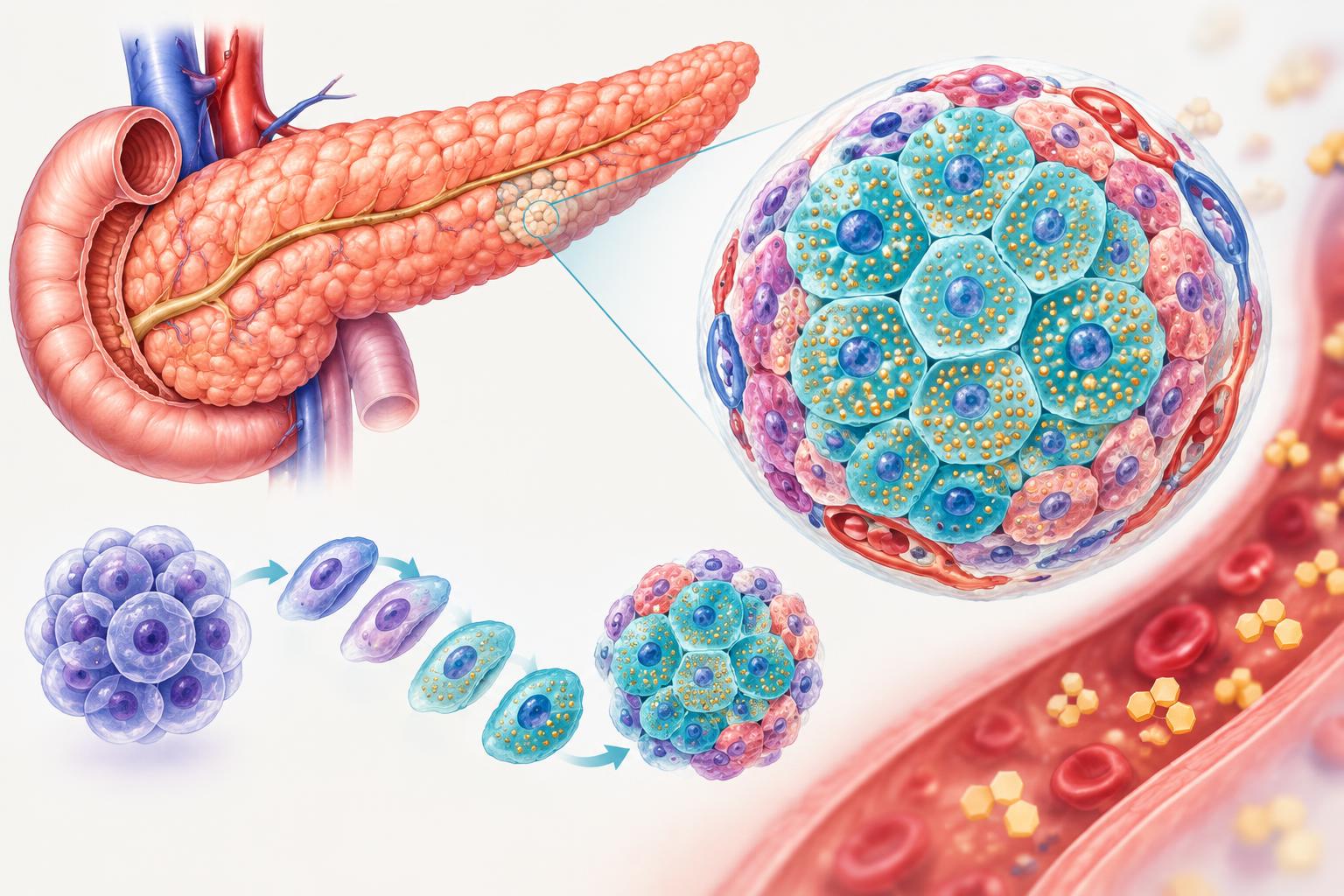
- Type 1 diabetes (T1D) is an autoimmune condition in which the immune system destroys the insulin-producing beta cells of the pancreas. Because the core problem is a missing cell population, T1D is the subtype best suited to cell-replacement approaches — and it is, by a wide margin, the most actively studied.
- Type 2 Diabetes: Real but Earlier-Stage Research
- Type 2 diabetes (T2D) involves insulin resistance plus progressive beta-cell decline, and accounts for the large majority of cases globally. Here, MSC research targets inflammation and insulin sensitivity rather than cell replacement.
- Gestational Diabetes and MODY: Little to No Dedicated Research
- Not every subtype has a stem cell story, and it would be misleading to force one. Gestational diabetes — glucose intolerance during pregnancy that typically resolves after delivery — has essentially no dedicated stem cell research; it's usually temporary and managed with diet, monitoring, and sometimes medication, leaving little rationale for a cell-based intervention.
- Diabetic Complications: Studied Separately
- Longstanding diabetes can lead to complications including diabetic foot ulcers, diabetic retinopathy, and diabetic peripheral neuropathy. These are genuinely active stem cell research areas in their own right, generally using MSCs to promote wound healing, blood vessel formation, or nerve repair — but they are distinct research programs from efforts targeting blood glucose itself.
- Bottom Line
- Stem cell research in diabetes is real, but concentrated almost entirely in Type 1 diabetes, with Type 2 a distant second and gestational diabetes and MODY essentially unstudied from a cell-therapy standpoint. Zimislecel's results are the field's most exciting data point to date — yet that program remains investigational, requires chronic immunosuppression, and hasn't been evaluated in the large, controlled trials needed before any regulatory approval could be considered.
"Diabetes" is not one disease. Type 1, Type 2, gestational diabetes, and rarer monogenic forms like MODY share a common endpoint — elevated blood glucose — but arise from very different mechanisms, and stem cell research has followed those mechanisms unevenly. According to the International Diabetes Federation's 2025 Diabetes Atlas, approximately 589 million adults worldwide live with diabetes, a figure projected to reach 853 million by 2050, with Type 2 accounting for the large majority of cases. This article surveys each major subtype, plus the most common diabetic complications, and is honest about where stem cell research is genuinely advanced, where it is early but real, and where it barely exists yet. No stem-cell-based therapy for any form of diabetes is FDA-approved for routine clinical use; everything below is investigational.
Type 1 Diabetes: The Most Advanced Research Frontier
Type 1 diabetes (T1D) is an autoimmune condition in which the immune system destroys the insulin-producing beta cells of the pancreas. Because the core problem is a missing cell population, T1D is the subtype best suited to cell-replacement approaches — and it is, by a wide margin, the most actively studied.
- Stem-cell-derived replacement islets: The most advanced program anywhere in this field is zimislecel (formerly VX-880), an allogeneic stem-cell-derived islet cell therapy from Vertex Pharmaceuticals. In data presented at the American Diabetes Association's 2025 Scientific Sessions, 10 of 12 participants (83%) who received a full dose in the Phase 1/2 portion of the ongoing Phase 1/2/3 FORWARD-101 trial no longer needed injected insulin at 12 months, with mean daily insulin use falling 92% across the group. These are genuinely striking results for a disease with no cure — but they come from a small, uncontrolled trial, and every participant required ongoing chronic immunosuppressive therapy to prevent rejection of the transplanted cells. Zimislecel remains investigational and unapproved.
- Mesenchymal stem cells (MSCs) for immune modulation: Trials such as NCT04061746 test whether umbilical cord-derived MSCs can calm the autoimmune attack in newly diagnosed patients and preserve remaining beta-cell function, rather than replacing cells outright. A 2020 meta-analysis in Aging and Disease pooling 10 T1D studies (226 patients) found bone-marrow-derived approaches associated with improved C-peptide and HbA1c at 12 months, with roughly 60% of hematopoietic stem cell recipients reaching insulin independence versus about 20% of MSC recipients — but it also flagged serious safety signals with hematopoietic cells (infections, endocrine dysfunction, one sepsis death), a cleaner safety profile for MSCs, and a near-total absence of randomized, blinded trials.
Type 2 Diabetes: Real but Earlier-Stage Research
Type 2 diabetes (T2D) involves insulin resistance plus progressive beta-cell decline, and accounts for the large majority of cases globally. Here, MSC research targets inflammation and insulin sensitivity rather than cell replacement. The same meta-analysis pooled 11 T2D studies (386 patients) and found MSC and bone-marrow mononuclear cell infusions associated with improved HbA1c and reduced insulin requirements, though C-peptide and fasting glucose results were inconsistent. Early trials — such as a Phase 1 pilot of umbilical cord MSCs for insulin resistance (NCT01142050) — show the interest but also the immaturity of this subfield: that study enrolled only 24 patients at one site. T2D research is promising in direction but well behind T1D in trial size and rigor.
Gestational Diabetes and MODY: Little to No Dedicated Research
Not every subtype has a stem cell story, and it would be misleading to force one. Gestational diabetes — glucose intolerance during pregnancy that typically resolves after delivery — has essentially no dedicated stem cell research; it's usually temporary and managed with diet, monitoring, and sometimes medication, leaving little rationale for a cell-based intervention.
MODY (maturity-onset diabetes of the young) and other monogenic forms are caused by single-gene mutations affecting beta-cell function. The research that exists is almost entirely patient-derived induced pluripotent stem cells (iPSCs) used in the lab to model how mutations impair beta cells — valuable science, but disease modeling, not a stem cell treatment. There is no meaningful stem-cell-therapy trial evidence for either subtype, and readers should treat claims to the contrary with skepticism.
Diabetic Complications: Studied Separately
Longstanding diabetes can lead to complications including diabetic foot ulcers, diabetic retinopathy, and diabetic peripheral neuropathy. These are genuinely active stem cell research areas in their own right, generally using MSCs to promote wound healing, blood vessel formation, or nerve repair — but they are distinct research programs from efforts targeting blood glucose itself. RegenMed Review covers each in dedicated articles, so this overview flags them rather than duplicating that detail.
Bottom Line
Stem cell research in diabetes is real, but concentrated almost entirely in Type 1 diabetes, with Type 2 a distant second and gestational diabetes and MODY essentially unstudied from a cell-therapy standpoint. Zimislecel's results are the field's most exciting data point to date — yet that program remains investigational, requires chronic immunosuppression, and hasn't been evaluated in the large, controlled trials needed before any regulatory approval could be considered. No stem cell therapy for any form of diabetes is currently FDA-approved for routine use, and every claim in this space, especially one not tied to a specific registered trial, deserves proportionate skepticism.
Key Questions Answered
- Which diabetes subtype has the most advanced stem cell research?
- Type 1 diabetes is the most actively studied, particularly stem-cell-derived replacement islets. Type 2 diabetes research is earlier-stage and largely focuses on inflammation and insulin sensitivity.
- What did the zimislecel trial report?
- Ten of 12 full-dose participants no longer needed injected insulin at 12 months. The trial was small and uncontrolled, all participants required chronic immunosuppression, and the therapy remains investigational.
- Are gestational diabetes and MODY treated with stem cells?
- There is no meaningful stem-cell-therapy trial evidence for either subtype. MODY iPSC work largely models disease in the laboratory rather than providing a treatment.
Sources
- The Clinical Efficacy and Safety of Stem Cell Therapy for Diabetes Mellitus: A Systematic Review and Meta-Analysis, Aging and Disease (2020) — https://pmc.ncbi.nlm.nih.gov/articles/PMC6961772
- Vertex Presents Positive Data for Zimislecel in Type 1 Diabetes, Vertex Pharmaceuticals press release (June 20, 2025) — https://investors.vrtx.com/news-releases/news-release-details/vertex-presents-positive-data-zimislecel-type-1-diabetes
- Vertex Releases New Data on Potential Cure for Type 1 Diabetes, diaTribe (2025) — https://diatribe.org/diabetes-research/vertex-releases-new-data-potential-cure-type-1-diabetes
- Cellular Therapy for Type 1 Diabetes Using Mesenchymal Stem Cells, ClinicalTrials.gov NCT04061746 — https://clinicaltrials.gov/study/NCT04061746
- Stem Cell Therapy for Type 2 Diabetes Mellitus, ClinicalTrials.gov NCT01142050, Cellonis Biotechnology — https://clinicaltrials.gov/study/NCT01142050
- Modeling Maturity Onset Diabetes of the Young in Pluripotent Stem Cells: Challenges and Achievements, Frontiers in Endocrinology (2021) — https://pmc.ncbi.nlm.nih.gov/articles/PMC7937923/
- IDF Diabetes Atlas, 11th Edition (2025), International Diabetes Federation — https://idf.org/news-and-resources/news/idf-diabetes-atlas-11th-edition/
Related Articles
- Fundamentals
Sleep and Recovery: What the Evidence Shows About Immune and Joint Health
Sleep restriction, inflammatory cytokines and osteoarthritis risk: what experimental and population studies show, and the limits of catch-up sleep and causation.
- Fundamentals
What Is Crohn's Disease?
Crohn’s disease causes, symptoms, diagnosis and standard care, with darvadstrocel’s approval history, failed confirmatory trial and current cell-therapy limits.
- Fundamentals
Embryonic Stem Cells vs. Adult Stem Cells: What's the Difference?
Compare embryonic and adult stem cells by origin, potency, ethical considerations and clinical maturity, including investigational retinal and islet therapies.