What Is Peripheral Artery Disease?
What this article covers
- Causes and Risk Factors
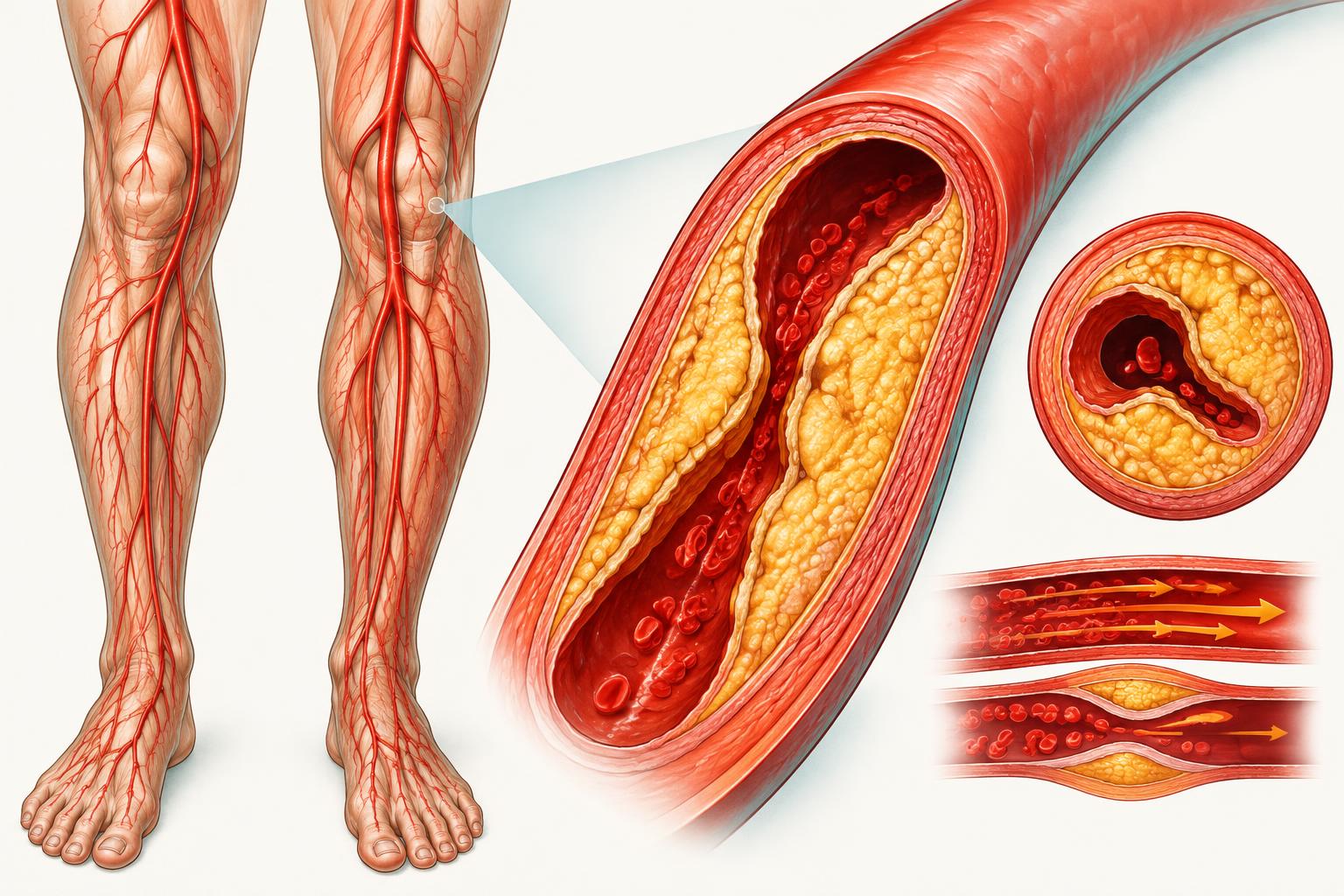
- PAD is usually caused by atherosclerosis: fatty, cholesterol-rich plaque builds up along artery walls, narrowing the vessels that supply the legs and reducing blood flow to muscles and tissue.
- Symptoms: Claudication to Critical Limb Ischemia
- Many people with PAD have no symptoms at all, which is part of why it's underdiagnosed. When symptoms appear, the classic one is claudication — cramping, aching, or fatigue in the calf, thigh, or buttock that comes on with walking and eases with rest, caused by muscles not getting enough blood during exertion.
- How It's Diagnosed
- The frontline test is the ankle-brachial index (ABI), a simple, painless comparison of blood pressure in the ankle versus the arm. Current guidelines recommend it for anyone with symptoms or exam findings suggestive of PAD, and consider it reasonable as a screening tool in people at higher risk.
- Standard Treatment Today
- Treatment is tiered to severity. For early, asymptomatic PAD and for claudication, the foundation is lifestyle change — quitting smoking, and supervised or structured exercise therapy, which current guidelines rate as strongly beneficial for improving walking distance.
- Where Stem Cell Research Stands
- For patients with CLTI who have run out of revascularization options — so-called "no-option" patients — researchers have spent over a decade testing whether injecting cells that promote new blood vessel growth could help. There is genuine, encouraging signal here: in an early-phase randomized trial of autologous CD34+ cells (cells mobilized from a patient's own bone marrow), amputation rates at 12 months trended lower in cell-treated groups (22–43%) versus placebo (75%), with no major safety concerns, prompting researchers to call it a "springboard" for larger studies.
Peripheral artery disease (PAD) is a common but under-recognized circulation problem in which narrowed arteries reduce blood flow to the legs (and sometimes the arms), most often from the same artery-clogging process that causes heart attacks and strokes. This article explains what causes PAD, how it shows up — from the aching leg pain of claudication to the limb-threatening emergency of critical limb ischemia — how doctors diagnose it, and what guideline-backed treatment looks like today. It also gives an honest, brief look at where stem cell and other cell-based therapies currently stand for PAD specifically; readers who want the full research picture can see this site's dedicated deep-dive, "Stem Cell Therapy for Peripheral Artery Disease."
Causes and Risk Factors
PAD is usually caused by atherosclerosis: fatty, cholesterol-rich plaque builds up along artery walls, narrowing the vessels that supply the legs and reducing blood flow to muscles and tissue. The major risk factors overlap heavily with those for heart disease and stroke, which makes sense since they share the same underlying process:
- Smoking or tobacco use (the single strongest modifiable risk factor)
- Diabetes
- High blood pressure and high cholesterol
- Age over 50, and especially over 65
- Obesity and a sedentary lifestyle
- Family history of PAD, heart disease, or stroke
- Chronic kidney disease
An estimated 202 million people worldwide were living with PAD as of a landmark 2010 global analysis, with the burden rising fastest in low- and middle-income countries. In the United States, the National Heart, Lung, and Blood Institute (NHLBI) estimates nearly 10 million people age 40 and older are affected.
Symptoms: Claudication to Critical Limb Ischemia
Many people with PAD have no symptoms at all, which is part of why it's underdiagnosed. When symptoms appear, the classic one is claudication — cramping, aching, or fatigue in the calf, thigh, or buttock that comes on with walking and eases with rest, caused by muscles not getting enough blood during exertion. Other possible signs include leg numbness or weakness, a cold lower leg or foot, skin or color changes, hair loss on the legs, and wounds that heal slowly.
In its most severe form, PAD can progress to chronic limb-threatening ischemia (CLTI), also known as critical limb ischemia. This happens in roughly 1 to 2 of every 10 people with PAD and means blood flow has dropped so low that tissue is at risk of dying. CLTI causes pain at rest (often worse at night), non-healing sores, and in advanced cases, gangrene. It is a medical emergency: without treatment, up to one-third of people with CLTI require a major amputation within a year, and it also raises the risk of heart attack, stroke, and death.
How It's Diagnosed
The frontline test is the ankle-brachial index (ABI), a simple, painless comparison of blood pressure in the ankle versus the arm. Current guidelines recommend it for anyone with symptoms or exam findings suggestive of PAD, and consider it reasonable as a screening tool in people at higher risk. When CLTI is suspected, doctors may add toe pressures, a toe-brachial index, or skin perfusion measurements, since ABI can be misleadingly normal in some patients with diabetes. Duplex ultrasound, CT or MR angiography, and catheter-based angiography help map the location and severity of blockages, particularly before a procedure.
Standard Treatment Today
Treatment is tiered to severity. For early, asymptomatic PAD and for claudication, the foundation is lifestyle change — quitting smoking, and supervised or structured exercise therapy, which current guidelines rate as strongly beneficial for improving walking distance. Medication management includes antiplatelet therapy (aspirin or clopidogrel), high-intensity statins aimed at cutting LDL cholesterol by at least half, blood pressure control, and for many patients, low-dose rivaroxaban added to aspirin. Cilostazol can help claudication symptoms specifically. People with PAD and type 2 diabetes may also benefit from certain GLP-1 or SGLT2 medications shown to reduce cardiovascular events.
When claudication doesn't respond adequately to exercise and medication, or in CLTI, revascularization — balloon angioplasty, stenting, or surgical bypass — restores blood flow and is strongly recommended to prevent amputation and relieve pain in limb-threatening disease.
Where Stem Cell Research Stands
For patients with CLTI who have run out of revascularization options — so-called "no-option" patients — researchers have spent over a decade testing whether injecting cells that promote new blood vessel growth could help. There is genuine, encouraging signal here: in an early-phase randomized trial of autologous CD34+ cells (cells mobilized from a patient's own bone marrow), amputation rates at 12 months trended lower in cell-treated groups (22–43%) versus placebo (75%), with no major safety concerns, prompting researchers to call it a "springboard" for larger studies.
That promise, however, has not yet translated into proof at scale. A larger, international Phase 3 trial of a different cell product (placenta-derived cells, PLX-PAD) in CLTI patients unsuitable for revascularization did not improve amputation-free survival compared with placebo. No stem cell or cell-based therapy is currently FDA-approved for PAD or CLTI, and research organizations continue to describe this approach as investigational. For a full accounting of the trial landscape, see this site's dedicated article on stem cell therapy for PAD.
Bottom Line
PAD is a common, serious, and treatable circulatory condition rooted in the same atherosclerosis that drives heart attacks and strokes — catching it early, through simple tests like the ABI, matters because untreated disease can progress to limb- and life-threatening critical limb ischemia. Lifestyle change, proven medications, and revascularization when needed form the real, evidence-backed standard of care today. Cell therapy research for PAD shows real early promise, especially for the hardest-to-treat patients, but it remains unproven and unapproved — a reason for cautious hope, not a substitute for guideline-based care.
Key Questions Answered
- What is claudication, and when is PAD limb-threatening?
- Claudication is exertional leg pain that eases with rest. CLTI involves severely reduced circulation, rest pain, non-healing wounds or gangrene and needs urgent medical care.
- How is PAD diagnosed and treated?
- The ankle-brachial index compares ankle and arm blood pressure. Standard care includes smoking cessation, structured exercise, proven medicines and, when needed, revascularization.
- Are cell therapies proven or approved for PAD?
- No. Early CD34+ results showed an encouraging trend toward fewer amputations, but the Phase 3 PLX-PAD trial did not improve amputation-free survival. No cell therapy is FDA-approved for PAD or CLTI.
Sources
- Facts About Peripheral Artery Disease (P.A.D.) — National Heart, Lung, and Blood Institute (NHLBI), 2021 — https://www.nhlbi.nih.gov/resources/facts-about-peripheral-artery-disease-pad
- 2024 ACC/AHA/Multisociety Guideline for Lower Extremity PAD: Key Points — American College of Cardiology, 2024 — https://www.acc.org/latest-in-cardiology/ten-points-to-remember/2024/05/09/15/00/2024-guideline-for-lower-extremity-pad
- Comparison of Global Estimates of Prevalence and Risk Factors for Peripheral Artery Disease in 2000 and 2010 — Fowkes et al., The Lancet, 2013 — https://evtoday.com/news/study-shows-rising-global-prevalence-of-pad
- Critical Limb Ischemia — Cleveland Clinic — https://my.clevelandclinic.org/health/diseases/23120-critical-limb-ischemia
- A Randomized, Controlled Pilot Study of Autologous CD34+ Cell Therapy for Critical Limb Ischemia (ACT34-CLI) — Losordo et al., Circulation: Cardiovascular Interventions, 2012 — https://www.lisata.com/research-technology/publications/a-randomized-controlled-pilot-study-of-autologous-cd34-cell-therapy-for-critical-limb-ischemia/
- PACE: A Randomized, Controlled, Multicentre, Multinational Phase III Study of PLX-PAD for Critical Limb Ischaemia in Patients Unsuitable for Revascularization — British Journal of Surgery, 2024 — https://www.bjsacademy.com/pace-randomized-controlled-multicentre-multinational-phase-iii-study-of-plx-pad-for-critical-limb-ischaemia-in-patients-unsuitable-for-revascularization-randomized-clinical-trial
Related Articles
- Fundamentals
Types of Chronic Pain Conditions: Which Are Being Studied With Stem Cell Therapy?
A research-based breakdown of which chronic pain conditions — from knee osteoarthritis to fibromyalgia — have real clinical trial evidence behind stem cell therapy, and which remain preclinical.
- Fundamentals
Protecting Liver Health As You Age: What the Evidence Actually Shows
How the liver ages, which habits genuinely protect it, and when fibrosis or hepatitis screening is actually recommended — evidence-based prevention, not lifestyle hype.
- Fundamentals
What Is Chimerism, and Why Do Doctors Test for It After a Stem Cell Transplant?
Chimerism testing after donor stem cell transplant: STR methods, full versus mixed donor cells, relapse warning signals and why MRD testing matters.