What Is Chimerism, and Why Do Doctors Test for It After a Stem Cell Transplant?
What this article covers
- What It Means for Two People's Cells to Coexist
- In an allogeneic hematopoietic stem cell transplant, a patient's own blood-forming cells are typically destroyed or suppressed (often with chemotherapy, sometimes radiation) and replaced with blood-forming stem cells from a donor. The result is that the recipient's blood cells carry a mix of their own DNA and the donor's DNA — they have, in a real genetic sense, two sources of blood.
- How Chimerism Is Actually Measured
- The standard method is short tandem repeat (STR) genotyping, performed on a blood or bone marrow sample and processed by PCR, according to a clinical laboratory reference. STR markers are small stretches of DNA whose length varies from person to person, so before transplant, labs genotype both the donor and the recipient to establish each person's unique genetic "fingerprint" — typically across 15 or more markers.
- Full vs. Mixed Chimerism: What the Terms Mean
- "Full chimerism" means essentially all of the blood-forming cells detected are the donor's — the patient's own cells have been fully replaced. "Mixed chimerism" means a measurable fraction of the patient's own original cells persists alongside the donor's.
- What Mixed Chimerism Can Signal: Relapse Risk
- This is where chimerism testing earns its place as a core piece of post-transplant monitoring, and the evidence here is genuinely encouraging for how early it can flag trouble. 47) even after accounting for other factors.
- Why a Trend Toward Mixed Chimerism Isn't Automatically Alarming
- A gradually falling donor percentage doesn't by itself mean a transplant has failed or relapse is inevitable — it's a trend clinicians act on, not a verdict. According to Anthony Nolan, a UK stem cell transplant charity and donor registry, when donor chimerism is low or declining, transplant teams may offer a donor lymphocyte infusion (DLI): an infusion of the original donor's T cells intended to boost the immune response and push chimerism back toward full donor.
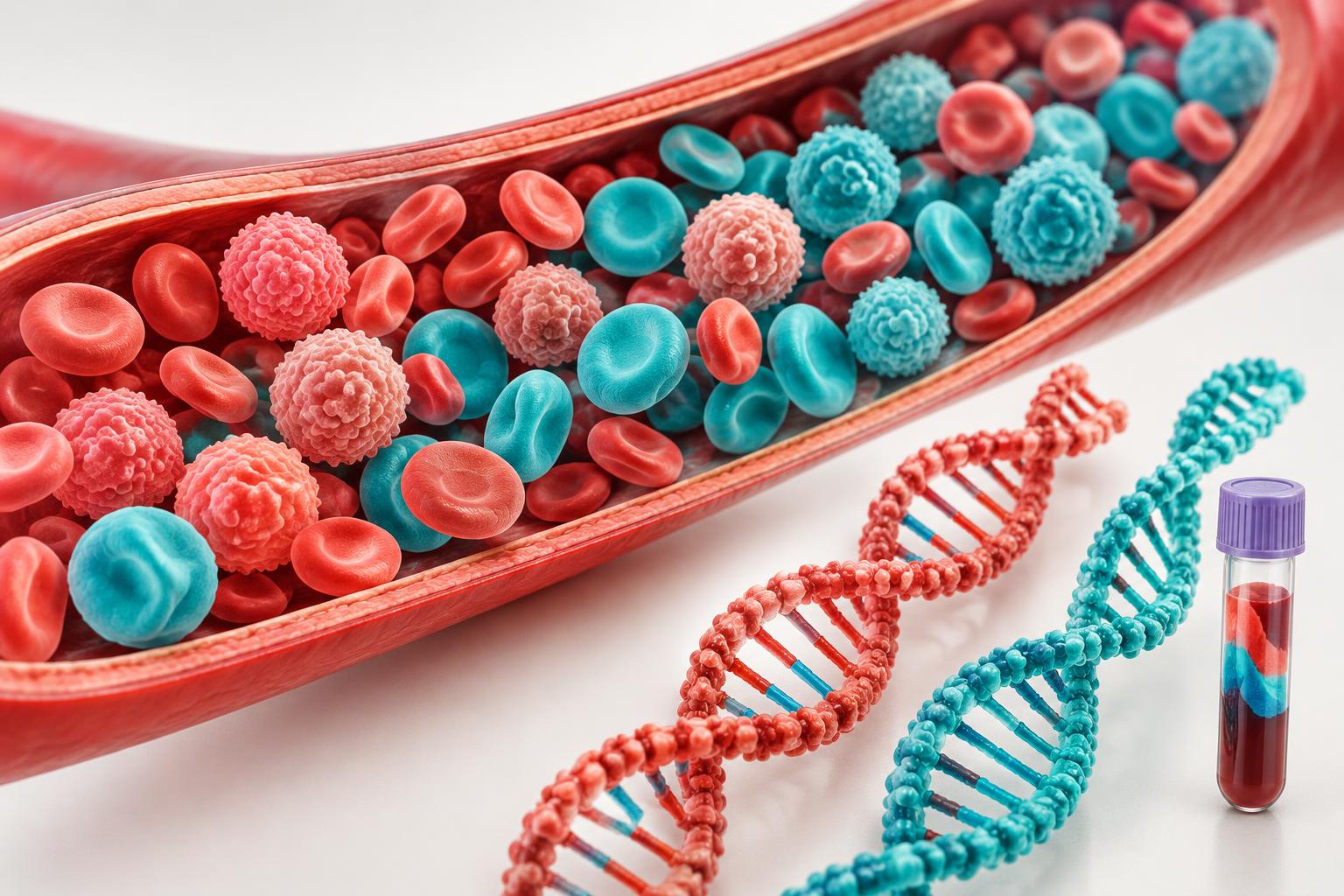
After an allogeneic stem cell transplant — one using a donor's cells rather than the patient's own — a patient's blood is, for a time, a genetic mixture of two people. Doctors have a name for this coexistence of donor and recipient cells: chimerism. Far from being an obscure lab curiosity, chimerism testing is one of the most routine and clinically important tools used to monitor a transplant's progress, and the pattern it reveals over the following months can flag a relapse before almost any other test does. This article explains what chimerism is, how it's measured, what "full" versus "mixed" chimerism actually means, and what the evidence shows about its ability to predict outcomes.
What It Means for Two People's Cells to Coexist
In an allogeneic hematopoietic stem cell transplant, a patient's own blood-forming cells are typically destroyed or suppressed (often with chemotherapy, sometimes radiation) and replaced with blood-forming stem cells from a donor. The result is that the recipient's blood cells carry a mix of their own DNA and the donor's DNA — they have, in a real genetic sense, two sources of blood. Clinicians track that mix closely in the weeks and months after transplant, because the balance between donor and recipient cells says a great deal about how the transplant is going, including whether the new immune system is taking hold and whether the original disease is staying away.
How Chimerism Is Actually Measured
The standard method is short tandem repeat (STR) genotyping, performed on a blood or bone marrow sample and processed by PCR, according to a clinical laboratory reference. STR markers are small stretches of DNA whose length varies from person to person, so before transplant, labs genotype both the donor and the recipient to establish each person's unique genetic "fingerprint" — typically across 15 or more markers. After transplant, the same markers are measured in the patient's blood, and the lab reports what percentage of the sample's DNA matches the donor versus the recipient. The reference notes this method is sensitive enough to reliably detect cell populations down to roughly 2% of the total, is more sensitive for engraftment monitoring than older techniques like FISH, and performs with about 98% analytic sensitivity — though it can't distinguish identical twins, since their DNA is the same.
Full vs. Mixed Chimerism: What the Terms Mean
"Full chimerism" means essentially all of the blood-forming cells detected are the donor's — the patient's own cells have been fully replaced. "Mixed chimerism" means a measurable fraction of the patient's own original cells persists alongside the donor's. There's no single universal cutoff used across every lab and every disease; definitions vary by study and institution. One retrospective analysis of 264 adults who underwent transplant for acute leukemia, published in the Mediterranean Journal of Hematology and Infectious Diseases, defined full donor chimerism as 99% or more donor cells, with anything below that counted as mixed. Mixed chimerism by itself isn't automatically bad news — it's a signal clinicians interpret in context, alongside other test results and the specific disease being treated — but a declining trend, or chimerism that fails to approach "full," is something transplant teams watch closely.
What Mixed Chimerism Can Signal: Relapse Risk
This is where chimerism testing earns its place as a core piece of post-transplant monitoring, and the evidence here is genuinely encouraging for how early it can flag trouble. In that same 264-patient study, among people treated for acute myeloid leukemia (AML), mixed chimerism measured at the three-month mark was far more common in patients who went on to relapse than in those who didn't — 33.3% versus 8.8%, a difference that held up in statistical modeling (hazard ratio 2.47) even after accounting for other factors. More strikingly, mixed chimerism at three months preceded relapse in just over half of the AML patients who ultimately relapsed, with a median lead time of about 90 days — in other words, for many patients, the chimerism test flagged the problem roughly three months before relapse became clinically apparent. Patients with mixed chimerism at three months also had substantially shorter median overall survival in this study (17.5 months versus 66.2 months) and disease-free survival. In acute lymphoblastic leukemia (ALL), the same study found a similar directional signal, though the association was weaker and the sample size smaller, so it didn't hold up as robustly in multivariate analysis.
It's worth being precise about chimerism's limits here too: the same researchers point out that chimerism testing can't distinguish residual normal recipient cells from residual leukemic cells, so a patient can have reassuringly low recipient chimerism and still be harboring disease. For that reason, many transplant centers now pair chimerism monitoring with minimal residual disease (MRD) testing, which looks directly for molecular evidence of leukemia. In the same study, MRD positivity at three months was an even stronger independent predictor of AML relapse than chimerism was, and the authors conclude that MRD should generally be prioritized for risk stratification when it's available, with chimerism remaining most valuable as a monitoring tool where MRD markers don't exist or aren't practical to test.
Why a Trend Toward Mixed Chimerism Isn't Automatically Alarming
A gradually falling donor percentage doesn't by itself mean a transplant has failed or relapse is inevitable — it's a trend clinicians act on, not a verdict. According to Anthony Nolan, a UK stem cell transplant charity and donor registry, when donor chimerism is low or declining, transplant teams may offer a donor lymphocyte infusion (DLI): an infusion of the original donor's T cells intended to boost the immune response and push chimerism back toward full donor. Encouragingly, this is a case where the system is designed with real guardrails — doses are typically escalated gradually over weeks to months specifically to balance effectiveness against the main risk of a DLI, graft-versus-host disease (GVHD), in which the donor's immune cells attack the patient's own tissues. Anthony Nolan notes that some degree of GVHD can actually be a sign the DLI is working, since it reflects an active donor immune response, while its absence doesn't necessarily mean the infusion failed — underscoring why this is managed by a transplant team rather than judged by a single data point.
Bottom Line
Chimerism testing gives transplant teams an ongoing, quantitative window into how a donor's immune system is taking hold inside a patient's body. Full donor chimerism is generally a reassuring sign; mixed or declining chimerism isn't a diagnosis on its own, but in diseases like AML the evidence shows it can meaningfully flag elevated relapse risk, sometimes months before relapse is otherwise apparent, which is exactly the kind of early warning that creates options — including donor lymphocyte infusions — that wouldn't exist without it. The honest caveat is that chimerism isn't a perfect or standalone test: it can't always distinguish harmless residual cells from active disease, thresholds for "full" versus "mixed" vary across studies and institutions, and in diseases like AML it appears to work best alongside, not instead of, molecular MRD testing.
Key Questions Answered
- What is full versus mixed chimerism?
- Full chimerism means essentially all detected blood-forming cells are donor-derived. Mixed chimerism means recipient cells remain alongside them. Cutoffs vary; one 264-patient study used at least 99% donor cells for full chimerism.
- Does mixed chimerism mean leukemia has relapsed?
- No. In the cited AML study, mixed chimerism at three months was associated with greater relapse risk and sometimes preceded relapse by about 90 days. It cannot distinguish normal residual recipient cells from leukemic cells and works best alongside MRD testing.
- How might transplant teams respond to declining donor chimerism?
- They may consider donor lymphocyte infusion to strengthen the donor immune response. Doses are escalated gradually to balance potential benefit against graft-versus-host disease risk; a single test result is not a verdict.
Sources
- "Chimerism Testing by Short Tandem Repeat (STR) Genotyping." ARUP Consult, 2026 — https://arupconsult.com/ati/chimerism-testing-short-tandem-repeat-str-genotyping
- "Chimerism." Cleveland Clinic, 2025 — https://my.clevelandclinic.org/health/diseases/chimerism
- "Post-Transplant Relapse in Acute Leukemia: Comparative Value of MRD and Chimerism." Mediterranean Journal of Hematology and Infectious Diseases — https://www.mjhid.org/mjhid/article/download/6192/4847/51914?inline=1
- "What Is a Donor Lymphocyte Infusion?" Anthony Nolan — https://anthonynolan.org/patients-and-families/recovery-body/what-a-donor-lymphocyte-infusion
Related Articles
- Fundamentals
Types of Diabetes and Diabetic Complications: Which Are Being Studied With Stem Cell Therapy?
Compare Type 1 and Type 2 diabetes cell-therapy research with gestational diabetes, MODY and complication studies, including trial results and approval limits.
- Fundamentals
Sleep and Recovery: What the Evidence Shows About Immune and Joint Health
Sleep restriction, inflammatory cytokines and osteoarthritis risk: what experimental and population studies show, and the limits of catch-up sleep and causation.
- Fundamentals
What Is Crohn's Disease?
Crohn’s disease causes, symptoms, diagnosis and standard care, with darvadstrocel’s approval history, failed confirmatory trial and current cell-therapy limits.