Types of Chronic Wounds and Skin Conditions: Which Ones Are Being Studied With Stem Cell Therapy?
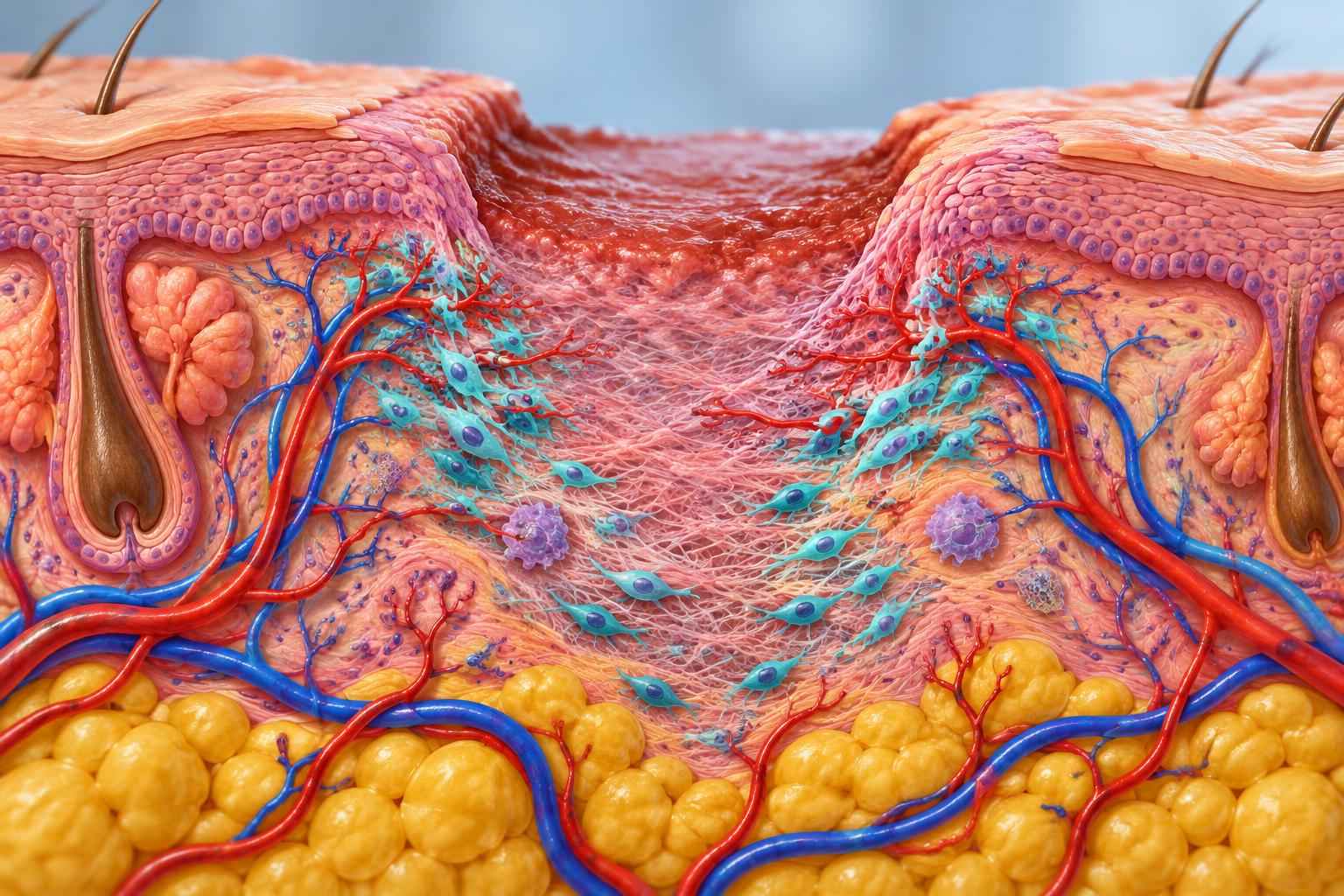
What this article covers
- What This Article Covers
- "Chronic wounds" is not one condition — it's an umbrella covering diabetic foot ulcers, venous leg ulcers, pressure ulcers, burns, rare genetic skin-fragility disorders like epidermolysis bullosa, and other wounds that simply refuse to close on their own. Stem cell and mesenchymal stromal cell (MSC) research has moved into real human trials for several of these, with diabetic foot ulcers showing the most encouraging aggregated clinical data.
- Diabetic Foot Ulcers: The Most Clinically Studied Subtype
- This is where the evidence base is strongest. A 2022 meta-analysis in Stem Cell Research & Therapy pooled 14 studies and 683 patients comparing stem cell therapy to conventional diabetic foot care.
- Venous Leg Ulcers: Promising Early Signals, Still Small-Scale
- Venous ulcers have attracted real trial interest, though the data set is thinner than for diabetic wounds. 13 cm/week), while saline and fibrin-only controls barely closed at all — a statistically significant difference despite the tiny sample.
- Pressure Ulcers (Bedsores): Mostly Preclinical, With Isolated Case Reports
- Pressure ulcers are the subtype with the least human trial support. A 2024 review in Frontiers in Bioengineering and Biotechnology centered on a single case report — one patient with a stage IV heel pressure ulcer treated with umbilical cord MSCs combined with platelet-rich plasma, which closed from 6 cm² to nearly healed by day 47 with no complications over 12 months.
- Burn Wounds: Strong Animal Data, Thin Clinical Evidence
- Burns show a similar pattern. A 2020 systematic review in the journal Cells examined 24 total studies and found 21 were preclinical rodent studies, versus only three involving actual patients (one case-control study of 60 people, and two case reports covering a total of three patients).
What This Article Covers
"Chronic wounds" is not one condition — it's an umbrella covering diabetic foot ulcers, venous leg ulcers, pressure ulcers, burns, rare genetic skin-fragility disorders like epidermolysis bullosa, and other wounds that simply refuse to close on their own. Stem cell and mesenchymal stromal cell (MSC) research has moved into real human trials for several of these, with diabetic foot ulcers showing the most encouraging aggregated clinical data. Others — pressure ulcers especially — remain largely in case-report and animal-model territory. No stem cell product is FDA-approved to treat any chronic wound; this article separates genuine clinical-trial momentum from early-stage promise so readers can tell the difference.
Diabetic Foot Ulcers: The Most Clinically Studied Subtype
This is where the evidence base is strongest. A 2022 meta-analysis in Stem Cell Research & Therapy pooled 14 studies and 683 patients comparing stem cell therapy to conventional diabetic foot care. The results were striking: ulcer/wound healing was roughly eight times more likely with stem cell treatment (odds ratio 8.20), and amputation risk dropped by about 80% (odds ratio 0.19). Secondary measures — new blood vessel formation, ankle-brachial index, pain-free walking distance — also improved. This is genuinely good news for a complication that drives a large share of non-traumatic lower-limb amputations worldwide.
That said, the authors themselves flagged limitations: many included studies were small, used different cell sources (bone marrow, adipose tissue) and delivery methods, and weren't uniformly blinded or placebo-controlled. They explicitly called for larger, multicenter, randomized, placebo-controlled trials before this becomes standard practice. Several such trials are currently active on ClinicalTrials.gov, but no stem cell product for DFUs has FDA approval.
Venous Leg Ulcers: Promising Early Signals, Still Small-Scale
Venous ulcers have attracted real trial interest, though the data set is thinner than for diabetic wounds. A small, randomized, double-blind pilot study (11 patients) presented at the 2017 Society for Investigative Dermatology meeting found that autologous bone marrow MSCs delivered in a topical fibrin spray produced steady wound closure (roughly 0.11–0.13 cm/week), while saline and fibrin-only controls barely closed at all — a statistically significant difference despite the tiny sample. A separate uncontrolled case series of 31 patients, published in 2018, used fat-derived stromal vascular fraction cells injected around non-healing ulcers and reported 58% full healing at 12 months, with the rest shrinking by an average of 96%; the authors were careful to note they could not prove superiority over standard care without a control group.
Encouragingly, the field has since moved toward more rigorous testing: a phase I/II randomized controlled trial protocol using allogeneic MSCs for venous ulcers was published in PLOS ONE in 2025, signaling that better-controlled trials are now underway. Venous ulcers sit solidly in "promising but early" territory — real trials, real signal, not yet definitive.
Pressure Ulcers (Bedsores): Mostly Preclinical, With Isolated Case Reports
Pressure ulcers are the subtype with the least human trial support. A 2024 review in Frontiers in Bioengineering and Biotechnology centered on a single case report — one patient with a stage IV heel pressure ulcer treated with umbilical cord MSCs combined with platelet-rich plasma, which closed from 6 cm² to nearly healed by day 47 with no complications over 12 months. Encouraging as an individual outcome, but the same review's literature search turned up mostly rodent and diabetic-animal-model studies, not controlled human trials. No randomized controlled trial evidence currently exists for MSC therapy in pressure ulcers specifically, making this one of the subtypes to watch rather than rely on.
Burn Wounds: Strong Animal Data, Thin Clinical Evidence
Burns show a similar pattern. A 2020 systematic review in the journal Cells examined 24 total studies and found 21 were preclinical rodent studies, versus only three involving actual patients (one case-control study of 60 people, and two case reports covering a total of three patients). The animal data was genuinely encouraging — benefits were reported across multiple phases of wound healing using adipose-derived, bone marrow, and umbilical cord MSCs — and the handful of human studies hinted at benefits, particularly for scarring and tissue remodeling. But the reviewers judged the human evidence weak overall, citing small numbers, inconsistent study designs, and high risk of bias, and explicitly called for well-designed randomized controlled trials before any firm conclusions.
Epidermolysis Bullosa: A Genuine Phase I/IIa Trial, With Real Caveats
Epidermolysis bullosa (EB) — a group of rare, severe inherited skin-fragility disorders — is notable because it has actual early-phase clinical trial data, not just case reports. A phase I/IIa trial published in JCI Insight in 2021 gave 16 patients with recessive dystrophic EB three intravenous infusions of allogeneic ABCB5-positive dermal MSCs. Disease activity scores improved modestly (about 13–18% by validated EB scoring tools) and itch dropped substantially, but the trial also recorded three cell-related adverse events, including two serious hypersensitivity reactions that led two patients to stop treatment early. It's genuine signal, but modest, and not risk-free. Worth distinguishing clearly: the only FDA-approved product for dystrophic EB, Vyjuvek (approved 2023), is a topical gene therapy — not a stem cell therapy — underscoring that "regenerative" EB treatments cover very different technologies with very different approval status.
General Chronic Non-Healing Wounds and the Regulatory Picture
Across all these subtypes, one fact holds steady: no MSC or stem cell product is FDA-approved to treat any chronic wound type. The FDA has repeatedly taken enforcement action — including warning letters and public notices — against clinics marketing unapproved stem cell products for serious conditions without adequate safety or efficacy evidence, underscoring that availability at a clinic is not the same as regulatory approval or proven benefit.
Bottom Line
Diabetic foot ulcers currently have the strongest aggregated clinical trial evidence for stem cell approaches, with meta-analysis data showing meaningfully better healing and lower amputation risk — though researchers themselves want bigger, more rigorous trials before declaring victory. Venous leg ulcers and epidermolysis bullosa have real, if small, human trials showing encouraging signals alongside notable caveats (including adverse events in the EB trial). Pressure ulcers and burns remain dominated by animal and case-report data, with human randomized trials still largely missing. None of these approaches is FDA-approved, and readers should treat clinic marketing claims with real skepticism regardless of which wound type is involved.
Key Questions Answered
- Which chronic wound subtype has the strongest aggregated evidence?
- Diabetic foot ulcers have the strongest aggregated clinical data described here, but small, heterogeneous studies still require larger randomized, placebo-controlled trials.
- Are pressure ulcer and burn approaches supported by large human trials?
- No. The evidence described is dominated by animal studies and isolated case reports, with weak or missing controlled human evidence.
- Is MSC research for epidermolysis bullosa risk-free?
- No. The early trial recorded cell-related adverse events, including two serious hypersensitivity reactions. Its modest benefits do not establish routine care.
Sources
- Effectiveness and safety of stem cell therapy for diabetic foot: a meta-analysis update — Stem Cell Research & Therapy, 2022 — https://pmc.ncbi.nlm.nih.gov/articles/PMC9375292/
- Autogenously derived regenerative cell therapy for venous leg ulcers — Archives of Medical Sciences – Atherosclerotic Diseases, 2018 — https://amsad.termedia.pl/Autogenously-derived-regenerative-cell-therapy-for-venous-leg-ulcers,97838,0,2.html
- Stem cell therapy significantly improves ulcer healing (SID 2017 pilot RCT coverage) — The Hospitalist/MDedge, 2017 — https://mdedge.com/content/stem-cell-therapy-significantly-improves-ulcer-healing
- Application of allogeneic adult mesenchymal stem cells in the treatment of venous ulcers: A phase I/II randomized controlled trial protocol — PLOS ONE, 2025 — https://doi.org/10.1371/journal.pone.0323173
- Combined treatment of umbilical cord Wharton's jelly-derived mesenchymal stem cells and platelet-rich plasma for a surgical patient with hospital-acquired pressure ulcer — Frontiers in Bioengineering and Biotechnology, 2024 — https://www.frontiersin.org/journals/bioengineering-and-biotechnology/articles/10.3389/fbioe.2024.1424941/full
- Systematic Review of Stem-Cell-Based Therapy of Burn Wounds: Lessons Learned from Animal and Clinical Studies — Cells, 2020 — https://pmc.ncbi.nlm.nih.gov/articles/PMC7761075/
- Intravenous infusion of ABCB5+ mesenchymal stromal cells in patients with recessive dystrophic epidermolysis bullosa — JCI Insight, 2021 — https://insight.jci.org/articles/view/151922
- FDA Puts Companies on Notice for Marketing Unapproved Stem Cell Products — U.S. Food and Drug Administration, 2019 — https://www.fda.gov/news-events/press-announcements/fda-puts-company-notice-marketing-unapproved-stem-cell-products-treating-serious-conditions
Related Articles
- Fundamentals
Protecting Kidney Health As You Age: What the Evidence Actually Shows
Evidence-based kidney protection through blood pressure and diabetes management, NSAID caution and risk-based testing, while regenerative approaches remain early.
- Fundamentals
What Is Type 2 Diabetes?
Type 2 diabetes causes, symptoms, established medications and complications, with a clear distinction between early MSC research and type 1 islet-replacement trials.
- Fundamentals
What Is CRISPR Gene Editing, and How Does It Intersect With Stem Cell Therapy?
How CRISPR edits DNA, why blood stem cells are a natural target, and how approved Casgevy differs from experimental iPSC and in vivo editing research.