Types of Neuromuscular Disease: Which Ones Are Being Studied With Stem Cell and Gene Therapy?
What this article covers
- WHAT THIS ARTICLE COVERS
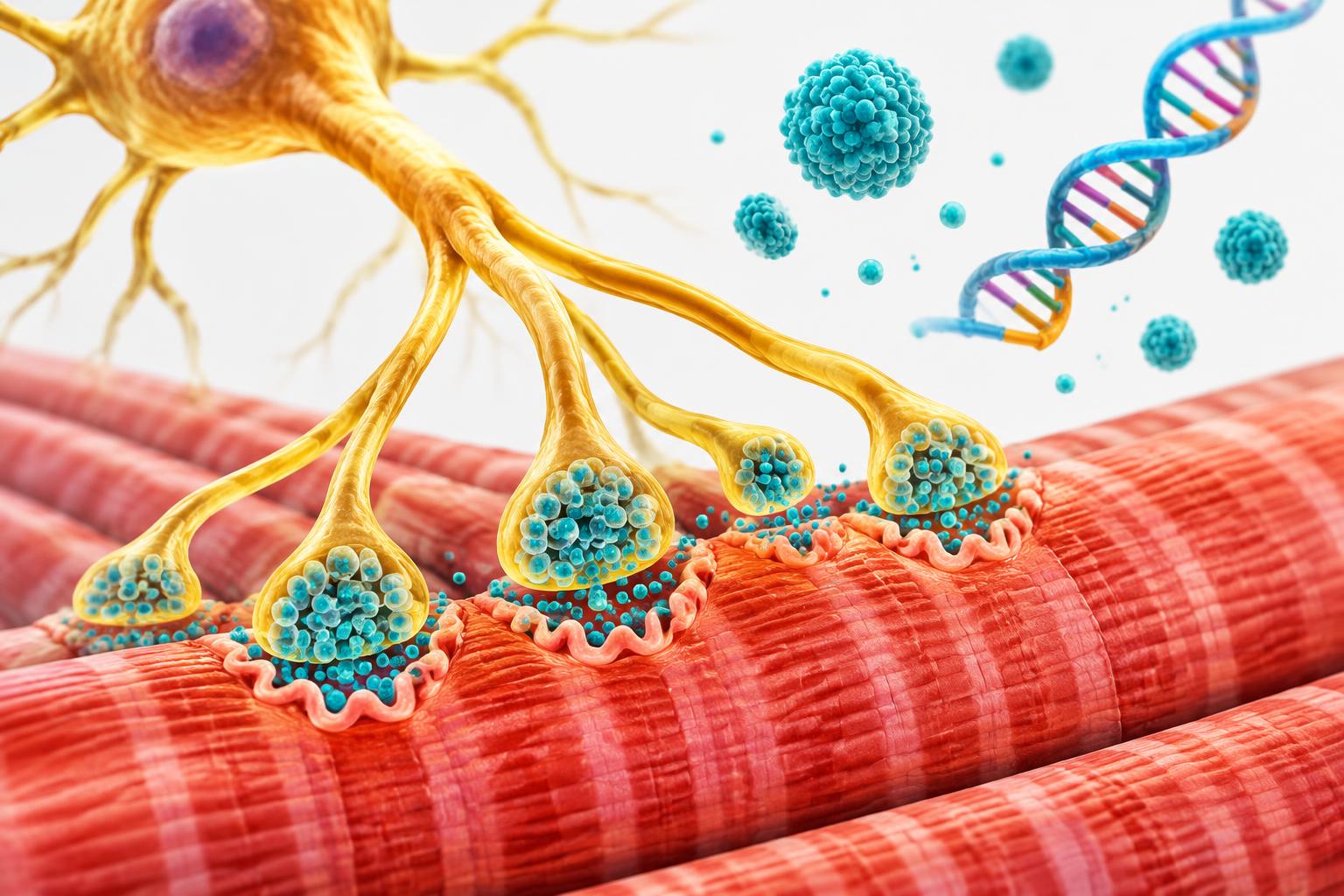
- "Neuromuscular disease" is an umbrella term for conditions that damage the nerves controlling muscles, the junction where nerve meets muscle, or muscle tissue itself. Amyotrophic lateral sclerosis (ALS) and Duchenne muscular dystrophy (DMD) are the best-known examples and already have their own dedicated pages on this site, so they appear here only briefly, for context.
- How Neuromuscular Diseases Are Grouped
- Neuromuscular diseases are typically sorted by where the damage occurs:
- Spinal Muscular Atrophy: The Field's Biggest Success Story
- Spinal muscular atrophy (SMA) is a genetic motor neuron disease, caused by mutations in the SMN1 gene, that in its most severe infant-onset form was once almost uniformly fatal within the first two years of life. SMA is the rare case in this field where a gene therapy has moved all the way from lab bench to full FDA approval: Zolgensma (onasemnogene abeparvovec), a one-time intravenous infusion that delivers a working copy of the SMN1 gene via an AAV9 viral vector, received FDA approval in May 2019 for SMA in children under two (a children's hospital, 2019; Novartis, 2019).
- Myasthenia Gravis: An Unexpected CAR-T Frontier
- Myasthenia gravis is an autoimmune disorder of the neuromuscular junction, where antibodies block or destroy the receptors muscles need to receive nerve signals, causing fluctuating weakness and fatigue. Because it's driven by misbehaving immune cells (often B cells producing the harmful antibodies), it has become an unlikely testing ground for CAR-T cell therapy — technology developed for blood cancers, now being redirected at autoimmune disease.
- Muscular Dystrophies Beyond Duchenne
- Duchenne muscular dystrophy has its own detailed page on this site, including the mixed, safety-complicated story of the gene therapy Elevidys — which received accelerated approval in 2023 and traditional approval in June 2024 for ambulatory patients, but whose trials were placed on FDA hold in July 2025 after three reported deaths involving acute liver failure, with the hold later lifted only for ambulatory patients (Pharmacy Times, 2025). That caution is relevant context for the dystrophies covered here too, since several use similar viral-vector gene delivery methods.
WHAT THIS ARTICLE COVERS
"Neuromuscular disease" is an umbrella term for conditions that damage the nerves controlling muscles, the junction where nerve meets muscle, or muscle tissue itself. Amyotrophic lateral sclerosis (ALS) and Duchenne muscular dystrophy (DMD) are the best-known examples and already have their own dedicated pages on this site, so they appear here only briefly, for context. This article instead focuses on the broader map of neuromuscular conditions — spinal muscular atrophy, myasthenia gravis, the muscular dystrophies beyond Duchenne, and hereditary neuropathies like Charcot-Marie-Tooth disease — and lays out, honestly, where cell and gene therapy research actually stands for each one: what has reached FDA approval, what looks genuinely promising in early trials, and what remains speculative.
How Neuromuscular Diseases Are Grouped
Neuromuscular diseases are typically sorted by where the damage occurs:
- Motor neuron diseases (the nerve cell itself) — ALS, spinal muscular atrophy
- Neuromuscular junction disorders (the nerve-to-muscle signal) — myasthenia gravis, Lambert-Eaton syndrome
- Muscular dystrophies (the muscle fiber) — Duchenne, Becker, limb-girdle, facioscapulohumeral (FSHD), myotonic dystrophy
- Peripheral neuropathies (the nerve fiber outside the brain/spinal cord) — Charcot-Marie-Tooth disease and related hereditary neuropathies
Most of these are genetic and progressive, which is exactly why gene and cell therapies — approaches that can, in principle, correct or replace a missing protein rather than just manage symptoms — have drawn so much research interest.
Spinal Muscular Atrophy: The Field's Biggest Success Story
Spinal muscular atrophy (SMA) is a genetic motor neuron disease, caused by mutations in the SMN1 gene, that in its most severe infant-onset form was once almost uniformly fatal within the first two years of life. SMA is the rare case in this field where a gene therapy has moved all the way from lab bench to full FDA approval: Zolgensma (onasemnogene abeparvovec), a one-time intravenous infusion that delivers a working copy of the SMN1 gene via an AAV9 viral vector, received FDA approval in May 2019 for SMA in children under two (a children's hospital, 2019; Novartis, 2019). Long-term follow-up data presented by Novartis in 2023 showed many treated children continuing to meet motor milestones years after a single infusion — a genuinely encouraging result for a disease that previously offered families almost no options.
It's worth being precise about what this is and isn't. Zolgensma is a gene therapy, not a stem cell therapy — it doesn't introduce new cells, it corrects a genetic deficit in a patient's existing motor neurons. True stem cell-based approaches to SMA (using cells to replace lost motor neurons rather than fix the gene) remain earlier-stage, explored mainly in preclinical and academic research rather than approved treatment (PMC, "Molecular, genetic and stem cell-mediated therapeutic strategies for spinal muscular atrophy," 2013; academic research, "Cell based therapy for spinal muscular atrophy"). SMA nonetheless stands as the clearest proof that a genetic neuromuscular disease can be meaningfully altered by a single intervention — a benchmark the rest of this field is still working toward.
Myasthenia Gravis: An Unexpected CAR-T Frontier
Myasthenia gravis is an autoimmune disorder of the neuromuscular junction, where antibodies block or destroy the receptors muscles need to receive nerve signals, causing fluctuating weakness and fatigue. Because it's driven by misbehaving immune cells (often B cells producing the harmful antibodies), it has become an unlikely testing ground for CAR-T cell therapy — technology developed for blood cancers, now being redirected at autoimmune disease.
The most mature data comes from Descartes-08, an autologous CAR-T therapy targeting BCMA-expressing cells, tested in a randomized, placebo-controlled phase 2b trial (NCT04146051) in 36 adults with generalized myasthenia gravis. Among the evaluable patients who received the therapy, mean MG-ADL (a standard symptom-severity score) fell by roughly 5.5 points at four months and remained reduced by about 4.8 points at twelve months after a single treatment course; patients with no prior exposure to other advanced therapies showed even larger, more durable responses. Reported adverse events were mostly mild and transient, with no cytokine release syndrome and no signs of increased infection risk (NeurologyLive, 2025). A separate anti-CD19 CAR-T trial (KYSA-6, NCT06193889) is also actively enrolling. These are still small, early datasets — the treated group numbered only a dozen evaluable patients — but a single-course cellular treatment producing a year of symptom control in a chronic autoimmune disease is a genuinely exciting signal worth watching closely as larger trials mature.
Muscular Dystrophies Beyond Duchenne
Duchenne muscular dystrophy has its own detailed page on this site, including the mixed, safety-complicated story of the gene therapy Elevidys — which received accelerated approval in 2023 and traditional approval in June 2024 for ambulatory patients, but whose trials were placed on FDA hold in July 2025 after three reported deaths involving acute liver failure, with the hold later lifted only for ambulatory patients (Pharmacy Times, 2025). That caution is relevant context for the dystrophies covered here too, since several use similar viral-vector gene delivery methods.
Limb-girdle muscular dystrophy (LGMD) is a group of dystrophies, several caused by sarcoglycan gene defects, that weaken the hip and shoulder muscles first. In a small trial of SRP-9003, a gene therapy for the SGCB-linked subtype (LGMD2E/R4), six treated patients showed robust restoration of the missing beta-sarcoglycan protein, a 67–83% drop in blood creatine kinase (a muscle-damage marker), and functional scores that rose over two years while an untreated comparison group declined — alongside two serious but resolved adverse events (hepatitis and severe dehydration) (Institut de Myologie, 2023). A larger phase 3 trial is now recruiting. It's a promising early signal, but one drawn from a handful of patients, and the Elevidys safety story is a reminder that these gains need to hold up in bigger, longer studies before they mean much for most patients.
Charcot-Marie-Tooth Disease and Hereditary Neuropathies
Charcot-Marie-Tooth disease (CMT) is the most common inherited neuropathy, slowly damaging the peripheral nerves that control sensation and muscle movement in the hands and feet. Unlike SMA or myasthenia gravis, CMT research is still mostly at the exploratory stage. A phase 1/2 trial (NCT06218134) is evaluating Wharton's jelly-derived mesenchymal stem cells for CMT type 1E, and a separate trial (EN001, NCT06328712) is testing a stem cell-derived biologic for the more common CMT1A subtype, building on preclinical work showing mesenchymal stem cell-secreted factors can reduce nerve demyelination in animal models (ClinicalTrials.gov; PMC, JCI references). These are genuinely early-stage investigations — safety and feasibility studies rather than anything approaching proven efficacy — so patients should treat any claims of CMT "stem cell treatment" outside a registered trial with real skepticism.
ALS, in Brief
ALS has its own dedicated page on this site; here it's worth noting only how it compares. BrainStorm Cell Therapeutics' NurOwn, a mesenchymal stem cell-derived product, went through a phase 3 trial that narrowly missed its primary endpoint, and in September 2023 an FDA advisory committee voted overwhelmingly against approval, concluding the evidence wasn't strong enough (PatientWorthy, 2023; BioSpace, 2023). The company has since pursued a further phase 3 trial rather than resubmitting for approval. ALS is a useful contrast to SMA and myasthenia gravis: it shows that cell therapy research in neuromuscular disease doesn't automatically succeed just because the biological rationale sounds reasonable — rigorous trial data still has to back it up.
Bottom Line
Across neuromuscular disease, the picture is genuinely mixed but not discouraging: spinal muscular atrophy has an approved gene therapy with encouraging long-term data, myasthenia gravis has an early but striking CAR-T signal, and limb-girdle muscular dystrophy has a small but real proof-of-concept — while Charcot-Marie-Tooth disease remains firmly in early-stage research, and ALS's NurOwn trial is a cautionary example of how a plausible approach can still fail to clear the bar regulators require. The common thread is that the subtypes making real progress are the ones with large, controlled trials and transparent safety reporting behind them, including honest accounting of serious adverse events like those seen with Elevidys. Patients and families should treat any neuromuscular stem cell therapy offered outside a registered, monitored clinical trial — especially one making confident promises for CMT, ALS, or other conditions still in early research — with significant caution, and should look for the kind of peer-reviewed, placebo-controlled evidence described above before taking any product's claims at face value.
Key Questions Answered
- Is Zolgensma a stem cell therapy?
- No. It is a gene therapy that delivers a working copy of SMN1 to existing motor neurons, with FDA approval in May 2019 for SMA in children under two. Stem cell replacement approaches remain earlier-stage.
- What is the early CAR-T signal in myasthenia gravis?
- Descartes-08 was studied in a small randomized phase 2b trial, with reported symptom improvement lasting twelve months after one treatment course. These early results need confirmation in larger trials.
- Are stem cell treatments established for Charcot-Marie-Tooth disease?
- No. The article describes early safety and feasibility investigations, not proven efficacy, and advises skepticism toward treatment claims outside registered trials.
Sources
- Molecular, genetic and stem cell-mediated therapeutic strategies for spinal muscular atrophy (SMA) — PMC, 2013 — https://www.ncbi.nlm.nih.gov/pmc/articles/PMC3930406/
- AVXS-101 (Zolgensma) FDA Approval announcement — Novartis, May 2019 — https://www.novartis.com/news/media-releases/avexis-receives-fda-approval-zolgensma-first-and-only-gene-therapy-pediatric-patients-spinal-muscular-atrophy-sma
- CAR-T Therapy Descartes-08 Demonstrates Efficacy, Safety in Phase 2 Trial of Myasthenia Gravis — NeurologyLive, April 2025 — https://www.neurologylive.com/view/car-t-therapy-descartes-08-demonstrates-efficacy-safety-phase-2-trial-myasthenia-gravis
- KYSA-6: Anti-CD19 CAR-T Cell Therapy in Generalized Myasthenia Gravis — ClinicalTrials.gov — https://clinicaltrials.gov/study/NCT06193889
- Gene therapy shows encouraging results in humans for limb-girdle muscular dystrophy linked to SGCB — Institut de Myologie, 2023 — https://www.institut-myologie.org/en/?p=42429
- FDA Restricts Elevidys Use Amidst New Safety Concerns — Pharmacy Times, July 2025 — https://www.pharmacytimes.com/view/fda-restricts-elevidys-use-amidst-new-safety-concerns
- Evaluate the Safety and Potential Efficacy of Human Wharton's Jelly-derived Mesenchymal Stem Cells With Charcot-Marie-Tooth Disease Type 1E — ClinicalTrials.gov (NCT06218134) — https://clinicaltrials.gov/study/NCT06218134
- FDA Advisory Committee Votes Against Approving NurOwn for ALS — PatientWorthy, September 2023 — https://patientworthy.com/2023/09/29/fda-advisory-committee-votes-against-als-therapy-nurown/
Related Articles
- Fundamentals
Protecting Lung and Respiratory Health As You Age: What the Evidence Actually Shows
Review evidence for smoking cessation, respiratory vaccines, pulmonary rehabilitation and cleaner air, while separating prevention from experimental lung cell therapy.
- Fundamentals
What Is Heart Failure?
Heart failure explained: causes, symptoms and proven treatment, plus encouraging but limited findings and safety risks in experimental heart-cell trials.
- Fundamentals
What Is GMP (Good Manufacturing Practice), and Why Does It Matter for Stem Cell Therapy?
Good Manufacturing Practice for stem cell products: contamination control, batch consistency, traceability, U.S. and EU frameworks, and questions to ask about manufacturing quality.