What Is Heart Failure?
What this article covers
- WHAT THIS ARTICLE COVERS
- Heart failure is a common, chronic condition in which the heart can no longer pump or fill with blood efficiently — it is not a sign the heart has stopped. This article covers its causes, symptoms, and standard treatment, then where stem cell and lab-grown heart-cell research honestly stands, including a recent small trial with real promise and real caveats.
- What Heart Failure Actually Is
- Heart failure means the heart muscle has become too weak or too stiff to pump enough blood to meet the body's needs. S.
- What Causes It
- Heart failure is almost always the downstream result of another condition that damaged or overworked the heart over time. Per the CDC and NHLBI, common contributors include coronary artery disease and prior heart attacks, high blood pressure, diabetes and obesity, heart valve disease, cardiomyopathy, and irregular rhythms like atrial fibrillation.
- Symptoms to Know
- Heart failure usually develops gradually, and early signs can be mistaken for simply being out of shape:
- How Heart Failure Is Treated Today
- There's no cure, but care has advanced substantially, and most people can meaningfully improve symptoms and survival with consistent treatment. For HFrEF, guidelines recommend promptly starting the "four pillars" of guideline-directed therapy: an ARNI (or ACE inhibitor/ARB), a beta-blocker, a mineralocorticoid receptor antagonist, and an SGLT2 inhibitor, plus diuretics for fluid control.
WHAT THIS ARTICLE COVERS
Heart failure is a common, chronic condition in which the heart can no longer pump or fill with blood efficiently — it is not a sign the heart has stopped. This article covers its causes, symptoms, and standard treatment, then where stem cell and lab-grown heart-cell research honestly stands, including a recent small trial with real promise and real caveats.
What Heart Failure Actually Is
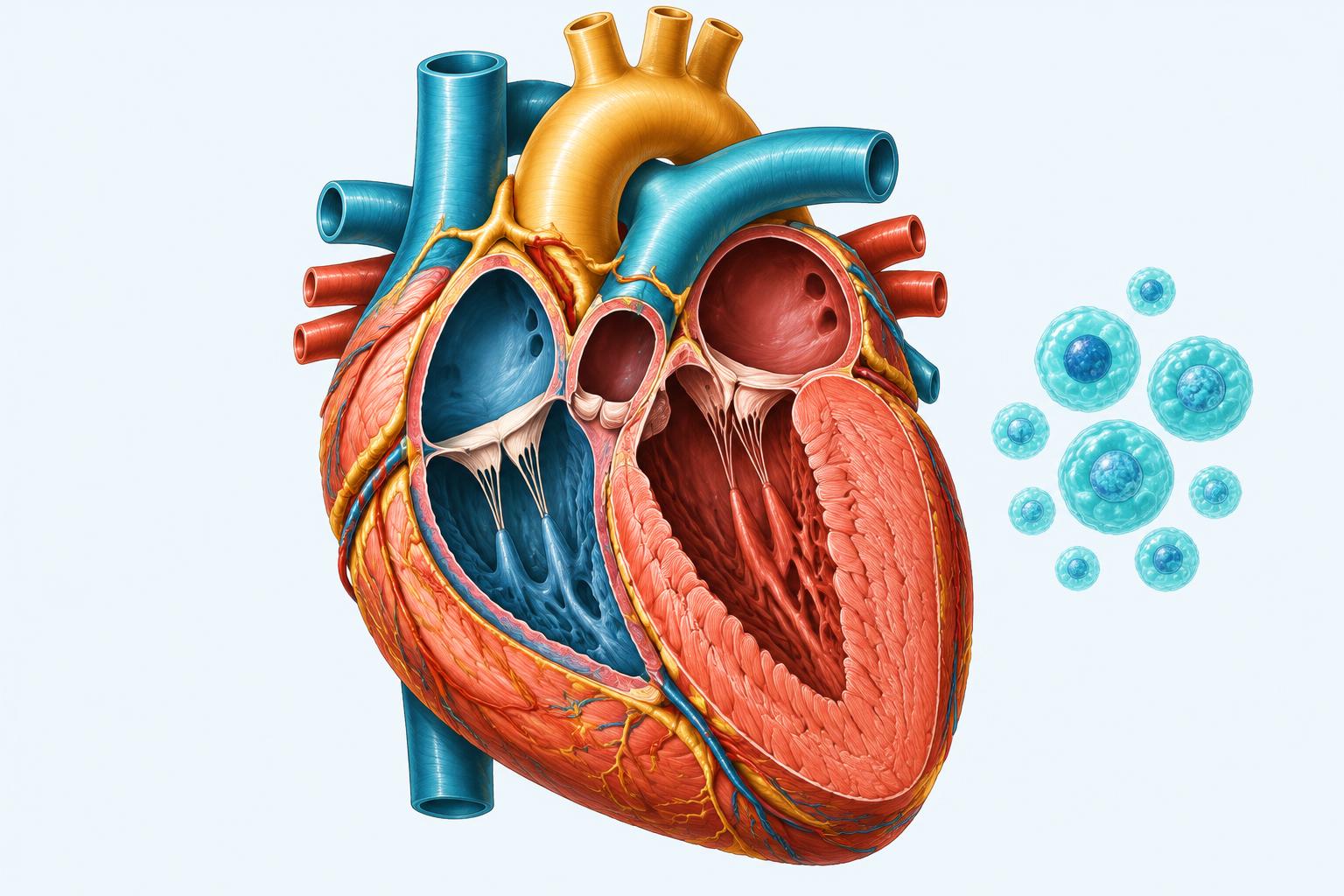
Heart failure means the heart muscle has become too weak or too stiff to pump enough blood to meet the body's needs. An estimated 6.7 million U.S. adults over 20 are living with it, a number expected to keep climbing as the population ages, according to the CDC. Doctors classify it largely by ejection fraction, the share of blood the left ventricle pumps out per beat: heart failure with reduced ejection fraction (HFrEF) means the muscle has weakened, while heart failure with preserved ejection fraction (HFpEF) means it squeezes normally but has become too stiff to fill properly. Symptoms overlap, but treatment differs somewhat.
What Causes It
Heart failure is almost always the downstream result of another condition that damaged or overworked the heart over time. Per the CDC and NHLBI, common contributors include coronary artery disease and prior heart attacks, high blood pressure, diabetes and obesity, heart valve disease, cardiomyopathy, and irregular rhythms like atrial fibrillation. Smoking, a high-sodium diet, inactivity, and heavy alcohol use add further risk.
Symptoms to Know
Heart failure usually develops gradually, and early signs can be mistaken for simply being out of shape:
- Shortness of breath during activity or when lying flat
- Persistent fatigue and weakness
- Swelling in the feet, ankles, legs, or abdomen from fluid buildup
- Rapid or irregular heartbeat, sudden weight gain, or a persistent cough
Diagnosis typically combines a history and exam with blood tests (including natriuretic peptide levels) and an echocardiogram to measure ejection fraction.
How Heart Failure Is Treated Today
There's no cure, but care has advanced substantially, and most people can meaningfully improve symptoms and survival with consistent treatment. For HFrEF, guidelines recommend promptly starting the "four pillars" of guideline-directed therapy: an ARNI (or ACE inhibitor/ARB), a beta-blocker, a mineralocorticoid receptor antagonist, and an SGLT2 inhibitor, plus diuretics for fluid control. Depending on severity, doctors may add an implantable defibrillator (ICD) or cardiac resynchronization therapy (CRT), alongside sodium/fluid restriction and activity as tolerated. For advanced cases unresponsive to medication and devices, options include a left ventricular assist device (LVAD) or heart transplant.
Where Stem Cell and Cell-Therapy Research Stands
Because heart muscle has very limited ability to regenerate after injury, researchers have spent roughly two decades trying to replace or support damaged heart tissue with cells. The honest summary: this remains investigational, not an available treatment, despite real progress.
One recent development worth knowing about: a small, early-stage randomized trial called HEAL-CHF, published in Nature Medicine in August 2026 and sponsored by HELP Therapeutics, injected lab-grown heart muscle cells — cardiomyocytes made from donor induced pluripotent stem cells — into damaged heart tissue in 10 patients with advanced heart failure undergoing bypass surgery, versus 10 who had bypass surgery alone. At 12 months, the cell-treated group improved on six-minute walk distance, blood flow to the heart muscle, and regional wall thickening compared with surgery alone — a genuinely encouraging sign that transplanted heart cells can survive, integrate, and functionally contribute, something earlier approaches struggled to show. That result deserves to land before the caveats: overall pump function, scar size, and quality-of-life scores did not significantly improve, and because everyone also had bypass surgery, the trial can't fully separate the cells' contribution from restored blood flow. All 10 cell recipients developed a temporary abnormal rhythm after injection, and two needed cardioversion for faster ventricular tachycardia — though no tumors formed and no sustained life-threatening arrhythmias occurred through 12 months. Donor-derived cells also meant recipients needed immunosuppression. With only 20 participants, the trial wasn't powered to show effects on hospitalizations or survival.
A different approach — a patient's own bone marrow cells, delivered by catheter — was tested in the Phase 3 CardiAMP-HF trial in 115 people with HFrEF. Its primary composite endpoint (survival, hospitalizations, and functional measures) did not reach statistical significance at 24 months. A post hoc subgroup with more elevated heart-strain biomarkers showed a significant signal, but since it wasn't pre-specified, it's hypothesis-generating, not proof.
Taken together, these and other ongoing trials (searchable on ClinicalTrials.gov) show a field that has moved past preclinical work into real human testing, with some promising biological signals. But no cell-based therapy for heart failure has been shown in a large trial to improve survival or hospitalization, and none is FDA-approved for routine use. People with heart failure today should rely on proven guideline-directed therapy and view cell-based approaches as research to watch.
Bottom Line
Heart failure is serious and common, but modern medications, devices, and lifestyle management have substantially improved outlook for many patients — these remain the proven foundation of care. Stem cell and lab-grown cardiomyocyte research is a genuinely active, encouraging-in-places frontier, with early human data showing transplanted heart cells can engraft and improve certain measures of function. But the evidence comes from small or mixed-result trials, carries real risks like abnormal rhythms and immunosuppression, and hasn't translated into an approved therapy. Anyone considering a trial should pursue it through a legitimate, registered study — not a clinic marketing unproven "stem cell treatments" outside research settings.
Key Questions Answered
- Does heart failure mean the heart has stopped?
- No. Heart failure means the heart cannot pump or fill efficiently enough to meet the body’s needs. Reduced and preserved ejection fraction describe different forms of the condition.
- What did the small HEAL-CHF trial show?
- Some functional measures improved after donor-derived heart cells plus bypass surgery, but overall pump function, scar size and quality-of-life scores did not significantly improve. All ten cell recipients had temporary abnormal rhythms, and two needed cardioversion.
- Is cell therapy approved for routine heart failure care?
- No. The article describes investigational treatments with small or mixed-result trials, no demonstrated large-trial survival or hospitalization benefit, and no FDA approval for routine use.
Sources
- About Heart Failure — Centers for Disease Control and Prevention, 2025 — https://www.cdc.gov/heart-disease/about/heart-failure.html
- Heart Failure — National Heart, Lung, and Blood Institute (NIH) — https://www.nhlbi.nih.gov/health/heart-failure
- Experimental Heart Cell Therapy Shows Promise for People With Advanced Heart Failure in Early Randomized Trial — Medical Daily, 2026 — https://www.medicaldaily.com/heart-cell-therapy-heart-failure-477832
- Treating Heart Failure With hPSC-CMs (HEAL-CHF trial registration, sponsor: HELP Therapeutics) — ClinicalTrials.gov, NCT03763136 — https://clinicaltrials.gov/study/NCT03763136
- CardiAMP: A Heart Failure Cell Therapy Misses Mark in Phase 3 Trial — HCPLive, 2025 — https://www.hcplive.com/view/cardiamp-a-heart-failure-cell-therapy-misses-mark-in-phase-3-trial
- CardiAMP Cell Therapy for Heart Failure Trial — ClinicalTrials.gov, NCT02438306 — https://clinicaltrials.gov/study/NCT02438306
Related Articles
- Fundamentals
Types of Neuromuscular Disease: Which Ones Are Being Studied With Stem Cell and Gene Therapy?
Explore the neuromuscular disease landscape, from approved SMA gene therapy to early CAR-T and muscular dystrophy trials and the limits of stem cell research.
- Fundamentals
Protecting Lung and Respiratory Health As You Age: What the Evidence Actually Shows
Review evidence for smoking cessation, respiratory vaccines, pulmonary rehabilitation and cleaner air, while separating prevention from experimental lung cell therapy.
- Fundamentals
What Is GMP (Good Manufacturing Practice), and Why Does It Matter for Stem Cell Therapy?
Good Manufacturing Practice for stem cell products: contamination control, batch consistency, traceability, U.S. and EU frameworks, and questions to ask about manufacturing quality.